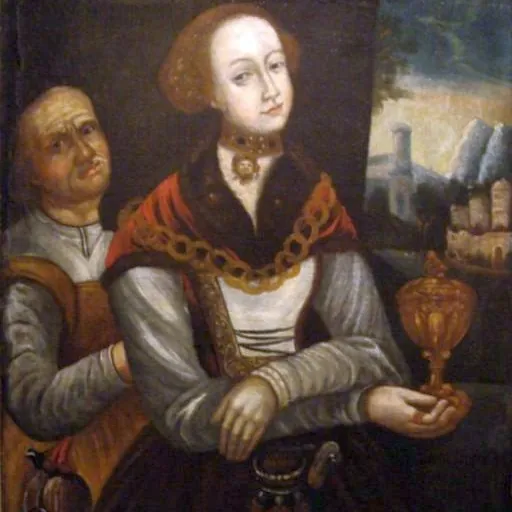
About Sidonia von Borcke
Lived 1548 – 1620 (aged 71–72). Sidonia von Borcke was a German nun.
Sidonia von Borcke (1548–1620) was a Pomeranian noblewoman who was tried and executed for witchcraft in the city of Stettin (today Szczecin, Poland). In posthumous legends, she is depicted as a femme fatale, and she has entered English literature as Sidonia the Sorceress. She had lived in various towns and villages throughout the country. Life The coat of arms of the von Borcke family, showing two wolves wearing golden crowns.
Sidonia von Borcke was born in 1548 into a wealthy noble Pomeranian family. Her father, Otto von Borcke zu Stramehl-Regenwalde, died in 1551, and her mother, Anna von Schwiechelt, died in 1568.
After the death of her sister in 1600 she took residence in 1604 in the Lutheran Noble Damsels' Foundation in Marienfließ Abbey which, since 1569 and following the Protestant Reformation, was a convent for unmarried noblewomen.
Before that she had been involved in several lawsuits concerning support payments which, she claimed, were owed to her. Defendants in the suits were her brother, Ulrich, and Johann Friedrich, Duke of Pomerania (died 1600). One of these suits was even heard in the imperial court in Vienna.
While living in Marienfließ, Sidonia engaged in several private and judicial conflicts with her (mostly younger) co-residents and with the administrative staff of the abbey. When in 1606 she was dismissed from her post as an Unterpriorin (sub-prioress) by the convent's prioress, Magdalena von Petersdorff, she appealed her dismissal to Bogislaw XIII, Duke of Pomerania.
Bogislaw sent a Commission, headed by Joachim von Wedel, to investigate the dispute.
Two years later, Sidonia filed complaints against the new prioress, Agnes von Kleist. These complaints were addressed to Philip II, Bogislaw's successor. Like his predecessor, Philip sent a Commission to investigate the complaints — a Commission headed by Jost von Borcke, a relative of Sidonia's
The new Commission did not succeed in calming the dispute, and Jost von Borcke described the situation at Marienfließ as one of chaos, mistrust, name-calling, and occasional violence.
In July 1619, a dispute between Sidonia and Unterpriorin (sub-prioress) Dorothea von Stettin escalated out of control during a mass, and both women were arrested. Dorothea von Stettin then accused Sidonia of witchcraft, specifically of forcing a former Marienfließ factotum, Wolde Albrechts, to ask the devil about her (Sidonia's) future. This bias was strengthened when the Pomeranian dynasty became extinct in 1637.
Wolde Albrechts The trial of Wolde Albrechts was a preface to the trial of Sidonia.
Albrechts was arrested on 28 July 1619. On 18 August, she was charged with maleficium and Teufelsbuhlschaft (i.e., sexual relations with the devil).
On 2 September, torture was admitted as a legitimate means of interrogation by the supreme court at Magdeburg.
On 7 September, Albrechts confessed under torture and accused Sidonia and two other women of witchcraft. She repeated these confessions in the presence of Sidonia during Sidonia's trial, which began on 1 October 1619.
Albrechts was burned at the stake on 9 October 1619.
Sidonia von Borcke Sidonia Von Bork by Edward Burne-Jones, 1860 (Tate Gallery, London). Sidonia, who had been imprisoned in the Marienfließ Abbey, attempted to escape but failed. She also attempted suicide, but this also failed.
On 18 November 1619, she was transferred to a prison in Stettin.
In December, 72 charges were brought against her. The most important of these were:
murder of her nephew, Otto von Borcke magical practices, such as praying the "Judas psalm" (Psalm 109) and crossing brooms beneath a kitchen table
On 1 September 1620, the final verdict was rendered. Sidonia was sentenced to death by beheading and subsequent burning of her body. A Gothic romance, Sidonia von Bork, die Klosterhexe, was written in 1847–1848 by Wilhelm Meinhold, a Pomeranian priest and author.
An English translation of this novel, titled Sidonia the Sorceress, was published in 1849 by Oscar Wilde's mother, Jane Wilde (later known as Lady Wilde). This translation was also published by William Morris in his Kelmscott Press in 1894.
The English translations achieved a popularity in Great Britain that was unmatched by any other German book in British literary history. Rossetti is said to have referred to and quoted from the novel "incessantly". Several members created paintings based on the novel, For his Sidonia painting, Rossetti's mistress Fanny Cornforth served as the model.
Other authors who wrote novels based Sidonia's life were Albert Emil Brachvogel (1824–1878) and Paul Jaromar Wendt (1840–1919).
The character also appears in the Aleksander Majkowski's novel Żëcé i przigòdë Remùsa (The Life and Adventures of Remus) published in 1938, considered to be the most important work of Kashubian literature.
In 2010, Polish heavy metal band Crystal Viper included a song dedicated to Sidonia titled Sydonia Bork on its studio album Legends.
The fate of Sydonia and her portraits is one of the themes of Leszek Herman's 2015 debut novel titled Sedinum. Wiadomość z podziemi (Sedinum. Message from the underworld).
In 2023 Elżbieta Cherezińska's bestseller book Sydonia. Słowo się rzekło (Sidonia. The word has been spoken) was published, which received an award in the historical novel category of the 9th edition of the 2023 Lubimyczytac.pl Book of the Year Poll, the largest reader poll in Poland.
On the anniversary of her death, members of the Szczecin Historical Society lay flowers near the site of her execution.
Don’t just read it —
keep it.
Full-length biographies made to live with: read them, listen on the way to work, watch them tonight.
- E-book
- Audio
- Video
Instant download · yours to keep · every purchase keeps this site free
Important facts
Related people
Same field, nearest in time




Contemporaries
People whose lives overlapped Sidonia von Borcke's






Frequently asked questions
Who was Sidonia von Borcke?
Pomeranian noble executed for witchcraft
When was Sidonia von Borcke born?
Sidonia von Borcke was born in 1548 in Strzmiele.
When did Sidonia von Borcke die?
Sidonia von Borcke died on 19 August 1620 in Szczecin.
What was Sidonia von Borcke's occupation?
Sidonia von Borcke was a nun.
What nationality was Sidonia von Borcke?
Sidonia von Borcke was German.
Sources & further reading
· Wikipedia: Sidonia von Borcke
Cite this page
APA: Biography.guide. (2026). Sidonia von Borcke. https://biography.guide/sidonia-von-borcke/
MLA: "Sidonia von Borcke." Biography.guide, https://biography.guide/sidonia-von-borcke/.
Chicago: "Sidonia von Borcke." Biography.guide. https://biography.guide/sidonia-von-borcke/.
Data last updated: 2026-09-21 · Spot an error? Report a correction.
Portrait: Wikimedia Commons · author & licence
Page generated 2026-09-27 05:00 UTC