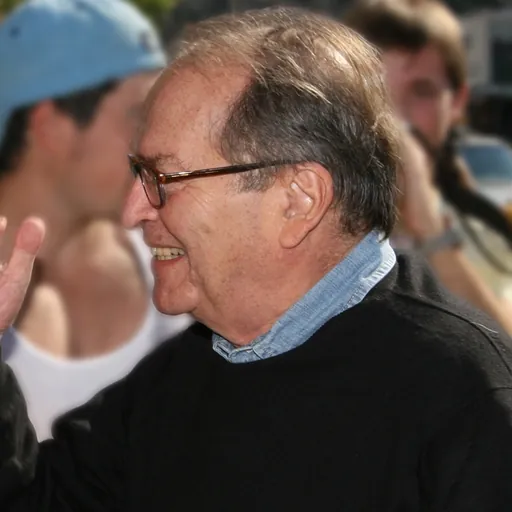
Sidney Lumet
American director, producer and screenwriter
About Sidney Lumet
Lived 1924 – 2011 (aged 86). Sidney Lumet was an American film director, screenwriter, film producer, writer, stage actor and film actor.
Sidney Arthur Lumet ( ; June 25, 1924 – April 9, 2011) was an American film director. Lumet started his career in theatre before moving to directing television in 1950, and then directing films from 1957, where he gained a reputation for making realistic and gritty New York dramas that focused on the working class, tackled social injustices, and often questioned authority. He received various accolades including an Academy Honorary Award and a Golden Globe Award as well as nominations for nine British Academy Film Awards and a Primetime Emmy Award.
He was nominated five times for Academy Awards: four for Best Director for the legal drama 12 Angry Men (1957), the crime drama Dog Day Afternoon (1975), the satirical drama Network (1976) and the legal thriller The Verdict (1982), and one for Best Adapted Screenplay for Prince of the City (1981). Other films include A View from the Bridge (1962), Long Day's Journey into Night (1962), The Pawnbroker (1964), Fail Safe (1964), The Hill (1965), Serpico (1973), Murder on the Orient Express (1974), Equus (1977), The Wiz (1978), The Morning After (1986), Running on Empty (1988) and Before the Devil Knows You're Dead (2007). He received the Academy Honorary Award in 2004.
A member of the inaugural class at New York's Actors Studio, Lumet started acting Off-Broadway and made his Broadway acting debut in the 1935 play Dead End. He went on to direct the Broadway plays Night of the Auk (1956), Caligula (1960) and Nowhere to Go But Up (1962). Lumet is also known for his work on television. He received a Primetime Emmy Award for Outstanding Directing for a Drama Series nomination for NBC Sunday Showcase (1961). He also directed for Goodyear Television Playhouse, Kraft Television Theatre and Playhouse 90.
Life and career Early years
Lumet was born in Philadelphia and grew up on the Lower East Side of Manhattan. He studied theater acting at the Professional Children's School of New York and Columbia University.
Lumet's parents, Baruch and Eugenia (née Wermus) Lumet, were Jewish and veterans of the Yiddish theatre; they had immigrated to the United States from Poland. His father, an actor, director, producer and writer, was born in Warsaw. Lumet's mother, who was a dancer, died when he was a child. He had an older sister. Lumet made his professional debut on the radio at age four and his stage debut at the Yiddish Art Theatre at age five. As a child, he also appeared in many Broadway productions, In 1939, at age 15, he made his only feature-length film appearance in ...One Third of a Nation....
World War II interrupted Lumet's early acting career and he spent four years in the U.S. Army. After returning from service as a radar repairman stationed in India and Burma (1942–1946), he became involved with the Actors Studio, then formed his own theater workshop. He organized an Off-Broadway group and became its director, and continued directing in summer stock theatre while teaching acting at the High School of Performing Arts.
He also directed original plays for Playhouse 90, Kraft Television Theatre and Studio One, directing approximately 200 episodes, which established him as "one of the most prolific and respected directors in the business", according to Turner Classic Movies. His ability to work quickly while shooting carried over to his film career.
A controversial TV show that he directed in 1960 gained some notoriety: Sacco-Vanzetti Story on NBC. According to The New York Times, the drama drew flack from the state of Massachusetts (where Sacco and Vanzetti were tried and executed) because it was thought to postulate that the condemned murderers were, in fact, wholly innocent. However, the resulting controversy did Lumet more good than harm, sending several prestigious film assignments his way.
He began adapting classic plays for both film and television, directing Marlon Brando, Joanne Woodward and Anna Magnani in the feature film The Fugitive Kind (1959), based on the Tennessee Williams play Orpheus Descending. He directed a live television version of Eugene O'Neill's The Iceman Cometh, which was followed by his film A View from the Bridge (1962), another psychological drama, from the play written by Arthur Miller. This was followed by another Eugene O'Neill play-turned-to-cinema, Long Day's Journey into Night (1962), with Katharine Hepburn earning an Oscar nomination for her performance as a drug-addicted housewife; the four principal actors swept the acting awards at the 1962 Cannes Film Festival.
Directing style and subjects Realism and energetic style Film critic Owen Gleiberman observed that Lumet was a "hardboiled straight-shooter" who, because he was trained during the Golden Age of Television in the 1950s, became noted for his energetic style of directing. The words, "Sidney Lumet" and "energy", he added, became synonymous. "The energy was there in the quietest moments. It was an inner energy, a hum of existence that Lumet observed in people and brought out in them...[when he] went into the New York streets...he made them electric." He also wrote:
Critic Justin Chang adds that Lumet's skill as a director and in developing strong stories continued up to his last film in 2007, writing of his "nimble touch with performers, his ability to draw out great warmth and zesty humor with one hand and coax them toward ever darker, more anguished extremes of emotion with the other, was on gratifying display in his ironically titled final film, Before the Devil Knows You're Dead".
Vision of future films In an interview with New York magazine, Lumet said that he expects to see more directors from different ethnic backgrounds and communities telling their stories. "You know, I started out making films about Jews and Italians and Irish because I didn't know anything else."
Works
+Directed featuresYearFilmDistributor 1957 12 Angry Men United Artists 1958 Stage Struck RKO Pictures 1959 That Kind of Woman Paramount Pictures 1960 The Fugitive Kind United Artists 1962 A View from the Bridge Continental Film Long Day's Journey into Night Embassy Pictures 1964 The Pawnbroker Paramount Pictures Fail Safe Columbia Pictures 1965 The Hill Metro-Goldwyn-Mayer 1966 The Group United Artists 1967 The Deadly Affair Columbia Pictures 1968 Bye Bye Braverman Warner Bros. The Sea Gull 1969 The Appointment Metro-Goldwyn-Mayer 1970 Last of the Mobile Hot Shots Warner Bros. 1971 The Anderson Tapes Columbia Pictures 1972 Child's Play Paramount Pictures 1973 The Offence United Artists Serpico Paramount Pictures 1974 Lovin' Molly Columbia Pictures Murder on the Orient Express Paramount Pictures 1975 Dog Day Afternoon Warner Bros. 1976 Network Metro-Goldwyn-Mayer / United Artists 1977 Equus United Artists 1978 The Wiz Universal Pictures 1980 Just Tell Me What You Want Warner Bros. 1981 Prince of the City Warner Bros. / Orion Pictures 1982 Deathtrap Warner Bros. The Verdict 20th Century Fox 1983 Daniel Paramount Pictures 1984 Garbo Talks Metro-Goldwyn-Mayer 1986 Power 20th Century Fox The Morning After 1988 Running on Empty Warner Bros. 1989 Family Business Tri-Star Pictures 1990 Q&A 1992 A Stranger Among UsBuena Vista Pictures 1993 Guilty as Sin 1996 Night Falls on Manhattan Paramount Pictures 1997 Critical Care LIVE Entertainment 1999 Gloria Columbia Pictures 2006 Find Me Guilty Freestyle Releasing 2007 Before the Devil Knows You're Dead ThinkFilm
Don’t just read it —
keep it.
Full-length biographies made to live with: read them, listen on the way to work, watch them tonight.
- E-book
- Audio
- Video
Instant download · yours to keep · every purchase keeps this site free
Important facts
Family & relationships
People in Sidney Lumet's life
Named in this biography and alive at the same time




Related people
Same field, nearest in time


Contemporaries
People whose lives overlapped Sidney Lumet's

Frequently asked questions
Who was Sidney Lumet?
American director, producer and screenwriter (1924–2011)
When was Sidney Lumet born?
Sidney Lumet was born on 25 June 1924 in Philadelphia.
When did Sidney Lumet die?
Sidney Lumet died on 9 April 2011 in Manhattan.
What was Sidney Lumet's occupation?
Sidney Lumet was a film director, screenwriter, film producer, writer, stage actor and film actor.
What nationality was Sidney Lumet?
Sidney Lumet was American.
Sources & further reading
Cite this page
APA: Biography.guide. (2026). Sidney Lumet. https://biography.guide/sidney-lumet/
MLA: "Sidney Lumet." Biography.guide, https://biography.guide/sidney-lumet/.
Chicago: "Sidney Lumet." Biography.guide. https://biography.guide/sidney-lumet/.
Data last updated: 2026-09-22 · Spot an error? Report a correction.
Portrait: Wikimedia Commons · author & licence
Page generated 2026-09-27 05:03 UTC