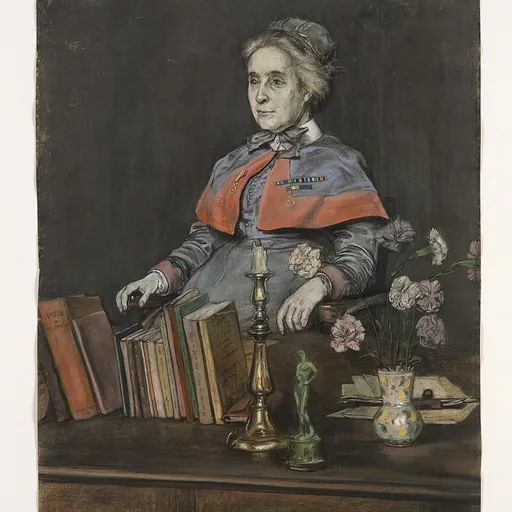
About Sidney Browne
Lived 1850 – 1941 (aged 91). Sidney Browne was a British nurse and royal College of Nursing.
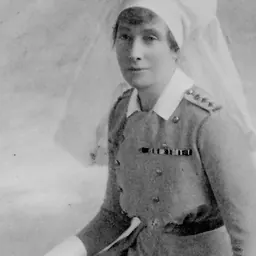
Dame Sidney Jane Browne, (5 January 1850 – 13 August 1941) was the first appointed Matron-in-Chief of the newly formed Queen Alexandra's Imperial Military Nursing Service (QAIMNS). After she retired from the QAIMNS she was appointed as Matron-in-Chief of the Territorial Force Nursing Service. Browne was appointed a Dame Grand Cross of the Order of the British Empire in 1919 and, in 1922, she became the first President of the Royal College of Nursing, a post she held until 1925.
Early life Sidney Browne was born in Bexley. She grew up in a medical family, with a surgeon father and two brothers who were doctors.
Nursing career Browne attended a series of lectures given by the pioneering district nurse Florence Lees, which prompted her interest in nursing as a career. In 1878 she briefly started nursing at the Guest Hospital, Dudley, and later that year entered training at the District Hospital West Bromwich. In 1882 Browne worked as Staff Nurse at St Bartholomew's Hospital for a year, where she was influenced by the matron, Ethel Manson (later Mrs Ethel Gordon Fenwick). Browne was one of the first nurses registered with the British Nurses' Association on 7 March 1890, the precursor of the State Register of Nurses.
In 1883, Browne joined the Army Nursing Service, where she was posted to the Royal Victoria Hospital, Netley and in 1884 had her first overseas posting during the Anglo-Egyptian War. For her work in the Mahdist War she received the Khedive's Star and the Egyptian medal and clasp (1885). Browne's postings took her to Malta (1887–1890), Ireland (Curragh Camp), Woolwich (Herbert Hospital) and Aldershot, rising steadily through the ranks.
Browne was still concerned about the lack of trained nurses available to the army and, with Elisabeth Haldane, established the Territorial Force Nursing Service (TFNS), a civilian trained nursing reserve, in 1908, for which she became Matron-in-Chief from 1910. With the outbreak of the First World War in 1914, Browne was responsible for the mobilisation of the TFNS, and its expansion from 3,000 to 7,000 nurses. Browne travelled across Britain and abroad inspecting living and working conditions of her nursing staff. Her work was recognised with a Bar to her Royal Red Cross. In 1918, Browne told her nurses: "Put a high ideal before you, and do your future service in a greater strength than your own, and your life will be for the betterment of the world."
In 1916, Browne, who had long supported the nursing state registration bill, agreed that the time was right for a College of Nursing to be established. Both Browne and Sarah Swift had worked as Matron-in-Chief during the First World War, and both became actively involved in what was to become the Royal College of Nursing. Browne was a member of the first Royal College of Nursing Council from 1917 until her retirement in 1927 and was the first Honorary Treasurer of the college as well as the inaugural President (1922–25). The insignia of the damehood was conferred at an investiture on 31 July 1919. She received many honours for her work including an honorary degree in 1925 from Leeds University, the freedom of West Bromwich; and in July 1927, she was awarded the International Florence Nightingale Medal by the League of Red Cross Societies.
Don’t just read it —
keep it.
Full-length biographies made to live with: read them, listen on the way to work, watch them tonight.
- E-book
- Audio
- Video
Instant download · yours to keep · every purchase keeps this site free
Important facts
People in Sidney Browne's life
Named in this biography and alive at the same time




Related people
Same field, nearest in time

Contemporaries
People whose lives overlapped Sidney Browne's


Frequently asked questions
Who was Sidney Browne?
British nurse
When was Sidney Browne born?
Sidney Browne was born on 5 January 1850 in Bexley.
When did Sidney Browne die?
Sidney Browne died on 13 August 1941 in Cheltenham.
What was Sidney Browne's occupation?
Sidney Browne was a nurse and royal College of Nursing.
What nationality was Sidney Browne?
Sidney Browne was British.
Sources & further reading
Cite this page
APA: Biography.guide. (2026). Sidney Browne. https://biography.guide/sidney-browne/
MLA: "Sidney Browne." Biography.guide, https://biography.guide/sidney-browne/.
Chicago: "Sidney Browne." Biography.guide. https://biography.guide/sidney-browne/.
Data last updated: 2026-09-24 · Spot an error? Report a correction.
Portrait: Wikimedia Commons · author & licence
Page generated 2026-09-27 05:08 UTC