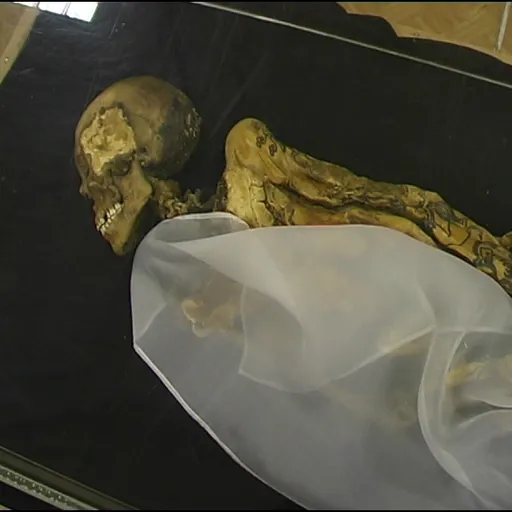
Siberian Ice Maiden
Mummy of a woman found in the Republic of Altai, Russia
About Siberian Ice Maiden
The Siberian Ice Maiden, also known as the Altai Princess or Princess of Ukok, is the naturally preserved mummy of a young woman from the Pazyryk culture who lived during the 5th century BCE. Discovered in 1993 in a frozen kurgan on the Ukok Plateau in the Altai Republic of southern Siberia, Russia, her remains were preserved for approximately 2,400 years by ice that formed within the burial chamber. The burial contained exceptionally well-preserved clothing, tattoos, wooden furnishings, sacrificed horses, and other organic materials that provided rare insights into the culture and mortuary practices of Iron Age nomadic peoples of the Eurasian Steppe.
Since her excavation, the Siberian Ice Maiden has become a prominent symbol of Indigenous Altaian cultural heritage and the subject of debates over archaeology, identity, and the repatriation of human remains. She is currently housed at the Republican National Museum in Gorno-Altaisk.
Identity and dating Known by several names, including the Altai Princess (Russian: Алтайская принцесса), Princess of Ukok (Russian: Принце́сса Уко́ка), Deva ("Virgin"), and Ochy-bala (Russian: Очы-бала), a heroine of Altaian epic tradition, the woman became widely known in English-language sources as the Siberian Ice Maiden.
She was a member of the Pazyryk culture, a Scytho-Siberian society that occupied parts of the Eurasian Steppe between the 6th and 2nd centuries BCE. Her remains were discovered in a kurgan on the Ukok Plateau in what is now the Altai Republic of southern Siberia, near the borders of Russia, Mongolia, China, and Kazakhstan.
Guided by border guard Mikhail Chepanov, the expedition investigated a group of kurgans located in a disputed strip of territory near the border between Russia and China. Before reaching the woman's tomb, the team encountered a later burial that had been placed above the original chamber. The secondary burial contained a skeleton in a stone-and-wood coffin together with three horses. According to Polosmak, it may have belonged to people from outside the Pazyryk culture who regarded burial within an existing kurgan as an honour.
Excavation of the overlying burial eventually revealed the woman's tomb below. A robber's shaft dug into the later grave had provided a route through which water and snow entered the older chamber. This sequence of events contributed to the formation of the frozen conditions that preserved her remains and grave goods for approximately 2,400 years until their discovery in 1993.
The woman's remains were preserved by frozen conditions within her burial chamber. After a later burial was placed above the original tomb, water and snow entered the chamber through a robber's shaft and collected around the coffin. The water subsequently froze, forming an ice block that encased the burial. Because the chamber remained frozen beneath layers of stone and permafrost, her body, clothing, and grave goods survived for approximately 2,400 years after her interment in the 5th century BCE.
The Ice Maiden and her horses were oriented with their heads toward the east, as was the case in other Pazyryk burials. The cause of the Ice Maiden's death was unknown until 2014, when new research suggested breast cancer, combined with injuries sustained in a fall, as likely culprits. The original researcher, Polosmak, stated in a 2004 article, "Probably, for the sick woman, constant inhalation of cannabis vapour became a forced necessity (Polosmak, Trunova, 2004) and she was often in a state of altered consciousness." This created the mistaken belief that the woman was buried with cannabis on her person. However, she was buried with coriander seeds, which were mistaken as cannabis.
She may have had the elevated status of a priestess in her community based on the items found in her chamber.
Associated objects and clothing
The woman was buried in a log coffin carved from a single larch tree trunk and decorated with leather appliqués depicting deer. A local journalist described the issue:
For some 19 years following her discovery, she was preserved at a scientific institute in Novosibirsk. In September 2012, the mummy was returned to the Altai, where she is kept in a mausoleum at the Republican National Museum in the capital Gorno-Altaysk. Subsequent excavations in the area are forbidden at the request of the Altaian people, though it is believed more artifacts and burial mounds are in the area. An archaeologist involved in the excavation expressed fears that the bodies in the mounds, if left unrecovered, will decay due to climate change.
DNA research by the Russian Academy of Sciences found clear differences in the Ice Maiden's genetic material and that of modern Altaian communities, which led archaeologists to claim that the mummy was European and that Altaians were recent migrants to the region. This was used as a reason to keep the mummy in Novosibirsk, and in 2004 the archaeologists who had refused to repatriate the Ice Maiden to the Altai because of her supposed European heritage were awarded the prestigious State Prize of the Russian Federation. Claims regarding the Ice Maiden's European or Altaian descent are, however, considered the products of indigenous Altaian cultural identity and political autonomy being undermined by a broad "Russian" nationalism.
In popular culture
Ledi, a 2018 book-length poem by the Canadian poet Kim Trainor, narrates the controversial excavation of the Ice Maiden.
Don’t just read it —
keep it.
Full-length biographies made to live with: read them, listen on the way to work, watch them tonight.
- E-book
- Audio
- Video
Instant download · yours to keep · every purchase keeps this site free
Frequently asked questions
Who was Siberian Ice Maiden?
mummy of a woman found in the Republic of Altai, Russia
Sources & further reading
· Wikipedia: Siberian Ice Maiden
· DBpedia: Siberian Ice Maiden
Cite this page
APA: Biography.guide. (2026). Siberian Ice Maiden. https://biography.guide/siberian-ice-maiden/
MLA: "Siberian Ice Maiden." Biography.guide, https://biography.guide/siberian-ice-maiden/.
Chicago: "Siberian Ice Maiden." Biography.guide. https://biography.guide/siberian-ice-maiden/.
Data last updated: 2026-09-23 · Spot an error? Report a correction.
Portrait: Wikimedia Commons · author & licence
Page generated 2026-09-27 05:07 UTC