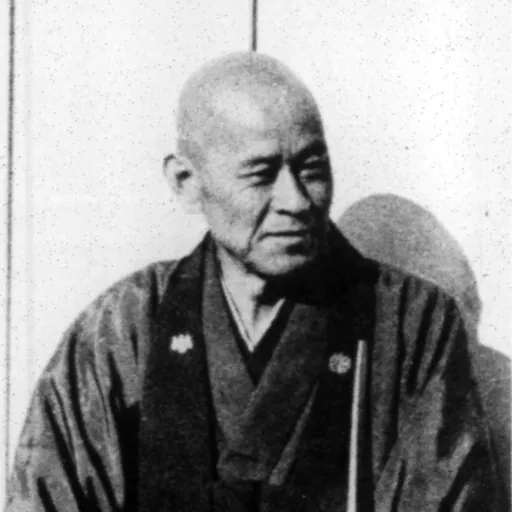
About Shunryu Suzuki
Lived 1904 – 1971 (aged 67). Shunryu Suzuki was a Japanese missionary, buddhist monk, writer and philosopher.
Shunryu Suzuki (鈴木 俊隆 Suzuki Shunryū, dharma name Shōgaku Shunryū 祥岳俊隆, often called Suzuki Roshi; May 18, 1904 – December 4, 1971) was a Sōtō Zen monk and teacher who helped popularize Zen Buddhism in the United States, and is renowned for founding the first Zen Buddhist monastery outside Asia (Tassajara Zen Mountain Center). Suzuki founded San Francisco Zen Center which, along with its affiliate temples, comprises one of the most influential Zen organizations in the United States. A book of his teachings, Zen Mind, Beginner's Mind, is one of the most popular books on Zen and Buddhism in the West. Biography
Shunryu Suzuki was born May 18, 1904, in Kanagawa Prefecture southwest of Tokyo, Japan. His father, Butsumon Sogaku Suzuki, was the abbot of the village Soto Zen temple. His mother, Yone, was the daughter of a priest and had been divorced from her first husband for being too independent. Shunryu grew up with an older half-brother from his mother's first marriage and two younger sisters. As an adult he was about tall.
His father's temple, Shōgan-ji, was located near Hiratsuka, a city on Sagami Bay about fifty miles southwest of Tokyo. The temple income was small and the family had to be very thrifty.
In 1916, 12-year-old Suzuki decided to train with a disciple of his father, Gyokujun So-on Suzuki. So-on was Sogaku's adopted son and abbot of Sogaku's former temple Zoun-in. His parents initially thought he was too young to live far from home but eventually allowed it.
Zoun-in is in a small village called Mori, Shizuoka in Japan. Suzuki arrived during a 100-day practice period at the temple and was the youngest student there. Zoun-in was a larger temple than Shōgan-ji.
At 4:00 each morning he arose for zazen. Next he would chant sutras and begin cleaning the temple with the others. They would work throughout the day and then, in the evenings, they all would resume zazen. Suzuki idolized his teacher, who was a strong disciplinarian. So-on often was rough on Suzuki but gave him some latitude for being so young.
When Suzuki turned 13, on May 18, 1917, So-on ordained him as a novice monk (unsui). He was given the Buddhist name Shogaku Shunryu, yet So-on nicknamed him Crooked Cucumber for his forgetful and unpredictable nature.
Higher education In 1924 Shunryu enrolled in a Soto preparatory school in Tokyo not far from Shogan-ji, where he lived on the school grounds in the dorm. From 1925 to 1926 Suzuki did Zen training with Dojun Kato in Shizuoka at Kenko-in. He continued his schooling during this period. Here Shunryu became head monk for a 100-day retreat, after which he was no longer merely considered a novice. He had completed his training as a head monk.
In 1925 Shunryu graduated from preparatory school and entered Komazawa University, the Soto Zen university in Tokyo. During this period he continued his connections with So-on in Zoun-in, going back and forth whenever possible.
Some of his teachers here were discussing how Soto Zen might reach a bigger audience with students and, while Shunryu couldn't comprehend how Western cultures could ever understand Zen, he was intrigued.
On August 26, 1926, So-on gave Dharma transmission to Suzuki. He was 22. Shunryu's father also retired as abbot at Shogan-ji this same year, and moved the family onto the grounds of Zoun-in where he served as inkyo (retired abbot).
Eihei-ji After graduating from Komazawa, Suzuki continued training at Eihei-ji. In September 1930, he entered the training temple. The abbot at the time was Gempo Kitano, whom Suzuki respected. Kitano had previously led Soto Zen in Korea and had helped found Zenshuji in Los Angeles. Suzuki’s father, Sogaku, had known Kitano earlier and appears to have viewed him with some rivalry or resentment. At Eihei-ji, Suzuki was assigned to serve Ian Kishizawa-roshi, a noted Soto teacher associated with Nishiari Bokusan and Oka Sotan.
Death Suzuki died on December 4, 1971, presumably from cancer.
Publications A collection of his teishos (Zen talks) was published in 1970 in the book Zen Mind, Beginner's Mind during Suzuki's lifetime. His lectures on the Sandokai are collected in Branching Streams Flow in the Darkness, edited by Mel Weitsman and Michael Wenger and published in 1999. Edward Espe Brown edited Not Always So: Practicing the True Spirit of Zen which was published in 2002.
A biography of Suzuki, titled Crooked Cucumber, was written by David Chadwick in 1999.
Lineage
Quotations "In the beginner's mind there are many possibilities, in the expert's mind there are few."
Books Zen Mind, Beginner's Mind. Ed. Trudy Dixon. Weatherhill, 1970. Branching Streams Flow in the Darkness: Zen Talks on the Sandokai 1st ed. Eds. Mel Weitsman and Michael Wenger. University of California Press, 1999. Not Always So: Practicing the True Spirit of Zen. Ed. Edward Espe Brown. HarperCollins, 2002. Zen is Right Here. Shambhala, 2007. "To Shine One Corner of the World: moments with Shunryu Suzuki / the students of Shunryu Suzuki". Ed. David Chadwick. Broadway Books, 2001. (Out of print - same as Zen is Right Here) Zen Is Right Now: More Teaching Stories and Anecdotes of Shunryu Suzuki. Ed. David Chadwick. Shambhala, 2021. Crooked Cucumber: the Life and Zen Teaching of Shunryu Suzuki. by David Chadwick. Harmony, 2000. ISBN 978-0767901055
Don’t just read it —
keep it.
Full-length biographies made to live with: read them, listen on the way to work, watch them tonight.
- E-book
- Audio
- Video
Instant download · yours to keep · every purchase keeps this site free
Important facts
People in Shunryu Suzuki's life
Named in this biography and alive at the same time



Related people
Same field, nearest in time


Contemporaries
People whose lives overlapped Shunryu Suzuki's




Frequently asked questions
Who was Shunryu Suzuki?
Japanese Buddhist missionary (1904–1971)
When was Shunryu Suzuki born?
Shunryu Suzuki was born on 18 May 1904 in Hiratsuka.
When did Shunryu Suzuki die?
Shunryu Suzuki died on 4 December 1971 in San Francisco.
What was Shunryu Suzuki's occupation?
Shunryu Suzuki was a missionary, buddhist monk, writer and philosopher.
What nationality was Shunryu Suzuki?
Shunryu Suzuki was Japanese.
Sources & further reading
Cite this page
APA: Biography.guide. (2026). Shunryu Suzuki. https://biography.guide/shunryu-suzuki/
MLA: "Shunryu Suzuki." Biography.guide, https://biography.guide/shunryu-suzuki/.
Chicago: "Shunryu Suzuki." Biography.guide. https://biography.guide/shunryu-suzuki/.
Data last updated: 2026-09-23 · Spot an error? Report a correction.
Portrait: Wikimedia Commons · author & licence
Page generated 2026-09-27 05:07 UTC