
About Shoshenq III
Lived 900 BC – 798 BC. Shoshenq III was an Egyptian statesperson.
The modern designation Shoshenq III refers to King Usermaatre Setepnamun Shoshenq Sibaste Meryamun Netjerheqaon, who reigned for about four decades, c. 803/799 BC or c. 831c. 791/788 BC. His highest attested regnal year is Year 39. Although he apparently retained control of Tanis and, for the most part, of Bubastis and Memphis, for most of his long reign, Shoshenq III had to reckon with rival kings in parts of the country.
Origins The family origins of Shoshenq III Sibaste are nowhere explicitly specified. The reappraisal of the chronological relationship between his reign and those of Osorkon II Sibaste and Takelot II Siese has invalidated the conjectural basis for considering Shoshenq III an apparent son of Takelot II, who succeeded him by allegedly displacing his brother, Takelot's rightful heir, the High Priest of Amun Osorkon. Since Osorkon II Sibaste already had a son named Shoshenq "D", the High Priest of Ptah at Memphis, who was buried or reburied by Shoshenq III Sibaste, it has been suggested that Shoshenq III Sibaste was a son of this Shoshenq "D" and a grandson of Osorkon II Sibaste. Alternatively, it has also been suggested that Shoshenq III Sibaste was a younger homonymous brother of the High Priest of Ptah Shoshenq "D", and a late-born son of Osorkon II Sibaste.
Recent scholarship has corrected a number of earlier assumptions about the reign of Shoshenq III Sibaste. He was long thought to be the successor of Takelot II Siese and predecessor of Pami I Sibaste, and to have reigned for 52 years on the basis of the burial of a 26-year-old Apis Bull, installed in Year 28 of Shoshenq III, in Year 2 of Pami I. It is now recognized that an additional king, designated Shoshenq IV, Hedjkheperre Setepenre Shoshenq Sibaste Meryamun Netjerheqaon, reigned between Shoshenq III and Pami for at least a decade, and that Shoshenq III and Shoshenq IV reigned for 52 years altogether. Further, most Egyptologists now agree that Takelot II Siese did not intervene as king between Osorkon II Sibaste and Shoshenq III, but reigned as a rival or regional king, apparently somewhere in Upper Egypt, from the last years of Osorkon II Sibaste until Year 22 of Shoshenq III; therefore, Shoshenq III Sibaste was the direct successor of Osorkon II Sibaste.
Accession The death of Osorkon II seems to have triggered a crisis in the order of succession. Shoshenq III ascended the throne under unclear circumstances.
Shoshenq III Sibaste succeeded his probable grandfather Osorkon II Sibaste in what was already Year 4 of Takelot II Siese, another probable grandson of Osorkon II Sibaste. It was Shoshenq III Sibaste that arranged for the burial of Osorkon II Sibaste in his tomb at Tanis (NRT I), where he is depicted making offerings to the gods. Additionally, Shoshenq III seems to have signalled his succession to Osorkon II by adopting the same basic Praenomen (Usermaatre) and epithet (Sibaste, "son of Bastet"), in contrast to Takelot II's Praenomen (Hedjkheperre) and epithet (Siese, "son of Isis").
Reign Shoshenq III Sibaste appears to have retained control of his capital Tanis throughout his reign, together with most of Lower Egypt. His probably indirect authority over Thebes and Upper Egypt, however, was intermittent, as he faced one or two rival kings at most times. By his Year 6, the distant authority of Shoshenq III Sibaste was recognized at Thebes, with the High Priest of Amun Harsiese "B" dating to his reign, having temporarily displaced Takelot II Siese's son Osorkon. From his Year 8, Shoshenq III Sibaste had to reckon with one more king, Padubaste I Sibaste/Siese, who became the new patron of the High Priest of Amun Harsiese "B". Padubaste I has been considered a possible brother of Shoshenq III Sibaste or perhaps a son of Osorkon II Sibaste's former rival, King Harsiese. Because the High Priest of Amun Harsiese "B" dated to Year 5 of Padubaste I and Year 12 of (unnamed) Shoshenq III on at least one occasion, it has been suggested that the two kings might have been allies at that time, in joint opposition to Takelot II Siese and his son Osorkon. Shoshenq III's son, the General Pashedbaste "B", restored the foregate of Pylon X at Karnak, dating by the regnal count of Padubaste I, although the year is lost. Whether as partner or rival of Shoshenq III Sibaste, Padubaste I is attested by his subjects' dedications at Memphis, and a donation stele at Bubastis. Takelot II Siese died in his Year 25, which corresponded to Year 22 of Shoshenq III Sibaste, and the high priest Osorkon now recognized Shoshenq's authority and dated by his reign at Thebes, in Years 22–25 and Years 26–29, briefly interrupted by Padubaste I and the High Priest of Amun Harsiese "B". The last attestations of Shoshenq III Sibaste, also at Thebes and also in association with the High Priest of Amun Osorkon, are from Year 39. Shortly thereafter, Shoshenq III died and the high priest Osorkon declared himself king, Osorkon III Siese. Shoshenq III seems to have outlived all of his Upper Egyptian rivals, Takelot III Siese (last attested in Shoshenq III's Year 25) and the latter's apparent successor Iuput I (last attested in Shoshenq III's Year 33), and Padubaste I (last attested in Shoshenq III's Year 30) and the latter's apparent successor, the counterfactually-designated Shoshenq VI (actually Shoshenq IV, last attested in Shoshenq III's Year 36?).
Shoshenq III Sibaste ruled throughout Lower Egypt, and in his Year 26 also at Heracleopolis, whose military commander Bakenptah is recorded as a brother of the High Priest of Amun Osorkon. Although the Libyan chieftains continued to defer to the king's authority, it appears that in this period they began to surpass their original function as garrison commanders by becoming more involved in and controlling larger territories. Their greater role is documented by an increased number of donation stelae. Some of the beneficiaries of this regionalisation were king's sons, or "king's sons of Rameses," like the king's eldest son Bakennefy "A" at Athribis, the general Takelot at Busiris, Padebehenbaste at Kom el-Hisn, and the Great Chief of Ma and High Priest of Ptah at Memphis, Takelot "B", a grandson of Osorkon II Sibaste and probably brother of the reigning king. Other chiefs of Ma are attested at Mendes (Harnakhte) and Pharbaithos (Iufera). The increasing autonomy of the chieftains was more pronounced among the more recently arrived Libu (rbw) than among the more integrated Ma (mʿ)/Meshwesh (mšwš). The Libu might have been settled in the western Delta during the reign of Shoshenq III Sibaste, and they seem to have been united under the authority of a single chieftain, Inamunnifnebu, by Year 31.
Building activities The name of Shoshenq III Sibaste appears throughout Lower Egypt, often in relation to building projects, for example at Tell Umm Harb, Bendariyah, Tell Balamun, and Kom el-Hisn. The main focus of his activity was the capital Tanis, where he opened a new monaumental gateway in the brick wall of the enclosure of the Temple of Amun, and where he also built his tomb (NRT V), using a simple design. The works at Tanis relied heavily on recycled building materials from Pi-Ramesses. At Memphis, where the king built a chapel to the goddess Sekhmet, Apis Bulls were buried in perhaps Year 4 and in Year 28, and a stele commemorating the latter was set up by king's probable nephew, the Great Chief of Ma Pediese, son of Takelot "B", and Pediese's sons the High Priest of Ptah Peftjauawybaste and the Sem Priest of Ptah Takelot. In his Year 30, Shoshenq III Sibaste may have celebrated his Heb Sed Jubilee, but there seems to be no surviving commemoration of this event in the reliefs and inscriptions.
Succession After a reign of 39–42 years (latest attested date is Year 39), Shoshenq III Sibaste died and was buried in his tomb (NRT V) at Tanis. He was succeeded by his probable son, Hedjkheperre Setepenre Shoshenq Sibaste Netjerheqaon, counterfactually designated Shoshenq IV, although he reigned later than the Upper Egyptian king Usermaatre Meryamun Shoshenq Meryamun, counterfactually designated Shoshenq VI. Shoshenq IV Sibaste reigned for 10–13 years (latest attested date is Year 10), and was succeeded by Usermaatre Setepenre Pami Sibaste Meryamun, designated Pami I. The latter could have been a son of either Shoshenq III or Shoshenq IV, with some scholars considering the relatively short reign of Shoshenq IV to suggest that he was followed by his brother rather than son. Given the length of the reign of Shoshenq III, this does not appear very conclusive.
Family Spouses and children Shoshenq III Sibaste had at least three known spouses and several known children:
The Great King's Wife Tentamenopet (tȝ-nt-jmn-jpt) The King's Daughter Ankhnes-Shoshenq (ʿnḫ.n-s-ššnq), who married Iufa i Ankh-Shoshenq i (ʿnḫ-ššnq), who married Taperet, daughter of the High Priest of Ptah at Memphis Pediese Tjaieniab, who married Nesmeriptah, daughter of Irefaenptah Ankh-Shoshenq ii The King's Wife Tadibaste (tȝ-dj-bȝstt), daughter of Tadibaste The King's Eldest Son Bakennefy "A" (bȝk-n-nfy), prince of Athribis The King's Wife Djedbastesankh (ḏd-bȝstt-jw-s-ʿnḫ) The King's Son of Rameses Takelot "C" (tkrjt), Commander of All Troops Unspecified Wives King's Son Pashedbaste "B" (pȝ-šd-bȝstt), General ? King's Son of Rameses Padebehenbaste (pȝ-dbḥ.n-bȝstt), High Priest of Amun (at Kom el-Hisn?) ? King Shoshenq IV Sibaste ? King Pami I Sibaste (or son of Shoshenq IV Sibaste?)
Probably not a son of Shoshenq III Sibaste, but rather a son of Shoshenq V Sibaste: The Chief of Ma Pami (pȝ-mjw, wrongly read as pȝ-mȝj, "Pimay"), son of the Lord of the Two Lands Shoshenq Meryamun, probably prince of Heracleopolis, previously thought to have been a prince of Sais, a son of Shoshenq III and possibly identical to the future King Pami I.
Burial At San el-Hagar (ancient Tanis), the Tomb of Shoshenq III (NRT V) with its reliefs have been found in the royal necropolis. The sarcophagus was carved from a Thirteenth Dynasty granite lintel, the lid was carved from a Ramesside sculpture. At Tanis, all stones used were reused from older monuments originating from Pi-Ramesses.
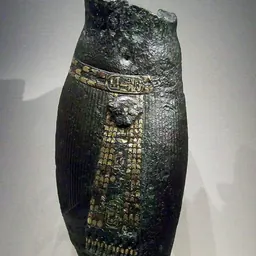
However, 225 ushabti figurines bearing the name of King Shoshenq III were discovered in the northern chamber of the tomb of King Osorkon II (NRT I) in 2025. The figurines were found in a compact layer of silt adjacent to an uninscribed granite sarcophagus previously uncovered in the same chamber. The association of the ushabtis with the sarcophagus has led archaeologists to suggest that it may belong to Shoshenq III, indicating either that his burial assemblage was moved into the chamber for safekeeping or that he was originally interred within the tomb of Osorkon II. Alternatively, Shoshenq III buried another family member in this sarcophagus associated with Osorkon II and adding his ushabti figurines.
Don’t just read it —
keep it.
Full-length biographies made to live with: read them, listen on the way to work, watch them tonight.
- E-book
- Audio
- Video
Instant download · yours to keep · every purchase keeps this site free
Important facts
Related people
Same field, nearest in time




Contemporaries
People whose lives overlapped Shoshenq III's




Frequently asked questions
Who was Shoshenq III?
Egyptian pharaoh of the 22th Dynasty
When was Shoshenq III born?
Shoshenq III was born in 900 BC.
When did Shoshenq III die?
Shoshenq III died in 798 BC.
What was Shoshenq III's occupation?
Shoshenq III was a statesperson.
What nationality was Shoshenq III?
Shoshenq III was Egyptian.
Sources & further reading
Cite this page
APA: Biography.guide. (2026). Shoshenq III. https://biography.guide/shoshenq-iii/
MLA: "Shoshenq III." Biography.guide, https://biography.guide/shoshenq-iii/.
Chicago: "Shoshenq III." Biography.guide. https://biography.guide/shoshenq-iii/.
Data last updated: 2026-09-20 · Spot an error? Report a correction.
Page generated 2026-09-27 05:24 UTC