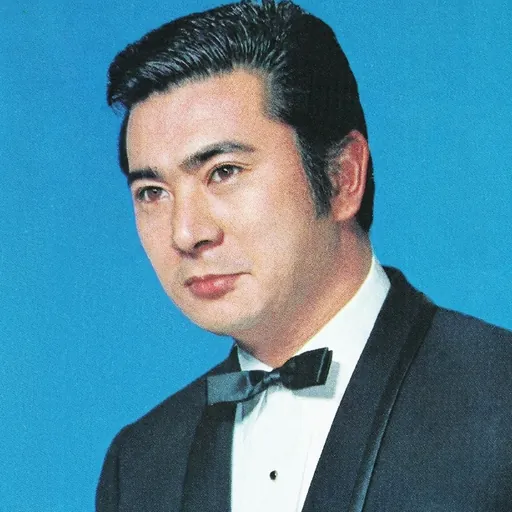
About Shintarō Katsu
Lived 1931 – 1997 (aged 65). Shintarō Katsu was a Japanese singer, film director, writer, film producer, screenwriter and film actor.
was a Japanese actor, singer, and filmmaker. He is known for starring in the Akumyo series, the Hoodlum Soldier series, the Hanzo the Razor series, and the Zatoichi series.
Life and career Shintaro Katsu with his entire family—his parents and older brother—at the inauguration tea party of The Supporters' Association for Shintaro Katsu in Tokyo, 1956. Born Toshio Okumura (奥村 利夫 Okumura Toshio) on 29 November 1931. Shortly after his birth in Chiba, he was brought to the Okumura family's ancestral home in Fukagawa, Tokyo, where he was raised. He was the son of Minoru Okumura (奥村 実), a noted kabuki performer who went by the stage name Katsutōji Kineya (杵屋 勝東治) and who was renowned for his nagauta and shamisen skills. He was the younger brother of actor Tomisaburo Wakayama.
Shintaro Katsu began his career in entertainment as a shamisen player. He switched to acting because he noticed it was better paid. In the 1960s he starred simultaneously in three long-running series of films, the Akumyo series, the Hoodlum Soldier series, and the Zatoichi series.
He played the role of blind masseur Zatoichi in a series of 25 films between 1962 and 1973, in 100 episodes across a four season television series from 1974 to 1979, and in a 26th and final film in 1989, which he also directed.
In 1967, Katsu formed the company Katsu Productions.
In 1972, Katsu Productions released the initial chanbara film in a trilogy with the Hanzo the Razor: Sword of Justice based on a gekiga by Koike Kazuo. Hanzo the Razor: The Snare would be released in 1973, and Hanzo the Razor: Who's Got the Gold? in 1974.
Katsu had a troubled personal life. A heavy drinker, Katsu had several brushes with the law over drug use as well, including marijuana, opium and cocaine with arrests in 1978, 1990 and 1992.
He had also developed a reputation as a troublemaker on set. When director Akira Kurosawa cast him for the lead role in Kagemusha (1980), Katsu left before the first day of shooting was over. Though accounts differ as to the incident, the most consistent one details Katsu's clash with Kurosawa regarding bringing his own film crew to the set (to film Kurosawa in action for later exhibition to his own acting students). Kurosawa is reputed to have taken great offense at this, resulting in Katsu's termination (he was replaced by Tatsuya Nakadai). In her book, Waiting on the Weather, about her experiences with director Kurosawa, script supervisor Teruyo Nogami chalks the differences between Katsu and Kurosawa up to a personality clash that had unfortunate artistic results.
He was the husband of actress Tamao Nakamura (married in 1962), and father of actor Ryutaro Gan (Gan Ryūtarō).
Stunt actor Yukio Kato was killed on the set of the 26th Zatoichi film by Katsu's son, who was co-starring, when an actual sword was mistaken for a prop, fatally wounding Kato.
In her biographical book The Flower Warfare of Geisha Mineko, Kyoto geisha Mineko Iwasaki disclosed her relationship with Katsu (whom she referred to by his given name, Toshio). Spanning from 1965 to 1976, it was an 11-year relationship encompassing a six-year courtship and a five-year romance. The two eventually restored a close friendship that lasted until his death.
Katsu produced the manga-based Lone Wolf and Cub (Kozure Okami) series of jidaigeki films starring his brother Tomisaburo Wakayama, two of which were later compiled into the movie Shogun Assassin, as well as co-writing, producing, and acting alongside his brother in the TV jidaigeki series Oshizamurai Kiichihōgan (Mute Samurai) and Tsūkai! Kōchiyama Sōshun.
His other television work includes the police drama (Superintendent K) which he starred in (as Katsutoshi Gatsu), co-wrote, directed, and produced. His daughter, , co-starred.
His film work includes the Hanzo the Razor series as Detective Itami Hanzo. He was also an accomplished shamisen player, as well as a vocalist, recording several albums in both pop and Enka.
He died of pharyngeal cancer on 21 June 1997.
Personal life
Religion Shintaro Katsu practiced Nichiren Buddhism, and both his family and personal life were bound by a deep connection with the sect.
The Okumura family possessed a statue of Nichiren Shonin carved from highly flammable white sandalwood. Near the end of the Pacific War, the Okumura residence in Tokyo was completely destroyed by American air raids, leading the family to believe the statue had been lost to the fire. However, when Katsu and his mother evacuated to Nikko, the statue miraculously appeared inside his clothing bag without anyone having placed it there, becoming his mother's spiritual support during their grueling period of evacuation.
Just before Katsu entered the film industry, a Buddhist monk named Reiko Ueda told him, "You will become a pillar. You will become a pillar of the film industry. The statue of Nichiren is backing you up; it has entered your body. Though waves of extreme volatility will crash through your life ahead, you will become a central pillar."
Marital relations Initial Co-stars and Marriage (1955 – 1960s) In 1955, Shintaro Katsu, an actor, and Tamao Nakamura, an actress, who were both under Daiei Film Co., Ltd. at the time, made their first appearance together in the film Kankanmushi wa Utau (The Cancan Insect Sings), marking the beginning of numerous subsequent film collaborations. Reflecting on those years, Katsu later recalled, "I never had a single thought that I would end up marrying Tamao-chan." However, while co-starring in the film Shiranui Kengyo (The Blind Menace) (1960), during their intense clash of acting on set, Katsu found himself unconsciously drawn to Tamao's feminine charm and the inner resilience of her character.
During their dating period, Tamao cheerfully agreed with and yielded to whatever Katsu said or did, always responding with "Yes, yes." However, exactly on the very day following their engagement in 1961, Katsu realized that their personalities were fundamentally incompatible. This realization struck him as Tamao’s strong-willed nature became exposed, prompting Katsu to later recall his mindset at that moment: "It seems I made a mistake (in choosing her)." However, their views on family were entirely different. Katsu loathed tranquility and could not stand the domestic atmosphere, stating that he could only be satisfied by constantly moving around; in contrast, Tamao yearned to establish an ideal family. Furthermore, their vastly different economic concepts rendered them incompatible. At the time of their marriage, relatives and friends remarked, "A colander and a tightly bound pouch have married." As they said, shortly after the marriage, Tamao regretted marrying an outrageous person, and Katsu himself also revealed that marrying Tamao was a mistake.
Within the very year of their marriage (1962), the couple began to quarrel, and Tamao returned to her parents' home repeatedly. In the following year, 1963, Katsu moved out of the house and resided regularly at the Hotel Fujita in Kyoto, and the two began living separately. After this, the two quarreled intensely, and it turned into a "regular league match." Around 1964, Katsu expressed an intention to divorce Tamao but was dissuaded by close associates and reconsidered. and challenged Katsu or competed for victory in various aspects of daily life. Furthermore, she lost her temper in professional social settings due to marital dissatisfaction, trampling Katsu's dignity and leaving him behind to depart alone; moreover, after scaring off the guests at their home late at night, she fiercely slapped Katsu across the face with blazing fury. While Tamao loathed his unfaithfulness, On September 13, 1971, Katsu issued a declaration dissolving the divorce; on the same day, Tamao held a solitary press conference, Only then did this divorce controversy come to an end.
Afterward, the two tried to avoid conflict, and Katsu did not travel with Tamao. Even when they needed to travel abroad together for social purposes, they would travel to the airport in separate cars; this was to avoid situations where they could not go together and return together due to arguing inside the car. Katsu expressed that once filming began for television dramas such as Zatoichi, they lived separately and he did not return home even once in half a year; he stated, "Since we do not see each other often, it is quite good," and that "even though we are a couple, each has their own world." Subsequently, in March 1982, their children were arrested on suspicion of violating the Cannabis Control Act. After the couple engaged in a fierce conflict regarding educational methods and responsibility, it was reported that Tamao proposed a divorce with a separation method where "the son goes to the father, and the daughter goes to the mother." A state of cold war between the couple had reportedly persisted since then. with his film work and economic activities largely stagnant, he lived on the assistance of friends. During this period, although there were conflicts as before, the two lived together as a couple in their apartment in Tokyo. In 1996, to celebrate the birthday of Katsu's close friend, the painter Balthus, the couple made their first and final trip together as just the two of them (a Swiss trip of about two days).
Tamao had previously proposed multiple projects to play the leading role in films directed by Katsu, but none came to fruition. The final time she was recognized by Katsu as an actress was in the 1996 stage play Meoto Zenzai (Marital Relations) which they performed together; however, during the tour of the show, Katsu was discovered to have cancer.
Although Tamao achieved massive success on variety television programs since 1994, Katsu did not financially rely on his wife. During his recuperation period, Katsu gave his father's heirloom (katami) shamisen as a token of gratitude to the sponsor who was willing to continuously sign checks and provide financial aid until the very end. On June 21, 1997, Katsu passed away before Tamao's eyes. It was as Tamao stated, "Just when I felt we had become like a real married couple finally, he died."
As producer Year Title Japanese Romanization Role 1970 Zatoichi Meets Yojimbo Zatōichi to Yōjinbō producer 1970 Zatoichi at the Fire Festival Zatōichi abare-himatsuri producer 1971 Zatoichi Meets the One Armed Swordsman Shin Zatōichi: Yabure! Tojin-ken producer 1971 Kaoyaku Kaoyaku executive producer 1972 Hanzo the Razor: Sword of Justice Goyōkiba producer 1972 Zatoichi at Large Zatōichi goyō-tabi producer 1972 New Hoodlum Soldier Story: Firing Line Shin heitai yakuza: Kasen producer 1972 Lone Wolf and Cub: Sword of Vengeance Kozure Ōkami: Kowokashi udekashi tsukamatsuru producer 1972 Lone Wolf and Cub: Baby Cart at the River Styx Kozure Ōkami: Sanzu no kawa no ubaguruma producer 1972 Lone Wolf and Cub: Baby Cart to Hades Kozure Ōkami: Shinikazeni mukau ubaguruma producer 1972 Zatoichi in Desperation Shin Zatōichi monogatari: Oreta tsue producer 1973 Mute Samurai Oshizamurai Kiichihōgan (TV series) executive producer 1973 Zatoichi's Conspiracy Shin Zatōichi monogatari: Kasama no chimatsuri 1973 Hanzo the Razor: The Snare Goyōkiba: Kamisori Hanzō jigoku zeme 1974 The Homeless Yadonashi producer 1974 Hanzo the Razor: Who's Got the Gold? Goyōkiba: Oni no Hanzō yawahada koban producer 1974 Akumyo: Notorious Dragon Akumyo: shima arashiaka 1980 Shogun Assassin producer 1989 Shintaro Katsu's Zatoichi Zatōichi
As director Year Title Japanese Romanization 1971 Kaoyaku Kaoyaku 1972 Zatoichi in Desperation Shin Zatōichi monogatari: Oreta tsue 1973 Mute Samurai Oshi samurai (TV series) 1974 Zatoichi Zatōichi monogatari (TV series)(episode "A Memorial Day and the Bell of Life") 1989 Zatoichi: Darkness Is His Ally Zatōichi
As writer Year Title Japanese Romanization 1970 Zatoichi at the Fire Festival Zatōichi abare-himatsuri 1971 Kaoyaku Kaoyaku 1989 Zatoichi: Darkness Is His Ally Zatōichi
As himself Year Film Film type 1978 The Blind Swordsman Documentary
Don’t just read it —
keep it.
Full-length biographies made to live with: read them, listen on the way to work, watch them tonight.
- E-book
- Audio
- Video
Instant download · yours to keep · every purchase keeps this site free
Important facts
Family & relationships
People in Shintarō Katsu's life
Named in this biography and alive at the same time


Related people
Same field, nearest in time


Contemporaries
People whose lives overlapped Shintarō Katsu's
Frequently asked questions
Who was Shintarō Katsu?
Japanese actor and director (1931-1997)
When was Shintarō Katsu born?
Shintarō Katsu was born on 29 November 1931 in Tokyo.
When did Shintarō Katsu die?
Shintarō Katsu died on 21 June 1997 in Kashiwa.
What was Shintarō Katsu's occupation?
Shintarō Katsu was a singer, film director, writer, film producer, screenwriter and film actor.
What nationality was Shintarō Katsu?
Shintarō Katsu was Japanese.
Sources & further reading
Cite this page
APA: Biography.guide. (2026). Shintarō Katsu. https://biography.guide/shintaro-katsu/
MLA: "Shintarō Katsu." Biography.guide, https://biography.guide/shintaro-katsu/.
Chicago: "Shintarō Katsu." Biography.guide. https://biography.guide/shintaro-katsu/.
Data last updated: 2026-09-23 · Spot an error? Report a correction.
Portrait: Wikimedia Commons · author & licence
Page generated 2026-09-27 05:06 UTC