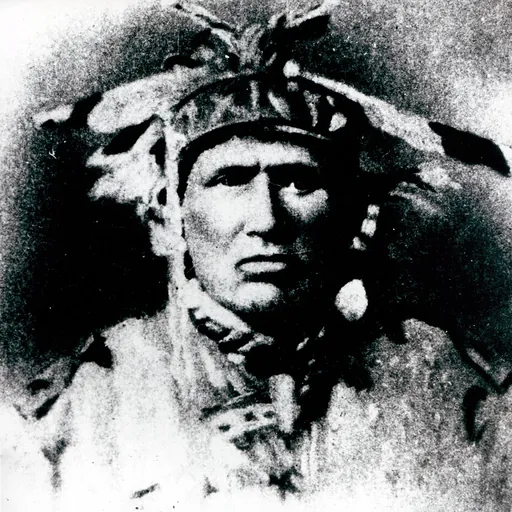
About Shingwauk
Lived 1773 – 1854 (aged 80–81). Shingwauk was a Canadian politician, known for Robinson-Huron Treaty.
Shingwaukonse (Fiero spelling: Zhingwaakoons; "Little Pine"), or Shingwauk (Fiero spelling: Zhingwaak; "Pine") (c. 1773–1854) was an Anishnaabe chief, who was instrumental in the establishment of the Garden River First Nation near Sault Ste. Marie, Ontario as a signatory to the Robinson Huron Treaty of 1850.
Personal life Shingwaukonse was born in the Sault Ste. Marie area in 1773. The names of his parents are unknown, but his father was a Frenchman, and his mother was Ogemahqua (Chief Woman) from the crane clan.
Shingwaukonse had many children including Augustine (1800-1890), Buhgwujjenene (1811-1900), John Askin (1836-1919), and George Menissino (1838-1923). (Fiero spelling: Bagwajinini; "Wildman"), who served as successive hereditary chiefs of Garden River after Shingwauk's death. Augustine served as hereditary chief from 1854-1890 and Buchkwujjene held the position from 1890-1900. Shingwaukonse's youngest son, George Shingwauk (1838-1923) (also known as George Menissino or George Pine), was elected chief of Garden River First Nation from 1899-1902 and again from 1903-1916.
Other less well known children of Shingwauk include: Tegoosh (1796-1876), Thomas Shingwauk (1796-1883), Nahwahquashkum (1799-1840), Jean Baptise Tegoosh (b. 1799), Waintegoochequai (b. 1800), Owiaquahgeyhegoqua (b. 1805), Marie (1816-1887), Ogimaqua (b. 1813), Joseph Shingwauk (b. 1837), and Louis Shingwauk (1839-1899).
War of 1812 Shingwaukonse is also known for his role as a national leader, warrior, and war chief during the War of 1812. He fought on the side of the British during the War. Shingwauk's advocacy around land-use rights can be seen in his participation in the Mica Bay Incident, which protested against the Quebec Mining Company.
Education advocacy In addition to his role as a prominent chief during the war years Shingwauk also strongly advocated education to help the Anishnaabe people preserve their language and culture. He also advocated the creation of a "Teaching Wigwam Lodge" for his people to learn how to read and write in the English language. This vision would create a space where they can receive education while retaining to their traditions and culture.
Don’t just read it —
keep it.
Full-length biographies made to live with: read them, listen on the way to work, watch them tonight.
- E-book
- Audio
- Video
Instant download · yours to keep · every purchase keeps this site free
Important facts
People in Shingwauk's life
Named in this biography and alive at the same time

Related people
Same field, nearest in time



Contemporaries
People whose lives overlapped Shingwauk's


Frequently asked questions
Who was Shingwauk?
Anishnabbe chief
When was Shingwauk born?
Shingwauk was born in 1773.
When did Shingwauk die?
Shingwauk died in 1854.
What was Shingwauk's occupation?
Shingwauk was a politician.
What was Shingwauk known for?
Shingwauk was known for Robinson-Huron Treaty.
What nationality was Shingwauk?
Shingwauk was Canadian.
Sources & further reading
Cite this page
APA: Biography.guide. (2026). Shingwauk. https://biography.guide/shingwauk/
MLA: "Shingwauk." Biography.guide, https://biography.guide/shingwauk/.
Chicago: "Shingwauk." Biography.guide. https://biography.guide/shingwauk/.
Data last updated: 2026-09-22 · Spot an error? Report a correction.
Portrait: Wikimedia Commons · author & licence
Page generated 2026-09-27 05:04 UTC