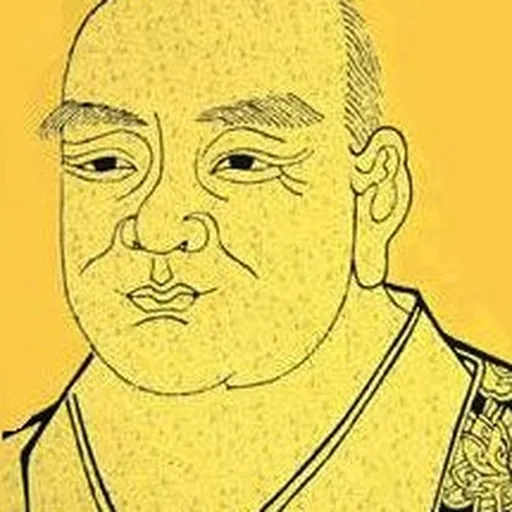
Shenhui
Chinese Buddhist monk
About Shenhui
Lived 670 – 762 (aged 91–92). Shenhui was a Chinese religious person.
Heze Shenhui (Chinese:菏澤神會/菏泽神会; Wade–Giles: Shen-hui; Japanese: Kataku Jinne, 684–758) was a Chinese Buddhist monk of the so-called "Southern School" of Chan/Zen, who "claimed to have studied under Huineng."
Shenhui is notable for his strident attacks on Yuquan Shenxiu and the associated "Northern School", which was the most prominent branch of Chan Buddhism in China at the time. He accused them of propagating gradual teachings, as opposed to his own sudden teachings.
At the age of 14 he became a monk under Huineng, a disciple of Hongren and the founder of the Southern School of Zen. For a time Shenhui served as his attendant.
Several extant stories relate encounters between Huineng and Shenhui. In one, Huineng said to his students,
In his writings and lectures Shenhui attacked what he called the "Northern School" of Zen. Despite his attacks on the Northern School, Shenhui traveled north to live amongst his ideological enemies in the capital city of Luoyang. While in the city he spoke publicly against the teachings of the Northern School. It was presented in the form of a discussion between him and a monk named Chongyuan, who took the side of Shenxiu's Northern School. Shenhui used the opportunity to question Shenxiu's legitimacy as Hongren's successor.
He also accused "Northern School" students of trying to steal Bodhidharma's robe, to sever the head of Huineng's mummy, and to rewrite the inscription on Shenxiu's tomb with the words "Sixth Patriarch".
Most memorably, however, he accused the Northern School of advocating "gradual" and not "sudden" enlightenment. However, some scholars indicate that Shenxiu's extant writings do not support the view that he rejected sudden enlightenment. Indeed, according to McRae, Shenxiu's Guanxin Lun (觀心論; Treatise on the Contemplation of the Mind) states: “It does not take long to witness this; enlightenment is in the instant. Why worry about your white hair (i.e., about your age)?”
Historical analysis of Shenhui's attack Several scholars consider Shenhui's arguments against the "Northern School" to be fabrications or exaggerations. Heinrich Dumoulin, commenting on Shenhui's accusations, wrote that Shenhui was "unscrupulous", while Ui Hakuju wrote that he had “traits deserving of moral censure and criticism for intolerance”. In this exchange, Shenhui presents his famous "four pronouncements" in which he denounces the Northern School practices of freezing the mind to enter concentration, fixing the mind to view purity, activating the mind for external illumination, and concentrating the mind for internal realization. For Shenhui, activating intentions to grasp bodhi, nirvana, emptiness, purity, or concentration were all examples of the false mind. Instead, Shenhui taught that true non-thought is to not intentionalize and not activate the mind. However, he says: "If you intentionally make your mind not activate, this is the concentration of consciousness. It is also called the concentration of mistaken views of the Dharma."
According to Shenhui, entering into and exiting from concentration were still conditioned and failed to transcend the false mind. He says should the false mind become activated so that one's thoughts stray "far and near," one should not try to bring the mind back into concentration. He says: "To make the mind go out is illness, and to make it come back into concentration is also illness. Both making it go out and making it come back are illness." Instead, he says if one can simply "shine the light of awareness" on a thought as soon as it arises, it will vanish into the light of awareness naturally. What's more, he says the light of awareness too will of itself also disappear. For Shenhui, the disappearing of thought with awareness is "precisely [what is meant by] the non-abiding mind of one’s original nature." Relying on the essence-function paradigm, he identifies serenity with essence and says, "Based on the essence of this empty serenity there naturally exists a fundamental wisdom, [of which] it is said that knowing is its function of illumination." He says, "Non-abiding is the fundamental quiescence of the self-nature (ben zixing ji 本自性寂). Knowing is the function. Quiescence is the essence of illumination, and illumination is the function of quiescence." For Shenhui, this is also what is meant by the equivalence of concentration and wisdom. He says:
Non-abiding is quiescence, and the essence of quiescence is called concentration. The natural wisdom (zhi 智) that occurs on the basis of this essence, whereby one can know the inherently quiescent essence, is called sagacity (hui 慧). This is the equivalence of concentration and wisdom. The sūtra says, “Activate illumination on the basis of serenity,” and the meaning here is the same. The non-abiding mind does not transcend knowing, and knowing does not transcend non-abiding. If one knows the mind’s non-abiding, there is nothing else to be known. The Nirvāṇa Sūtra says, “For concentration to be great and wisdom little is to increase one’s ignorance. For wisdom to be great and concentration little is to increase one’s wrong views. For concentration and wisdom to be equivalent is called ‘seeing the Buddha-nature.’”
Regarding the practice of seated meditation, Shenhui did not teach that physical sitting was necessary. He says: "When I say ‘sit,’ [I mean that] ‘sitting’ is for thoughts to not be activated. When I say ‘meditation,’ [I mean that] ‘meditation’ is to see the fundamental nature. Therefore I do not teach people to have their bodies sit and their minds abide while entering into concentration."
Shenhui was also critical of "secret teachings." He says:
When other masters are asked about this teaching, they do not explain but keep it secret. I am completely different—whether to many persons or few, I always explain it to everyone. [...] The teachings of the buddhas of the past have all been directed at the eightfold congregation; there has been no private teaching, no secret teaching.
Influence In the early 10th century, the founder of the Fayan School commented on Shenhui's lineage: The record of that time was indeed excellent. Today, if we point to a greatly awakened school, it is the Heze school.
Shenhui's distinction between "gradual" versus "sudden" methods of enlightenment became a hallmark of Chinese Zen. Mazu Daoyi, whose Hongzhou school became the hallmark of Zen, was an early and important adopter of the "sudden" approach.
His speeches were found again in Dunhuang.
Don’t just read it —
keep it.
Full-length biographies made to live with: read them, listen on the way to work, watch them tonight.
- E-book
- Audio
- Video
Instant download · yours to keep · every purchase keeps this site free
Important facts
People in Shenhui's life
Named in this biography and alive at the same time
Related people
Same field, nearest in time






Contemporaries
People whose lives overlapped Shenhui's



Frequently asked questions
Who was Shenhui?
Chinese Buddhist monk
When was Shenhui born?
Shenhui was born in 670 in Xiangyang.
When did Shenhui die?
Shenhui died in 762.
What was Shenhui's occupation?
Shenhui was a religious person.
What nationality was Shenhui?
Shenhui was Chinese.
Sources & further reading
Cite this page
APA: Biography.guide. (2026). Shenhui. https://biography.guide/shenhui/
MLA: "Shenhui." Biography.guide, https://biography.guide/shenhui/.
Chicago: "Shenhui." Biography.guide. https://biography.guide/shenhui/.
Data last updated: 2026-09-22 · Spot an error? Report a correction.
Portrait: Wikimedia Commons · author & licence
Page generated 2026-09-27 05:02 UTC