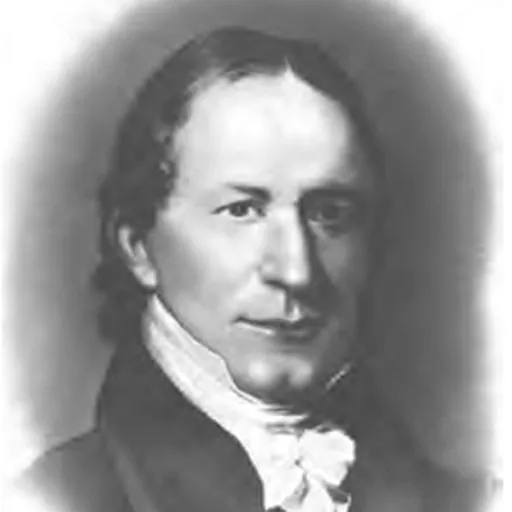
Shadrach Bond
American politician: 1st Governor of Illinois; Illinois Territory congressman
About Shadrach Bond
Lived 1773 – 1832 (aged 58). Shadrach Bond was an American politician, farmer, governor and judge.
Shadrach Bond (November 24, 1773 – April 12, 1832) was a representative from the Illinois Territory to the United States Congress. In 1818, he was elected governor of Illinois, becoming the new state's first chief executive. In an example of American politics during the Era of Good Feelings, Bond was elected to both positions without opposition.
Early life and career Bond was born in 1773 in Frederick, Maryland the son of Nicodemus, a landowner, and Rachel (Stevenson) Bond.
Political career A Democratic-Republican, Bond was elected to the Indiana Territorial Council. After Illinois Territory was organized, he was elected to the United States House of Representatives. When Illinois was admitted to the Union, Bond was elected the first governor. His inauguration took place on October 6, 1818, at the initial state capital of Kaskaskia.
As Illinois's first governor, Bond led a new state that had sterling prospects but almost no transportation infrastructure or cash in hand. Bond made transportation his top priority as governor, along with education. Because the state had almost no money, the General Assembly passed and Bond signed bills to build privately operated toll roads and bridges, headed by a road connecting the state's then capital, Kaskaskia on the Mississippi River, with what was then the state's largest city, Shawneetown, on the Ohio River. The road was built and eventually taken over by the state of Illinois as a state highway. After almost two centuries of improvements, much of it is now part of Illinois Route 13. Legislature also passed a bill that put taxes on the land non-residents owned to improve the newly formed state's lack of money. Bond had a method to lease salt springs.
Bond was less successful in his advocacy for a canal that would connect Lake Michigan and the Illinois River (the Illinois and Michigan Canal). The canal was eventually built in the 1840s, long after Bond had left office.
Governor Bond was deeply concerned about arson. The Illinois criminal law made arsonists eligible for the death penalty, along with persons guilty of rape and murder. The governor was by no means exclusively concerned with appearing to be tough on crime, however. He took steps to abolish the whipping post and pillory for misdemeanor offenses. Bond also
Bond's most controversial act was his attempt to veto an act passed by the General Assembly to create a non-capitalized State Bank of Illinois. The bank was ready to issue banknotes based on the prospect of future economic growth within Illinois. Bond considered this dishonorable and felt that there should be no banks chartered by the state government of Illinois until the State had enough specie (gold and silver coin) to support the value of its banknotes. The undercapitalized bank was chartered anyway, and promptly went bankrupt, justifying Bond's concerns.
Retirement After Bond's single term as governor, he returned to his Kaskaskia farm. He was no longer in the center of Illinois politics, as the General Assembly had moved the state capital from Kaskaskia to Vandalia. President James Monroe appointed Bond chief record keeper of the Kaskaskia land office, an important job in a land-hungry frontier state. As a respected local leader, Bond also helped to raise the local share of funding to secure the construction of the state's first penitentiary in Alton. In the early 1830s Bond was elected Master of his Masonic Lodge.
Personal life Bond was a Methodist-Episcopalian. Bond married his distant cousin, Achsah, on November 27, 1810, at Nashville, Tennessee. They had seven children; Rachel, Mary Achsah, Isabella Fell, Thomas Shadrach, Benjamin Nicodemus, and two unnamed daughters. Bond was also popular with females. He was also noted for being six feet long and weighed an estimate of 200 pounds.
Death Shadrach Bond died of pneumonia on his farm at Kaskaskia in 1832. He is interred in Evergreen Cemetery in Chester, and his grave is marked by the Governor Bond State Memorial. In September 2008, his obelisk – the tallest and most prominent monument in the cemetery – was toppled by the effects of Hurricane Ike.
Honors In 1817, Illinois Territory named the newly created Bond County for Shadrach Bond. The honor was bestowed for Bond's service as a congressional delegate; he had not yet become governor. Governor Bond Lake in Greenville, Illinois is also named in honor of Bond.
Don’t just read it —
keep it.
Full-length biographies made to live with: read them, listen on the way to work, watch them tonight.
- E-book
- Audio
- Video
Instant download · yours to keep · every purchase keeps this site free
Important facts
People in Shadrach Bond's life
Named in this biography and alive at the same time
Related people
Same field, nearest in time



Contemporaries
People whose lives overlapped Shadrach Bond's




Frequently asked questions
Who was Shadrach Bond?
American politician: 1st Governor of Illinois; Illinois Territory congressman (1773-1832)
When was Shadrach Bond born?
Shadrach Bond was born on 24 November 1773 in Frederick.
When did Shadrach Bond die?
Shadrach Bond died on 12 April 1832 in Kaskaskia.
What was Shadrach Bond's occupation?
Shadrach Bond was a politician, farmer, governor and judge.
What nationality was Shadrach Bond?
Shadrach Bond was American.
Sources & further reading
Cite this page
APA: Biography.guide. (2026). Shadrach Bond. https://biography.guide/shadrach-bond/
MLA: "Shadrach Bond." Biography.guide, https://biography.guide/shadrach-bond/.
Chicago: "Shadrach Bond." Biography.guide. https://biography.guide/shadrach-bond/.
Data last updated: 2026-09-24 · Spot an error? Report a correction.
Portrait: Wikimedia Commons · author & licence
Page generated 2026-09-27 05:09 UTC