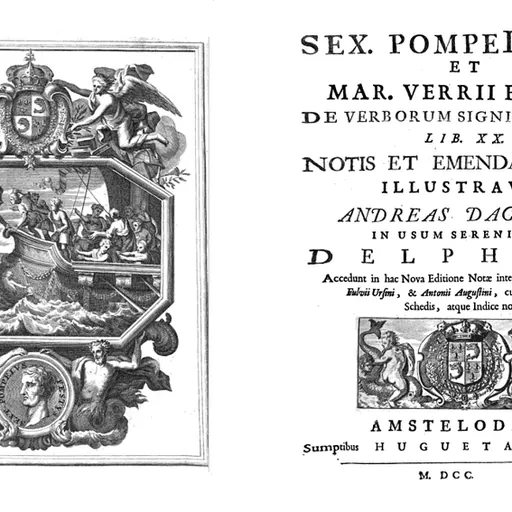
About Sextus Pompeius Festus
Sextus Pompeius Festus was a Roman lexicographer, classical philologist, writer, poet and grammarian.
Sextus Pompeius Festus, usually known simply as Festus, was a Roman grammarian who probably flourished in the later 2nd century AD, perhaps at Narbo (Narbonne) in Gaul.
Work He made a 20-volume epitome of Verrius Flaccus's voluminous and encyclopedic treatise De verborum significatione. Flaccus had been a celebrated grammarian who flourished in the reign of Augustus. Festus gives the etymology as well as the meaning of many words, and his work throws considerable light on the language, mythology and antiquities of ancient Rome. He made a few alterations, and inserted some critical remarks of his own. He also omitted such ancient Latin words as had long been obsolete; these he apparently discussed in a separate work now lost, entitled Priscorum verborum cum exemplis. Even incomplete, Festus' lexicon reflects at second hand the enormous intellectual effort that had been made in the Augustan Age to put together information on the traditions of the Roman world, which was already in a state of flux and change.
Of Flaccus' work only a few fragments remain; of Festus' epitome, only one damaged, fragmentary manuscript. The remainder, further abridged, survives in a summary made at the close of the 8th century by Paul the Deacon.
The Festus Lexicon Project has summed up Paul's epitome of Festus' De Verborum Significatu as follows:
Manuscript The 11th-century Codex Farnesianus at Naples is the sole surviving manuscript of Festus. It was rediscovered in 1436 at Speyer by the Venetian humanist and bishop Pietro Donato. When he found it, half of the manuscript was already missing, so that it only contains the alphabetized entries M-V, and not in perfect condition. During the 15th century it was scorched by fire and then disassembled by the antiquarian humanist Julius Pomponius Laetus.
The project of the collation and republication with translations of these fragmentary abridgments is being coordinated at University College London, with several objectives: to make this information available in usable form, to stimulate debate on Festus and on the Augustan antiquarian tradition upon which he drew, and to enrich and to renew studies on Roman life, about which Festus provides essential information.
Don’t just read it —
keep it.
Full-length biographies made to live with: read them, listen on the way to work, watch them tonight.
- E-book
- Audio
- Video
Instant download · yours to keep · every purchase keeps this site free
Important facts
Related people
Same field, nearest in time






Frequently asked questions
Who was Sextus Pompeius Festus?
2nd century AD Roman grammarian
When was Sextus Pompeius Festus born?
Sextus Pompeius Festus was born in Narbonne.
What was Sextus Pompeius Festus's occupation?
Sextus Pompeius Festus was a lexicographer, classical philologist, writer, poet and grammarian.
What nationality was Sextus Pompeius Festus?
Sextus Pompeius Festus was Roman.
Sources & further reading
· Wikipedia: Sextus Pompeius Festus
· DBpedia: Sextus Pompeius Festus
Cite this page
APA: Biography.guide. (2026). Sextus Pompeius Festus. https://biography.guide/sextus-pompeius-festus/
MLA: "Sextus Pompeius Festus." Biography.guide, https://biography.guide/sextus-pompeius-festus/.
Chicago: "Sextus Pompeius Festus." Biography.guide. https://biography.guide/sextus-pompeius-festus/.
Data last updated: 2026-09-22 · Spot an error? Report a correction.
Portrait: Wikimedia Commons · author & licence
Page generated 2026-09-27 05:04 UTC