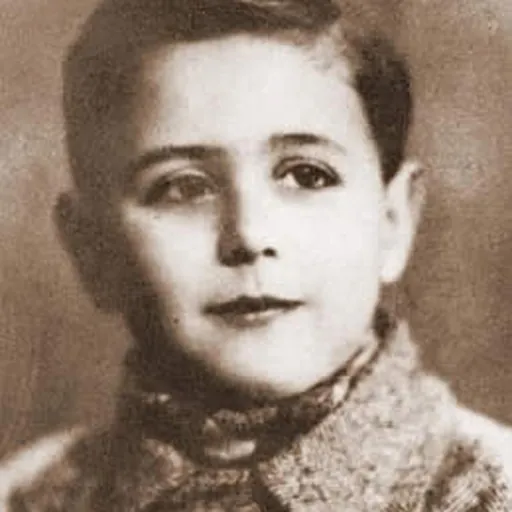
Sergio De Simone
Italian Holocaust victim
About Sergio De Simone
Lived 1937 – 1945 (aged 7). Sergio De Simone was an Italian.
The story of my brother and the other 19 children... should never be silenced or merely hinted at — but rather narrated in its full and aberrant detail.
On the street where Sergio De Simone's family lived in Naples, a memorial plaque and a pavement Stolperstein mark his life, which is commemorated annually on 27 January International Holocaust Remembrance Day.
Background
Sergio De Simone was born in the Vomero district of Naples, Italy, on 29 November 1937 to Eduardo De Simone (unknown-1964), a Catholic, non-commissioned officer in the Italian Navy and Gisella Perlow. De Simone's mother, of Jewish origin, was born on 23 September 1904 in Vidrinka, a town that no longer exists (possibly in Belarus, though more likely, Ukraine). The two met in Rijeka (on the Istrian Peninsula of what then belonged to the Kingdom of Italy), where Perlow's family lived. After marrying, the couple settled in Naples, on Via Morghen, not far above Piazza Vanvitelli.
Translated: SERGIO DE SIMONE, born 1937, Napoli, deported during the war to Germany, transferred to Neuengamme concentration camp, subjected to experiments by a fanatical Nazi doctor. In an attempt to erase any trace of this criminal ferocity he was transferred together with 19 other children to the Bullenhuser Damm School in Hamburg and hanged there on 20 April 1945, a few days before the end of the Second World War. His body, like that of the other little martyrs, was never found.
So that this atrocious madness may never repeat itself.
In August 1943, with her husband called to the Navy (later taken to Dortmund as slave labor) and Italy having entered the war alongside Nazi Germany, Gisella Perlow was alone with her six-year-old son in Naples, which now experienced heavy bombings and where she risked being discovered in the hunt for Jews, by Nazi-fascists. Gisella unwittingly moved to Fiume (Rijeka) with Sergio to join her mother, brothers and sisters at their home at Via Milano 17.
Neuengamme experimentation
Having been chosen in November 1944 by Joseph Mengele as one of the twenty children (10 boys and 10 girls) to be sent to the Neuengamme concentration camp, Sergio was made available as a human subject in Kurt Heissmeyer's tuberculosis experimentation.
As early as April 1944, Heissmeyer had conducted medical experiments on Russian POWs. As the court expert would later testify during the subsequent trials of the early 1960s, Heissmeyer had no scientific expertise or background in immunology or bacteriology, but based his work on pseudo-science, studies already considered scientifically unreliable at the time. But Heissmeyer was convinced that by injecting tuberculosis bacilli under a subject's skin, infection would form that would generate immune defense responses, leading to vaccinations against pulmonary tuberculosis. He was not discouraged by his first negative results and with influential support among the Nazi leaders, he insisted that the experiment continue, now with Jewish children.
On 29 November 1944, Sergio's seventh birthday, he and 19 other children, from France, the Netherlands, Yugoslavia, and Poland, arrived at the Neuengamme concentration camp, accompanied by Dr. Paulina Trocki and three nurses. In Neuengamme the children were entrusted to four deportees, charged with taking care of the group: the French doctors, René Quenouille and Gabriel Florence, and two Dutch nurses, Anton Hölzel and Dirk Deutekom.
For several weeks the children experienced a period of relative calm; the experiment required their good health. On 9 January 1945 Heissmeyer began the experiments: he had the skin on the chest of 11 children, under the right armpit, incised with X-shaped cuts, three to four centimeters long, to introduce tuberculosis bacilli with a spatula — causing rapid spread of the disease. In early March the children, sick and feverish, were operated on to remove their axillary lymph nodes, which according to the doctor's theories should have produced antibodies against tuberculosis.
A series of twenty surviving photographs document the operations; they show each child, shaven and shirtless, presenting their raised arms and their under-arm incisions. The experiment had failed: the removed lymphatic glands were sent to Hans Klein, a pathologist at the Hohenlychen clinic, who on 12 March 1945 certified to Heissmeyer that no antibodies had been generated.
Before leaving the extermination camp on 17 January 1945, the German SS burned all possible evidence attesting to what happened in Auschwitz-Birkenau. Sergio's name appears in a rare exception, a medical report, one of the few documents not destroyed. The document, dated 14 May 1944, confirmed the presence of the children of Bullenhuser Damm.
Bullenhuser Damm Massacre
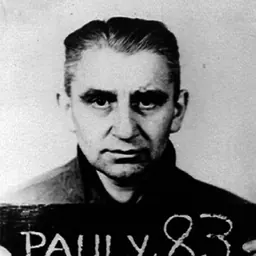
By the time his experiments failed and news traveled that the Allies were fast approaching, Heissmeyer had fled. The camp commander Max Pauly was left to deal with the children. On the evening of 20 April, orders came directly from Berlin to eliminate all trace of what had transpired in Neuengamme.
At 10pm on the evening of 20 April, the children, their four adult caretakers and several Soviet prisoners were loaded into a mail truck and driven the approximately 30 kilometers from the Kinderblock hut 4a, the site of the experimentation, to Bullenhuser Damm — along with Wilhelm Dreimann, Adolf Speck, Heinrich Wiehagen, their executioners, so-called SS doctor Alfred Trzebinski and Johann Frahm, German SS sergeant.
Johann Frahm, German SS sergeant at Neuengamme concentration camp and deputy camp commander at the Neuengamme satellite camp on Bullenhuser Damm, reported on 2 May 1946:
The commander of the Bullenhuser Damm camp was Jauch, the executor of the orders was Strippel... I went down to the cellar where the new arrivals were gathered. There were about 20 children. Some appeared to be sick. Besides the children in the cellar were Dr. Trzebinski, Dreimann and Jauch. Strippel came and went. The children had to undress in a cellar room, then were taken to another room, where Dr. Trzebinski gave them an injection to put them to sleep. Those who still showed signs of life after the injection were taken to another room. A rope was put around their necks and they were hung on a hook. This was done by Jauch, myself, Trzebinski and Dreimann. When asked by Captain Walter Freud "How did he hang them?" Frahm replied "Wie Bilder an die Wand" (like pictures on the wall).
In the 1980s, around the time the story of the Bullenhuser Damm Massacre began to emerge, Sergio's mother began receiving letters from Hamburg, dismissing them because she didn't read German. In 1983, after the death of Sergio's father in 1964, his mother was informed of the massacre. Mario De Simone later related that on learning of the atrocities, his mother — who had clung to the possibility of Sergio's survival — was deeply affected; her entire affect changed. She attended the memorial ceremony on 20 April 1984 in Hamburg Sergio's younger brother continues to advocate for human rights. In 2019, he said "my brother was murdered because he was compromising evidence."
Location: Roman-Zeller-PlatzHamburg-SchnelsenBurgwedel A-Bahn stop
In April 1946 the main material perpetrators of the massacre, including Commander Max Pauly, who gave the final orders, were tried by an English court and sentenced to death, carried out in October 1946.
In the Vomero district of Naples, Italy, in front of the building where Sergio's family lived at Via Morghen 65 bis (at Via Bonito), a plaque marks Sergio's life and story.
Vomero Historic Marker, Via Morghen:
On 27 January 2014 an annual Remembrance Day was inaugurated in Naples in his memory, in conjunction with International Holocaust Remembrance Day.
In 2020, a small engraved memorial Stolperstein or stumbling block (Italian: pietra d’inciampo) was laid at Piazza Bovio (at the Naples Royal Hospital for the Poor), marking those deported to concentration camps during the war, and including a block for Sergio.
In 2022, a small engraved memorial Stolperstein or stumbling block (Italian: pietra d’inciampo) was inlaid in front of his family's Vomero residence, in a ceremony attended by Sergio's younger brother Mario de Simone (born in 1946, after the war).
Santobono Pediatric Hospital, Naples On 9 February 2021, the emergency room of the Santobono Children's Hospital in Naples was named after Sergio de Simone. At the ceremony, the emergency room was declared "a place where help and care is offered to all children, regardless of their condition and creed. It takes on greater symbolic value to remember those who were denied this and for whom the most humane of the practices, the care of the little ones, was transformed into."
Don’t just read it —
keep it.
Full-length biographies made to live with: read them, listen on the way to work, watch them tonight.
- E-book
- Audio
- Video
Instant download · yours to keep · every purchase keeps this site free
Important facts
People in Sergio De Simone's life
Named in this biography and alive at the same time



Frequently asked questions
Who was Sergio De Simone?
Italian Holocaust victim (1937–1945)
When was Sergio De Simone born?
Sergio De Simone was born on 29 November 1937 in Naples.
When did Sergio De Simone die?
Sergio De Simone died on 20 April 1945 in Schule Bullenhuser Damm.
What nationality was Sergio De Simone?
Sergio De Simone was Italian.
Sources & further reading
Cite this page
APA: Biography.guide. (2026). Sergio De Simone. https://biography.guide/sergio-de-simone/
MLA: "Sergio De Simone." Biography.guide, https://biography.guide/sergio-de-simone/.
Chicago: "Sergio De Simone." Biography.guide. https://biography.guide/sergio-de-simone/.
Data last updated: 2026-09-22 · Spot an error? Report a correction.
Portrait: Wikimedia Commons · author & licence
Page generated 2026-09-27 05:03 UTC