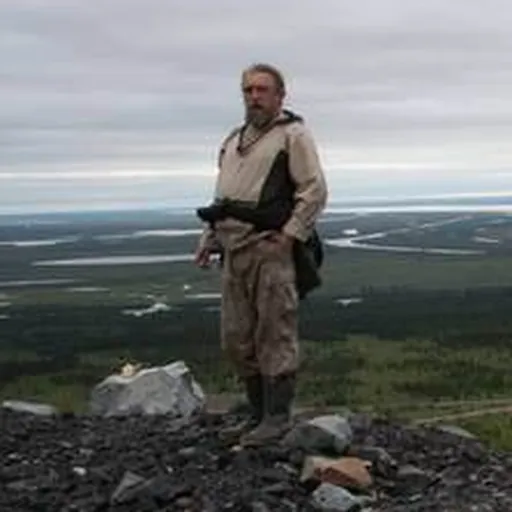
About Sergey Zimov
Born 1955. Sergey Zimov is a Russian ecologist and geophysicist, known for Carbon, Methane and Pleistocene.
Sergey Aphanasievich Zimov (; born 18 July 1955) is a Russian geophysicist who specialises in arctic and subarctic ecology. He is the Director of Northeast Scientific Station (a research institute of the Russian Academy of Sciences), a senior research fellow of the Pacific Institute for Geography (an institute within the Far East Division of the Russian Academy of Sciences (FED RAS)), and one of the founders of Pleistocene Park (a 160 km2 wildlife preserve and a research substation of the Northeast Scientific Station). He is best known for his work in advocating the theory that human overhunting of large herbivores during the Pleistocene caused Siberia's grassland-steppe ecosystem to disappear and for raising awareness as to the important roles permafrost and thermokarst lakes play in the global carbon cycle.
According to a colleague, Sergey Zimov is the most cited Russian earth scientist.
Life and work
Sergey Zimov, born 18 July 1955, is a Russian scientist who resides in Cherskii, Sakha Republic, Russia. He studied and received his degree in geophysics from Far East State University, located in Vladivostok, Russia.
Zimov founded the Northeast Science Station near Cherskii in 1977. Twelve years later, in 1988, he began the Pleistocene Park project.
Professional highlights and accomplishments
Northeast Science Station
Coordinates: 69 degrees 30 minutes North latitude, 161 degrees 30 minutes East longitude
Sergey Zimov is a co-founder and the director of the Northeast Science Station, one of the world's three largest Arctic stations. Located near Cherskii, Russia on the mouth of the Kolyma River, 150 kilometers south of the Arctic Ocean, the station serves as a year-round base for international Arctic research. Founded in 1977, A barge floating on the Kolyma River serves as a traveling dormitory and laboratory.
Permafrost is a large global carbon reservoir which has remained frozen throughout much of the Holocene. Due to recent climate change, the permafrost is beginning to thaw, releasing stored carbon and forming thermokarst lakes. Methane is a potent greenhouse gas and the methane emissions from thermokarst lakes have the potential to initiate a positive feedback cycle in which increased atmospheric methane concentrations lead to amplified global climate change, which in turn leads to more permafrost thaw and more methane and carbon dioxide emissions.
Current efforts in the park include reintroducing surviving Pleistocene megafauna into the fenced enclosure until they reach densities to change the vegetation and soil to a steppe grassland ecosystem.
Zimov’s concept of Pleistocene Park and repopulating the mammoth steppe is listed as one of the “100 most substantive solutions to global warming” by Project Drawdown. The list, encompassing only technologically viable, existing solutions, was compiled by a team of over 200 scholars, scientists, policymakers, business leaders and activists; for each solution the carbon impact through the year 2050, the total and net cost to society, and the total lifetime savings were measured and modelled.
Filmography « L'hypothèse de Zimov » feature-length documentary (90 and 52 min) ; international co-production involving Arturo Mio, 13 Productions, ARTE France (France), Take Five, RTBF (Belgique) and Ethnofund (Russia). Film written and directed by Denis Sneguirev, in Russian and English; in post-production for a release scheduled for November 2021. (Film site; ARTE Germany )
Selected publications
This paper estimates that 33-87% of high-latitude increases in atmospheric methane originate from thermokarst lakes. It is suggested that sediments which have been frozen since the Pleistocene, called yedoma, will have high methane-releasing potential as they thaw due to climate change.
This paper quantifies methane emissions from thermokarst lakes in North Siberia. Most of the methane is sourced to thawing permafrost from the lake margins. PDF This essay outlines the concept behind Pleistocene Park, Sergei Zimov's research site in which he seeks to demonstrate that human overhunting of Pleistocene megafauna led to the disappearance of the Pleistocene's grassland-steppe ecosystem.
This paper suggests that increasing high-latitude ecological disturbances such as fires and grazing contribute to the long-term increase in atmospheric carbon dioxide.
This paper contends that permafrost represents a significant global carbon sink. As climate change causes permafrost to thaw, the stored carbon will be released and amplify global climate change.
This paper identifies Pleistocene-aged soils, referred to as yedoma, as being a major carbon source for methane emissions from thermokarst lakes in North Siberia.
Don’t just read it —
keep it.
Full-length biographies made to live with: read them, listen on the way to work, watch them tonight.
- E-book
- Audio
- Video
Instant download · yours to keep · every purchase keeps this site free
Important facts
more
S. Zimov, S Zimov, Zimov, Zimov S, Zimov S., Zimov S.A., Zimov S. A., Zimov S A, Zimov SARelated people
Same field, nearest in time





Contemporaries
People whose lives overlapped Sergey Zimov's


Frequently asked questions
Who is Sergey Zimov?
Russian geophysicist
When was Sergey Zimov born?
Sergey Zimov was born on 18 July 1955 in Saint Petersburg.
What is Sergey Zimov's occupation?
Sergey Zimov is an ecologist and geophysicist.
What is Sergey Zimov known for?
Sergey Zimov is known for Carbon, Methane, Pleistocene and Pleistocene Park.
What nationality is Sergey Zimov?
Sergey Zimov is Russian.
Sources & further reading
Cite this page
APA: Biography.guide. (2026). Sergey Zimov. https://biography.guide/sergey-zimov/
MLA: "Sergey Zimov." Biography.guide, https://biography.guide/sergey-zimov/.
Chicago: "Sergey Zimov." Biography.guide. https://biography.guide/sergey-zimov/.
Data last updated: 2026-09-20 · Spot an error? Report a correction.
Page generated 2026-09-27 05:10 UTC