
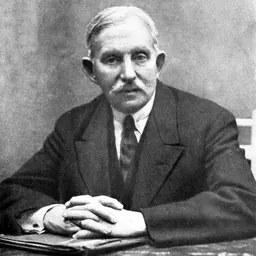
Sergei Tumansky
Soviet aeronautical engineer, aircraft engine designer, scientist
About Sergei Tumansky
Lived 1901 – 1973 (aged 72). Sergei Tumansky was a Russian aerospace engineer, scientist and university teacher.
Sergei Konstantinovich Tumansky (; – 9 September 1973) was a designer of Soviet aircraft engines and the chief designer in the Tumansky Design Bureau, OKB-300. He worked in TsIAM (1931–38 and in 1940), and at the aircraft-engine plant N 29, in Zaporozhye.
He also worked as a substitute main designer in OKB A.A. Mikulin beginning in 1943.
Biography
Sergei Tumansky was born in Minsk, the Russian Empire, on May 21, 1901 and died, at age 73, in Moscow, the Soviet Union, on September 9, 1973. He studied at the Vladimir school until joining the Red Army in 1918 where he took part in air operations on both fronts. In 1919 Sergey graduated from radio engineering school and served as a technician at the Petrogradskaya Military Technical School starting in 1921. 1927 saw Tumansky enter the Zhukovsky Air Force Engineering Academy where he worked with other engineers (Ponomarev, Fedorov, & Zenichkin) to develop the Tufsen aircraft engine, for which they were awarded the first place price for creativity in design. In 1931 he took a position as senior engineer at the Baranov Central Institute of Aviation Motor Development, spending his time there engaged in aircraft engine construction and research, until being appointed as the chief designer at Aircraft Plant #29 in Zaporozhye in 1938, where the Tumansky M-87 engine was developed under his supervision. In 1939 this plant developed the Tumansky M-88 used on the Ilyushin Il-4 bomber. Aleksandr Mikulin invited Tumansky to work at Plant #300 in 1943 as Deputy Chief Designer, which he worked at for the next 30 years, developing the multiple piston and jet engines, including the Tumansky R-11 which powered the Mikoyan-Gurevich MiG-21. After Mikulin's removal in 1956, Sergey was appointed as the General Constructor of the bureau, which has been renamed OKB-300. Tumansky also served as a General Designer at the Soyuz Joint Experimental Plant.
Around 1962 the Soyuz Joint Experimental Plant began development of liquid rocket motors to stabilize and orient spacecraft. That same year Alexander Yakovlev proposed that OKB-300 create an engine for vertical take off in aircraft. Tumansky and his engineers modified an existing engine into the Tumansky R-27-300 which was installed on a Yakovlev Yak-36. At the Domodedovo Aviation Parade in July, 1967, a demonstration was made of the new engine's VTOL capability. Further developments in this area led to the creation of the Yakovlev Yak-38, which was fitted with a Tumansky R-27V-300 and two Rybinsk RD-36-35F engines. Sergei Konstantinovich Tumansky died on 9 September 1973 in Moscow, and was buried at the Novodevichy cemetery.
Contributions
Some of the engines he worked on and/or designed include:
M-75 - Gnome-Rhône 9K Mistral built under license M-85 - Gnome-Rhône 14K Mistral Major built under license M-86 - higher power version of M-85 with increased supercharging and a higher compression ratio Tumansky M-87 - improved M-86 with more power Tumansky M-88 - improved M-87 with more power Tumansky M-89 Tumansky M-90 - prototype two-row, 18 cylinder version of M-75; cancelled in 1944 as it was too underpowered and suffered numerous failures Tumansky M-92 - prototype development of M-90, 1943 Tumansky RD-9 - initially known as Mikulin AM-5, renamed to RD-9 when Tumansky took over development Tumansky RD-10 - designation given to captured examples and copies of the Junkers Jumo 004 Tumansky R-11 - a twin-spool, axial-flow non-afterburning turbojet engine Tumansky R-13 - a twin-spool, axial-flow afterburning turbojet engine designed by Sergei Alekseevich Gavrilov, developed from the R-11 Tumansky R-15 - an axial-flow, single shaft afterburning turbojet Tumansky R-21 - projected twin-spool, axial-flow afterburning turbojet based on the R-11 Tumansky R-25 - a twin-spool, axial-flow afterburning turbojet engine, the ultimate development of the Tumansky R-11 Tumansky R-29
Awards Hero of Socialist Labour (1957) Lenin Prize winner (1957) Gospremii of the USSR (1946) Honorary Citizen Kuybyshev (1982) Order of Lenin (4 times) Order of the October Revolution Order of the Red Star
Don’t just read it —
keep it.
Full-length biographies made to live with: read them, listen on the way to work, watch them tonight.
- E-book
- Audio
- Video
Instant download · yours to keep · every purchase keeps this site free
Important facts
Related people
Same field, nearest in time



Contemporaries
People whose lives overlapped Sergei Tumansky's



Frequently asked questions
Who was Sergei Tumansky?
Soviet aeronautical engineer, aircraft engine designer, scientist (1901-1973)
When was Sergei Tumansky born?
Sergei Tumansky was born on 8 May 1901 in Minsk.
When did Sergei Tumansky die?
Sergei Tumansky died on 9 September 1973 in Moscow.
What was Sergei Tumansky's occupation?
Sergei Tumansky was an aerospace engineer, scientist and university teacher.
What nationality was Sergei Tumansky?
Sergei Tumansky was Russian.
Sources & further reading
Cite this page
APA: Biography.guide. (2026). Sergei Tumansky. https://biography.guide/sergei-tumansky/
MLA: "Sergei Tumansky." Biography.guide, https://biography.guide/sergei-tumansky/.
Chicago: "Sergei Tumansky." Biography.guide. https://biography.guide/sergei-tumansky/.
Data last updated: 2026-09-22 · Spot an error? Report a correction.
Page generated 2026-09-27 05:26 UTC