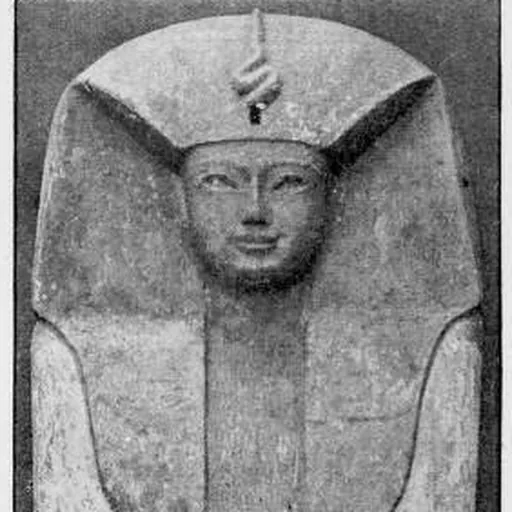
About Seqenenre Tao
Lived 1590 BC – 1554 BC (aged 35–36). Seqenenre Tao was a statesperson.
Seqenenre Tao (also Seqenera Djehuty-aa or Sekenenra Taa, called 'the Brave'; 1600 BC - 1555 BC)
A relatively large amount of pottery known as Kerma-ware was found at the site, indicating that a large number of Kerma Nubians were resident at the site. It is thought that they were there as allies of the king in his wars against the Hyksos.
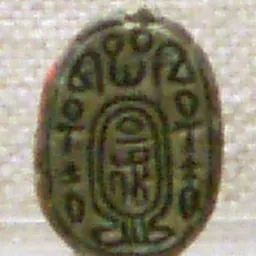
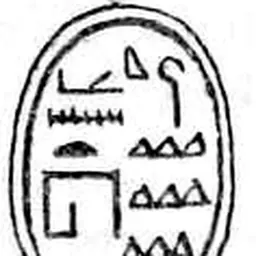
Historical attestations Seqenenre's existence is attested to by several artifacts that mention his name. Louvre E 15682 | A limestone statue of a seated man with the royal name of Seqenenre and owner Senior King's Son Ahmose (sꜣ-nsw smsw), given by his sister Great King's Daughter Ahmose (sꜣt-nsw wrt), also mentions Great King's Daughter and United with the White Crown, Ahhotep (sꜣt-nsw wrt, ẖnmt nfr ḥḏt). Karnak Sheikh Labib 87CL358 | At Karnak, a limestone round-topped stela was found with the royal name of Seqenenre belonging to King's Daughter Ahmose (cartouche). JE 21461 | At Dra Abu el-Naga, the Tomb of Hornakht, a throw-stick with the royal name of Seqenenre and King's Son Tjuiu (ṯwjw) was found.
Death Mummy Mummified head of Tao. The cut above his eye was most likely made by some sort of dagger. The common theory is that he died in a battle against the Hyksos. In the Deir el-Bahri cache, the mummy of Tao was discovered in 1881. Priests had interred his mummy in the cache, along with Ahmose I, Amenhotep I, Thutmose I, Thutmose II, Thutmose III, Ramesses I, Seti I, Ramesses II, and Ramesses IX of the later 18th and 19th Dynasty.
The mummy was unwrapped by Eugène Grébaut when Professor Gaston Maspero resigned his office of directorship on June 5, 1886, and was succeeded in the superintendency of excavations and Egyptian archeology by Grébaut. In the same month, Grébaut began the work of unbandaging the mummy of Tao. The history of Tao's reign and revolt against the Hyksos had been considered legendary, but from the wounds present on the body, it was concluded by Maspero that he had died in battle. During the same season, the mummy of Seti I was unbandaged, and also that of an anonymous prince.
Maspero provides a vivid description of the injury that was done to the pharaoh at his death:
The wound on his forehead was probably caused by a Hyksos axe and his neck wound was probably caused by a dagger while he was prone. A reconstruction of his death by Egyptologist Garry J Shaw and archaeologist and weapons expert Robert Mason suggested a third, which they saw as the likeliest, that Tao was executed by the Hyksos king Apepi. Garry J Shaw also analysed the arguments for the competing hypotheses and other physical, textual and statistical evidence concluding "that the most likely cause of Seqenenre's death is ceremonial execution at the hands of an enemy commander, following a Theban defeat on the battlefield."
His mummy appears to have been hastily embalmed. X-rays that were taken of the mummy in the late 1960s show that no attempt had been made to remove the brain or to add linen inside the cranium or eyes, both normal embalming practices for the time. In the opinion of James Harris and Kent Weeks, who undertook the forensic examination at the time the X-rays were taken, his mummy is the worst preserved of all the royal mummies held at the Egyptian Museum, and they noted that a "foul, oily smell filled the room the moment the case in which his body was exhibited was opened," which is likely due to the poor embalming process and the absence of the use of absorbing natron salts, leaving some bodily fluids in the mummy at the time of burial. Also, Harris and Weeks noted in 1973 that "his entire facial complex, in fact, is so different from other pharaohs (it is closest in fact to his son Ahmose) that he could be fitted more easily into the series of Nubian and Old Kingdom Giza skulls than into that of later Egyptian kings. Various scholars in the past have proposed a Nubian - that is, non-Egyptian-origin - for Seqenenre and his family, and his facial features suggest that this might indeed be true."
He was the earliest royal mummy on display in the revamped Royal Mummies Hall at the Egyptian Museum, Cairo.
In 2021, a CT scan of his mummy revealed that he died in his 40s, possibly on a battlefield, while his deformed hands imply that he was possibly imprisoned with his hands tied, and his facial fractures correlated well with the Hyksos weapons.
In April 2021, his mummy was moved to the National Museum of Egyptian Civilization along with those of 17 other kings and four queens in an event termed the Pharaohs' Golden Parade.
Legacy in modern literature Seqenenre Tao appears in the historical novel Shadow Hawk by Andre Norton, in which he is murdered by priests allied with the Hyksos. The book focuses on an Egyptian officer leading Nubian troops in the service of the Theban kingdom.
The Hiram Key, a work of non-fiction by Christopher Knight and Robert Lomas, argues that Seqenenre Tao's death formed the basis of the Hiram Abiff legend in Freemasonry; however, this thesis is not widely accepted and the book has been criticized as pseudohistory.
Don’t just read it —
keep it.
Full-length biographies made to live with: read them, listen on the way to work, watch them tonight.
- E-book
- Audio
- Video
Instant download · yours to keep · every purchase keeps this site free
Important facts
People in Seqenenre Tao's life
Named in this biography and alive at the same time
Related people
Same field, nearest in time




Contemporaries
People whose lives overlapped Seqenenre Tao's




Frequently asked questions
Who was Seqenenre Tao?
pharaoh from the Seventeenth Dynasty of Ancient Egypt
When was Seqenenre Tao born?
Seqenenre Tao was born in 1590 BC.
When did Seqenenre Tao die?
Seqenenre Tao died in 1554 BC.
What was Seqenenre Tao's occupation?
Seqenenre Tao was a statesperson.
Sources & further reading
Cite this page
APA: Biography.guide. (2026). Seqenenre Tao. https://biography.guide/seqenenre-tao/
MLA: "Seqenenre Tao." Biography.guide, https://biography.guide/seqenenre-tao/.
Chicago: "Seqenenre Tao." Biography.guide. https://biography.guide/seqenenre-tao/.
Data last updated: 2026-09-21 · Spot an error? Report a correction.
Portrait: Wikimedia Commons · author & licence
Page generated 2026-09-27 04:59 UTC