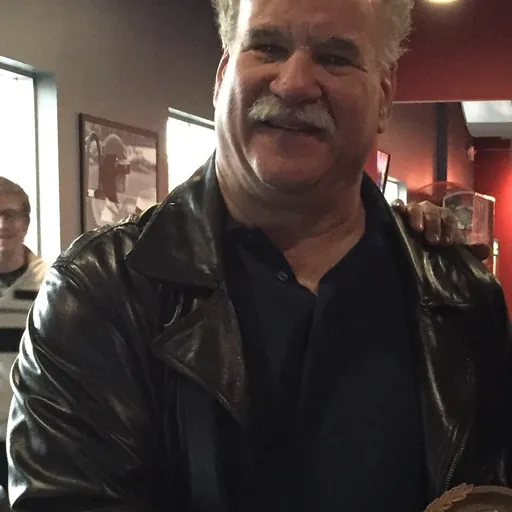
About Scott E. Denmark
Born 1953. Scott E. Denmark is an American chemist and university teacher, known for Enantioselective synthesis, Organic Reactions and Organocatalysis.
Scott Eric Denmark is an American chemist who is the Reynold C. Fuson Professor of Chemistry at the University of Illinois at Urbana-Champaign (UIUC). Denmark received an S.B. degree from MIT in 1975 and the D.Sc.Tech. degree from ETH Zurich in 1980, under the supervision of Professor Albert Eschenmoser. He joined the faculty at UIUC the same year and became an associate professor in 1986, full professor in 1987, and was named the Fuson Professor of Chemistry in 1991. He served as the president and editor-in-chief of the Organic Reactions book series between 2008 and 2018.
Early life and education Denmark was born in Lynbrook, New York in 1953. He attended MIT as an undergraduate and during his studies he was involved in research with both Richard H. Holm on ferredoxin analogs and Daniel S. Kemp on functionalized cyclophanes. Denmark was the third Eschenmoser lecturer at the ETH Zürich in 2018, the first former Eschenmoser graduate student thus honored.
Research Denmark began his independent academic research career in 1980 at the University of Illinois at Urbana-Champaign, where his laboratory's early work focused on investigation of the Nazarov cyclization reaction and Claisen rearrangement. This work was later recognized by the Frederick Stanley Kipping Award to Denmark in 2014.
Other interests in Denmark's group include nitroalkene related cycloaddition reactions, phosphorus-stabilized anions, aldol chemistry, asymmetric allylmetal chemistry, silicon-based cross-coupling reactions, phase-transfer catalysis, water-gas shift reaction, and organocatalysis. His work on the palladium-catalyzed cross-coupling reaction with vinylsilanol and arylsilanol has been recognized as the Hiyama-Denmark coupling.
Significant interests of Denmark's also include asymmetric catalysis with main group elements, also known as Lewis base catalysis, which is a subclass of organocatalysis. He developed the paradigm of Lewis base activation of Lewis acids and successfully applied it to the asymmetric addition of a broad range of nucleophiles to silyl ketene acetals, iodo- and bromo-functionalization of alkenes, and enantioselective thio- and seleno-functionalization of alkenes. His work has yielded several Lewis base catalysts that are chiral phosphoramide derivatives. Unlike other organocatalysts, the Lewis base catalysts operate without the assistance of H-bonding, and have a broad substrate scope.
An additional area of research for the Denmark group is the observation and characterization of the pre-transmetalation species of the boron-palladium adduct in Suzuki reactions using rapid-injection NMR techniques. Denmark also has research interests in computational chemistry and chemoinformatics, organic chemistry, and catalysis with nanoparticles.
Denmark has published over 400 peer-reviewed articles and 27 book chapters and edited several book volumes including: Topics in Stereochemistry, Organic Syntheses, and Lewis Base Catalysis in Organic Synthesis. Denmark is known for his intensity and enthusiasm as an advisor and for his strict adherence to the 'Swiss method' of organic synthesis, compound characterization, and reporting of experimental methods. Students who worked with him early in his research career later recalled their self-description as "Denmark's Disciples" in a retrospective recognizing his contributions.
Awards and honors Elected fellow of the American Chemical Society, 2009 Elected to the American Academy of Arts and Sciences, 2017 Elected to the United States National Academy of Sciences, 2018
Don’t just read it —
keep it.
Full-length biographies made to live with: read them, listen on the way to work, watch them tonight.
- E-book
- Audio
- Video
Instant download · yours to keep · every purchase keeps this site free
Important facts
People in Scott E. Denmark's life
Named in this biography and alive at the same time

Related people
Same field, nearest in time




Contemporaries
People whose lives overlapped Scott E. Denmark's


Frequently asked questions
Who is Scott E. Denmark?
American chemist
When was Scott E. Denmark born?
Scott E. Denmark was born on 17 June 1953 in Lynbrook.
What is Scott E. Denmark's occupation?
Scott E. Denmark is a chemist and university teacher.
What is Scott E. Denmark known for?
Scott E. Denmark is known for Enantioselective synthesis, Organic Reactions, Organocatalysis, Organometallic chemistry and Suzuki reaction.
What nationality is Scott E. Denmark?
Scott E. Denmark is American.
Sources & further reading
Cite this page
APA: Biography.guide. (2026). Scott E. Denmark. https://biography.guide/scott-e-denmark/
MLA: "Scott E. Denmark." Biography.guide, https://biography.guide/scott-e-denmark/.
Chicago: "Scott E. Denmark." Biography.guide. https://biography.guide/scott-e-denmark/.
Data last updated: 2026-09-23 · Spot an error? Report a correction.
Portrait: Wikimedia Commons · author & licence
Page generated 2026-09-27 05:05 UTC