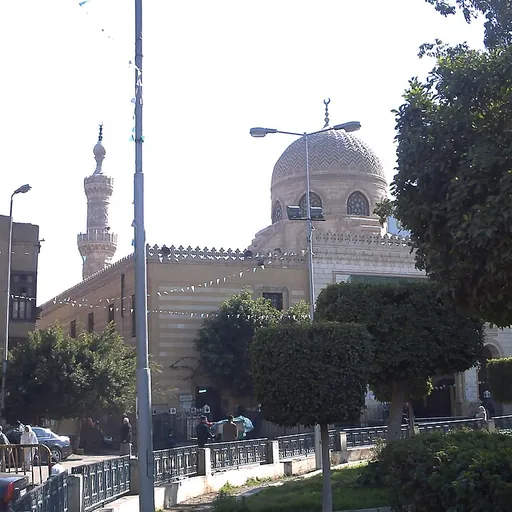
About Sayyida Nafisa
Lived 762 – 824 (aged 61–62). Sayyida Nafisa was an Arab ulema and muhaddith.
Sayyida Nafisa (d. 208 AH / 830 CE), the full name As-Sayyidah Nafīsah bint Amīr al-Muʾminīn Al-Ḥasan al-Anwar ibn Zayd al-Ablaj ibn Al-Hasan ibn ʿAlī ibn Abī Ṭālib al-ʿAlawiyyah al-Ḥasaniyyah , was a female descendant of the Islamic prophet Muhammad, and a scholar and teacher of Islam. Having taught Sunni Imam Muhammad ibn Idris ash-Shafi'i, she is the best known female scholar of hadith in Egypt.
Biography She was born in Mecca around 762 A.D, the daughter of Al-Hasan al-Anwar, the son of Zayd al-Ablaj, the son of Al-Hasan, the grandson of Muhammad. She spent her later life in Cairo, where there is a mosque that bears her name.
Her students came from faraway places, and among them was Al-Shafi'i, the man behind the Shafi'i school of Sunni fiqh. She financially sponsored his education for him. Ibn Kathir in al-Bidayah wa al-nihayah reports about her the following statement:
She was a wealthy lady, did a lot of favors to the people, especially those paralyzed, those with severe illness, and to all other ill people. She was devout, ascetic, and of abundant virtue. When Imam al-Shafi'i arrived in Egypt, she did good to him, and sometimes Shafi'i led her in prayers in Ramadan.|Ibn Kathir It is said that al-Shafi'i, after coming to Cairo, called upon Nafisa to hear hadiths from her, and that it was not possible that he was without the influence of knowledge and personality of Nafisa, since he had been a frequent guest in her house, a listener of her lectures in her mosque, and as it is reported by the historians, asked for her invocation (Duʿāʾ) and sought for blessings (Barakāt) from her.
Ascetic way of life and miracles It is reported that Nafisa has been living an ascetic way of life. Zainab, her niece, had witnessed that her aunt ate once per three days and kept an empty basket with her, each time she wanted to eat something small, she put her hand inside and found something sent from Allah. Once being moved by the way of life led by Sayyida Nafisa, Zainab asked her aunt: "You must take care of yourself." On that, she replied "How shall I take care of myself before I reach my Lord? Ahead of me are so many barriers which no one can cross except the successful ones (al-fāʾizūn, )."
After her death, one accident had happened. Some thieves entered her mosque and took sixteen silver lamps. They wanted to escape immediately but failed to find the doors. They were trapped as if they were in a cage. The next morning, they were found and put into prison. In addition, this was one of the five mashhads sponsored for female relatives of the prophet during the Fatimid caliphate. The other four shrines were devoted to Sayyid Ruqayya, Sayyid Zaynab, Umm Kulthum, and ‘Atika.
Don’t just read it —
keep it.
Full-length biographies made to live with: read them, listen on the way to work, watch them tonight.
- E-book
- Audio
- Video
Instant download · yours to keep · every purchase keeps this site free
Important facts
People in Sayyida Nafisa's life
Named in this biography and alive at the same time
Related people
Same field, nearest in time




Contemporaries
People whose lives overlapped Sayyida Nafisa's



Frequently asked questions
Who was Sayyida Nafisa?
Muslim scholar
When was Sayyida Nafisa born?
Sayyida Nafisa was born on 9 June 762 in Mecca.
When did Sayyida Nafisa die?
Sayyida Nafisa died in 824 in Cairo.
What was Sayyida Nafisa's occupation?
Sayyida Nafisa was an ulema and muhaddith.
What nationality was Sayyida Nafisa?
Sayyida Nafisa was Arab.
Sources & further reading
Cite this page
APA: Biography.guide. (2026). Sayyida Nafisa. https://biography.guide/sayyida-nafisa/
MLA: "Sayyida Nafisa." Biography.guide, https://biography.guide/sayyida-nafisa/.
Chicago: "Sayyida Nafisa." Biography.guide. https://biography.guide/sayyida-nafisa/.
Data last updated: 2026-09-20 · Spot an error? Report a correction.
Page generated 2026-09-27 05:09 UTC