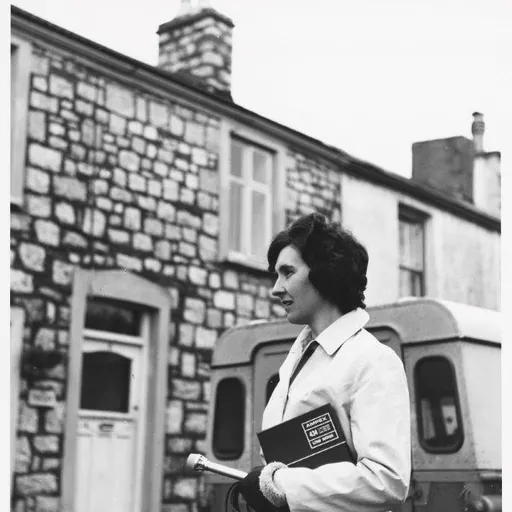
About Sara Minwel Tibbott
Lived 1936 – 1998 (aged 62). Sara Minwel Tibbott was a writer, historian and folklorist.
Sara Minwel Tibbott was an oral historian, anthropologist, folklorist, and researcher on Welsh cuisine.
Tibbott is considered to be a pioneer in the field of women's studies in Wales and an expert in the study of domestic life and traditional foods.
Tibbott was born Sara Minwel Williams. She married Delwyn Tibbott in Crugybar on 2 April 1960.
Career
Tibbott was an assistant keeper at the Department of Oral Traditions and Dialects at St Fagans National Museum of History. Through her fieldwork across Wales she collected and recorded Welsh folk life for the museum for it to be made available to people interested in Welsh life.
With the introduction of the tape recorder it became possible for Tibbott and the museum to record people speaking about their lives. By collecting such recordings Tibbott helped the museum to build an archive of oral recollections of traditional Welsh life. The collection is now kept in the archives as taped interviews or in manuscript form and is available on the museum's web site.
Writing
Tibbott contributed to the museum's programme of publications on Welsh life with Welsh Fare. The book was published in the Welsh language in 1974 and an English language edition followed in 1975. The book is based on oral evidence collected by Tibbott from speakers throughout Wales who supplied information concerning traditional Welsh cuisine. The book contains a selection of recipes and background commentary on them. The commentary is academic in nature and explains the role the recipes have had in the history of food in Wales. In 2017 the book was published on the museum's web site.
In the book Domestic Life in Wales, Tibbott wrote about specific aspects of the folk life of Wales. The book was seen by the Western Mail (Wales) as breaking new ground in the study of folk life in Wales. The book also demonstrated the variety and depth of Tibbot's research, it covers the social and cultural history of Wales, folk life and food history and is based on oral and documentary evidence from a variety of sources and periods. The book contains eight chapters on different elements of folk life. In 'Liberality and Hospitality', Tibbot analysed the importance of food as a social factor through the ages. In 'Laundering in the Welsh Home', Tibbott wrote about the time before washing machines, when laundry was a major domestic task. In 'Sucan and Llymru', the sour oatmeal-based 'jelly' produced in Wales is analysed. In 'Cheese-making in Glamorgan' the women's task of cheese-making and its contribution to farming income is discussed. In 'Traditional Breads of Wales', Tibbott writes about the making of home-made bread. In the section 'Going Electric', Tibbott records the changes that modernised the farmhouse kitchen and the suspicion around it. In 'The Covering of Table Legs in (South-East) Wales', a series of photographs demonstrates this unusual tradition. In the final chapter, 'Knitting Stockings in Wales', Tibbott discussed the economic value of knitting and the implements connected with it. Tibbott died before she completed her work and Beth Thomas, Keeper of Social and Cultural History at the museum completed the work.
In her review of the book, for the Welsh Books Council, Susan Passmore commented:
In the book O'r Gwaith I'r Gwely: A Woman's Work, Tibbott (and Beth Thomas) used women's recollections from the Sound Archive at the Museum of Welsh Life to show what women's lives were like during the twentieth century. The book shows the skills, effort and many hours of labour needed to run a home.
Tibbot contributed to scholarly journals such as Folk Life, where in 1981 she published her article on Laundering in the Welsh Home.
Tibbott also published in Welsh, including a book on kitchen terminology: Geirfa'r gegin: Casgliad o dermau yn ymwneud â pharatoi a choginio bwyd.
List of books Welsh Fare, A Selection of Traditional Recipes, National Museum of Wales (Welsh Folk Museum), 1976. Cooking on the Open Hearth, National Museum of Wales (Welsh Folk Museum), 1982. Geirfa'r Gegin: Casgliad O Dermau Yn Ymwneud a Pharatoi a Choginio Bwyd, Amgueddfa Werin Cymru, Llandysul, 1983. The Gwalia: The Story of a Valleys Shop, National Museums and Galleries of Wales, 1991. O'r Gwaith I'r Gwely: A Woman's Work, National Museum of Wales, 1994. Domestic Life in Wales, University of Wales Press, 2002.
Don’t just read it —
keep it.
Full-length biographies made to live with: read them, listen on the way to work, watch them tonight.
- E-book
- Audio
- Video
Instant download · yours to keep · every purchase keeps this site free
Important facts
Related people
Same field, nearest in time




Contemporaries
People whose lives overlapped Sara Minwel Tibbott's






Frequently asked questions
Who was Sara Minwel Tibbott?
Welsh-born historian
When was Sara Minwel Tibbott born?
Sara Minwel Tibbott was born on 8 February 1936 in Carmarthen.
When did Sara Minwel Tibbott die?
Sara Minwel Tibbott died on 13 October 1998 in Church Village.
What was Sara Minwel Tibbott's occupation?
Sara Minwel Tibbott was a writer, historian and folklorist.
Sources & further reading
· Wikipedia: Sara Minwel Tibbott
Cite this page
APA: Biography.guide. (2026). Sara Minwel Tibbott. https://biography.guide/sara-minwel-tibbott/
MLA: "Sara Minwel Tibbott." Biography.guide, https://biography.guide/sara-minwel-tibbott/.
Chicago: "Sara Minwel Tibbott." Biography.guide. https://biography.guide/sara-minwel-tibbott/.
Data last updated: 2026-09-20 · Spot an error? Report a correction.
Portrait: Wikimedia Commons · author & licence
Page generated 2026-09-27 04:57 UTC