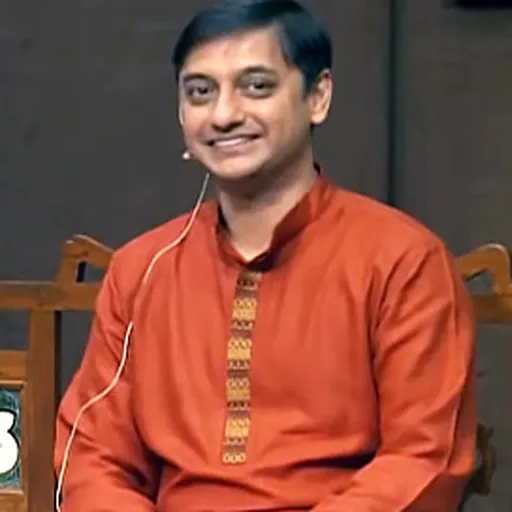
About Sanjeev Sanyal
Born 1970. Sanjeev Sanyal is an Indian economist, environmentalist and writer.
Sanjeev Sanyal (born 27 August 1970) is an Indian economist and popular historian known for writing books based on revisionist Hindutva history A member of the Economic Advisory Council to the Prime Minister of India, he has helped prepare six editions of the Economic Survey of India and has represented India at G7 and OECD meetings. He is also the Chancellor of Gokhale Institute of Politics and Economics, and has written several books on Indian history to mixed reviews.
Early life and education Sanjeev Sanyal was born in Calcutta (now Kolkata) and studied at St. Xavier's School and St. James' School. He received a Bachelor's degree in economics from Shri Ram College of Commerce, Delhi University. He then went to St John's College, University of Oxford, where he received a BA in philosophy, politics and economics in 1992, he was a Rhodes scholar, and received an MSc in Economics in 1994.
Government of India In February 2017, he was appointed as the Principal Economic Adviser to the Indian Ministry of Finance and in that job helped prepare six editions of the Economic Survey of India.
Miscellaneous In 2004, he and environmental economist Pavan Sukhdev created the Green Indian States Trust to promote sustainable development. He has also served on the Future City Sub-Committee of the Singapore government tasked with building a long-term vision for the city-state.
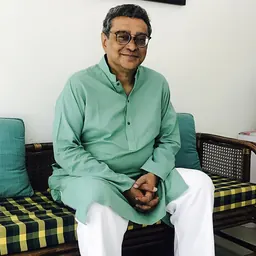
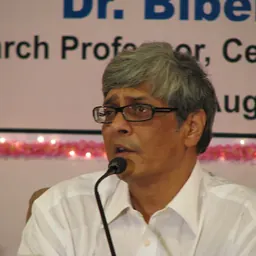
In March 2023, Sanyal led the first edition of the Delhi University Literature Festival as its patron, alongside Swapan Dasgupta as the festival director. On 7 October 2024, he was appointed as the Chancellor of the Gokhale Institute of Politics and Economics (GIPE), replacing Bibek Debroy. On 4 April 2025, it was reported that Sanyal was removed by GIPE, however, the institute's social media account on X (formerly Twitter) denied this report.
Views Sanyal has been a vocal critic of Nehruvian socialism, which he deems to have stemmed from an "inward-looking cultural attitude". Nehru and P. C. Mahalanobis are criticised by Sanyal for treating the economy as a "mechanical toy", leaving little scope for the "flourish of private enterprises", and ultimately "throttling creativity".
Sanjeev Sanyal called India’s judicial system the "single biggest hurdle" to achieving “Viksit Bharat”(Developed India) by 2047, citing the "99-1 problem" where regulations get overcomplicated to prevent 1% misuse due to slow dispute resolution. He criticised colonial legacies like “my lord” terminology for the judges, "prayer" terminology for petitions, long court vacations that halt the whole system, and compulsory pre-litigation mediation that fails 98–99% of the time while adding delays. He urged urgent judicial reforms and warned India has just 20–25 years to use its demographic dividend before ageing like Japan and Europe.
Sanyal says that the primary goal of September 2025 GST rate cuts is to enhance economic efficiency by simplifying the tax system, not just one-time savings. He emphasising the need for public pressure to ensure businesses pass benefits to consumers. He champions "process reforms," which are small, meticulous, sectoral changes crucial for improving the ease of doing business.
Sanyal argues that it has been his long-standing view that H-1B visas primarily benefit the US companies, questioning why India negotiates for these long-term visas when it primarily benefits foreign companies. Instead, the foreign countries should be negotiating it with India, not vice versa. It has "entirely been unclear" to him how it benefits Indians. Giving it up as a negotiating point to foreign countries, when the IT sector can "work from anywhere", is not beneficial to India. A host of other sources are invoked to compare Ashoka with "modern day fundamentalists", whose Dhaṃma Mahāmātās were "religious police"; the famed edicts about religious tolerance are read as propaganda. Shiv Visvanathan, a social anthropologist specialising in science and technology studies, praised the same work for being a feisty, combative, and comprehensive history of the Indian Ocean aimed at a general audience; like Pillai, he commended the "devastating" reconstruction of Ashoka and recovering figures from the margins of history. (Sanyal objects to this.) Academic historians have rejected Sanyal's revisionism. Meera Visvanathan, a historian of ancient India, finds him ignorant of methodologies in historical research. R. Mahalakshmi, a historian of ancient India at Jawaharlal Nehru University, held Sanyal's reinterpretation of Ashoka to be entirely lacking in "contextual understanding" of the King and a politically motivated endeavour on the overall.
Sanyal has been accused of unfairly blaming the judiciary for India’s failures, while failing to question the actions or inaction of the government and Parliament, including outdated laws, misconceived new laws, inadequate infrastructure, the government’s own frivolous litigation, and broader deficits in the rule of law, all of which place immense pressure on the understaffed judiciary.
Honours Sanyal was awarded an Eisenhower Fellowship in 2007 for his work on urban issues. Sanyal has been a fellow of the Royal Geographical Society, London, visiting scholar at Oxford University, adjunct fellow at the Institute of Policy Studies (Singapore), and a senior fellow of the World Wide Fund for Nature (formerly World Wildlife Fund). In 2023, he was awarded the KPS Menon Memorial Award for 2023 for his contributions to economic policy-making and public service.
Works
Books The Indian Renaissance: India's Rise After A Thousand Years of Decline, World Scientific, 2008, 264 p. Land of the Seven Rivers: A Brief History of India's Geography, Penguin, 2013, 192 p. The Incredible History of India's Geography, Penguin, 2015, 264 p. The Ocean of Churn: How the Indian Ocean Shaped Human History, Penguin, 2017, 324 p. Life over Two Beers and Other Stories, Penguin, 2018, 232 p. India in the Age of Ideas: Select Writings, 2006-2018, Westland, 2018, 318 p. Revolutionaries : The Other Story of How India Won Its Freedom, HarperCollins India, 2023, 364 p. The Incredible History of The Indian Ocean, Penguin, 2020, 298 p.
Columns Sanyal is an occasional columnist for the Hindustan Times, Project Syndicate, The Economic Times, Live Mint, Business Standard, Swarajya, and several other publications.
Don’t just read it —
keep it.
Full-length biographies made to live with: read them, listen on the way to work, watch them tonight.
- E-book
- Audio
- Video
Instant download · yours to keep · every purchase keeps this site free
Important facts
People in Sanjeev Sanyal's life
Named in this biography and alive at the same time


Related people
Same field, nearest in time


Contemporaries
People whose lives overlapped Sanjeev Sanyal's


Frequently asked questions
Who is Sanjeev Sanyal?
Indian economist
When was Sanjeev Sanyal born?
Sanjeev Sanyal was born on 27 August 1970 in Kolkata.
What is Sanjeev Sanyal's occupation?
Sanjeev Sanyal is an economist, environmentalist and writer.
What nationality is Sanjeev Sanyal?
Sanjeev Sanyal is Indian.
Sources & further reading
Cite this page
APA: Biography.guide. (2026). Sanjeev Sanyal. https://biography.guide/sanjeev-sanyal/
MLA: "Sanjeev Sanyal." Biography.guide, https://biography.guide/sanjeev-sanyal/.
Chicago: "Sanjeev Sanyal." Biography.guide. https://biography.guide/sanjeev-sanyal/.
Data last updated: 2026-09-20 · Spot an error? Report a correction.
Portrait: Wikimedia Commons · author & licence
Page generated 2026-09-27 04:58 UTC