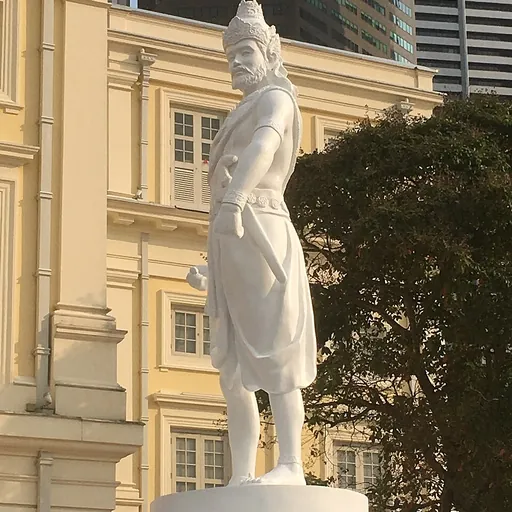
Sang Nila Utama
Raja of Singapura
About Sang Nila Utama
Lived 1201 – 1347.
Light mapping projection show during the Singapore Night Festival 2023 retelling the legend of Sang Nila Utama. Sang Nila Utama was a prince from Palembang and is the founder of the Kingdom of Singapura in 1299. His official title adopted upon his coronation was Sri Tri Buana , which can be translated as "Lord of Three Worlds"; the "Three Worlds" may refer to the three realms of the universe—the heaven of the gods, the world of humans, and the underworld of demons or his lordship over Java, Sumatra and Temasek/Singapura. This title is attested to elsewhere in Southeast Asia.
Sang Nila Utama died in 1347 and his son, Sri Wikrama Wira succeeded him. Malay Annals stated that the name of the founder of Singapore was Sri Tri Buana, who was later associated with the Maharaja of Bhumi Malayu, Srimat Tribhuwanaraja Mauli Warmadewa. The account of his life and those of his successors is given in the Malay Annals; the historicity of the events as recorded there is debated by scholars, and some contend that Sang Nila Utama may be a mythical figure, even if the historicity of Singapore's 14th-century settlement is no longer disputed.
Biography
Sang Nila Utama was a Prince of Palembang, born to King Sang Sapurba, supposed descendant of Rajendra I through his interpretation in Islamic legend as Iskandar Zulkarnain and the pseudo-mythical ancestor to many monarchs and chiefs of the Malay world. He was wed to Princess Wan Sri Bini, the daughter of Permaisuri Iskandar Syah, the Queen of the on Bintan Island, and received high honours comprising a golden crown studded with precious stones and a royal signet ring indicating his authority. He held the title Chakravatin of Indo-pura during his reign
He landed safely on the beach, and went to hunt wild animals near the river mouth on a patch of open ground, now referred to as the Padang. Suddenly, he saw a strange animal with a red body, black head and a white breast, which swiftly disappeared into the jungle. Impressed by this beast's beauty, he asked his chief minister Demang Lebar Daun what animal it was and was informed that it was a lion. Pleased with this as he believed it to be a good omen, he decided to build his new city in Temasek. He and his men stayed on the island and founded a city, renaming the island to Singapura, which in Sanskrit means "Lion City".
Personal life Sang Nila Utama fathered two sons with Wan Sri Bini, born Raja Kechil-Besar and Raja Kechil-Muda the elder son was married to Nila Panchadi, a princess from India and the younger was married to his cousin, a granddaughter of Demang Lebar Dawn. After ruling Singapura for 48 years, Sang Nila Utama died in 1347 and Raja Kechil-Besar ascended to the throne as Sri Wikrama Wira, becoming the second Raja of Singapura; Kechil-Muda was appointed his prime minister and Bendahara of its port. Sang Nila Utama was buried on Bukit Larangan, now known as Fort Canning Hill; the exact location of his grave is unknown, although the altar at Keramat Iskandar Shah may share a site with the royal burials atop the hill.
Interpretation The events in the tale of Sang Nila Utama are highly symbolic and are unlikely to be sober retellings of historical events. The casting of the crown into the sea, an action imbued with symbolic meaning as "sovereignty" in the Malay world relied strongly on ceremony and attire, could represent the shift of power from Palembang to Singapura as the new centre of power for the Malay kings. Another candidate for the beast mentioned in the Malay Annals is mythical beast called janggi told in Minangkabau legends as a guardian of gold mines. Dark red hair called rambut janggi, said to be of this mythical beast but probably actually from orangutans, adorn lances that were kept by the Minangkabaus as heirlooms. Regardless of the exact species of animal, the symbolism of the Asiatic lion as an emblem of power was strongly established through the spread of Buddhist culture in Southeast Asia. With regards to the historicity of settlement on Singapore itself, it remains debated if a 3rd-century Chinese account of a locality named Pu Luo Zhong refers to the main island of Singapore, Pulau Ujong. Nevertheless, other settlements such as Long Ya Men and Ban Zu on the island of Dan Ma Xi (assumed to be a transliteration of Temasek), along with their governance by local rulers, are recorded by the Yuan Dynasty Chinese traveller Wang Dayuan in his Daoyi Zhilue and later Ming Dynasty records.
Identification with Parameswara A keramat erected on Fort Canning Hill to memorialise Iskandar Shah, the last Raja of Singapura commonly identified with Parameswara due to commonalities in their biographies.
Although the archaeology of Singapore has lain rest to the idea that its 14th-century history is wholly fictional, Confusing matters further is that "Parameswara", deriving from the Sanskrit for "Supreme Lord", was a highly popular title amongst contemporary rulers both in mainland and archipelagic Southeast Asia.
Parameswara's rule, unlike Sang Nila Utama's, involves deceit and treachery, namely assassinating its local ruler after enjoying his hospitality for nine days, and unlike Sri Tri Buana's illustrious settlement is terminated almost immediately by the Siamese superiors of this murdered chieftain. The conquest of Singapore forces him to flee to the Malay Peninsula, eventually leading to the establishment of the Melaka Sultanate; the destruction of Singapore is instead blamed on a king known as Iskandar Shah, the fifth Raja of Singapura and fourth successor to Sang Nila Utama, and the island's conquerors are identified as Javanese of Majapahit.
The 1299 was not a date from the Sejarah Melayu but a proposition made by William Linehan in 1947. The colonial historian had assumed Parameswara to be Iskandar Shah, the fifth and last king of Singapura described in Sejarah Melayu. Taking a Chinese announcement of Parameswara’s death in 1414, and considering it to have happened the year before (i.e. 1413), Linehan worked backwards using the combined duration of reigns of the five Singapura kings in the Raffles 18 (114 years) to arrive that Sang Nila Utama was made king in 1299.
Linehan's theory was long discredited by Wang Gungwu's verification that Parameswara and Iskandar Shah were not the same persons, but father and son, as the Ming dynasty records stated. The Chinese reported Iskandar Shah's death in 1424.
Don’t just read it —
keep it.
Full-length biographies made to live with: read them, listen on the way to work, watch them tonight.
- E-book
- Audio
- Video
Instant download · yours to keep · every purchase keeps this site free
Important facts
Family & relationships
People in Sang Nila Utama's life
Named in this biography and alive at the same time

Contemporaries
People whose lives overlapped Sang Nila Utama's





Frequently asked questions
Who was Sang Nila Utama?
Raja of Singapura
When was Sang Nila Utama born?
Sang Nila Utama was born in 1201 in Sumatra.
When did Sang Nila Utama die?
Sang Nila Utama died in 1347 in Singapore.
Sources & further reading
Cite this page
APA: Biography.guide. (2026). Sang Nila Utama. https://biography.guide/sang-nila-utama/
MLA: "Sang Nila Utama." Biography.guide, https://biography.guide/sang-nila-utama/.
Chicago: "Sang Nila Utama." Biography.guide. https://biography.guide/sang-nila-utama/.
Data last updated: 2026-09-23 · Spot an error? Report a correction.
Portrait: Wikimedia Commons · author & licence
Page generated 2026-09-27 05:07 UTC