
Sandy Petersen
American game designer (born 1955)
About Sandy Petersen
Born 1955. Sandy Petersen is an American game designer, role-playing game designer, board game publishing company and video game designer.
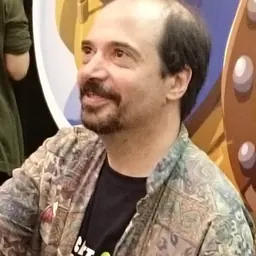
Carl Sanford Joslyn "Sandy" Petersen (born September 16, 1955) is an American game designer. He worked at Chaosium, contributing to the development of RuneQuest and creating the acclaimed and influential horror role-playing game Call of Cthulhu. He later joined id Software where he worked on the development of the Doom franchise and Quake. As part of Ensemble Studios, Petersen subsequently contributed to the Age of Empires franchise.
Biography Petersen was born in St. Louis, Missouri and developed a love for dinosaurs at age 3. He studied zoology at Brigham Young University and later attended the University of California, Berkeley, majoring in entomology.
Petersen started role-playing when TSR first released Dungeons & Dragon, playing the first edition with friends in 1974. In 1978, when RuneQuest was published by Chaosium, Sandy switched to RuneQuest as his primary game, instead.
Career Over a career spanning more than four decades, he has served as author, designer, developer, or producer on more than 100 published games, with combined sales exceeding 36 million copies. Widely regarded as the founder of Lovecraftian gaming, he is credited with inventing a substantial portion of the established canon within the modern Cthulhu Mythos.
He has received more than 70 industry awards, including induction into the Origins Game Designer Hall of Fame, and was voted “Favorite Designer” in the 1994 Gamer’s Choice Awards—an honor given annually to a single recipient selected by fan vote.
Work Chaosium After a friend encouraged Petersen to write to Greg Stafford with ideas for new RuneQuest material, the two quickly became friends. In 1980, Sandy’s first publication, the Gateway Bestiary, was released. This RuneQuest bestiary featured a section on giant insects—reflecting his graduate studies in entomology—as well as a section on Lovecraftian monsters, marking the first appearance of Lovecraft creatures in any role-playing game.
Between 1979 and 1981, Petersen wrote or contributed to numerous Chaosium publications, including substantial collaboration with Greg Stafford on the seminal Trollpak for RuneQuest.
Petersen became a full-time staff member at Chaosium in 1982. His interest for role-playing games and H. P. Lovecraft were fused when he became principal author of Chaosium's game Call of Cthulhu, published 1981, and many scenarios and background pieces thereafter.
He authored several critically acclaimed RuneQuest supplements for Avalon Hill and Games Workshop.
Sandy was on the team which developed Sid Meier’s Civilization. One of his contributions was to make unemployed people appear as “Elvis”, and that you can change them to be “Einsteins” instead. He has stated in multiple interviews that Lightspeed (and its sequel Hyperspeed) is the only game in his entire career as an employee, when he was allowed to freely choose the game’s theme and create its universe from whole cloth.
Id Software Petersen was hired by id Software in August 1993. During his interview, John Romero introduced him to DoomEd and simply asked him to build a level. Romero was ultimately happy with the results, so Petersen was brought on to production for Doom. The level from Petersen's interview eventually became "E2M6". He was a fast level designer and produced all maps for the third episode of Doom, Inferno. Petersen designed 20 of the 27 levels in Doom and 17 levels of the 32 for Doom II. An 18th, "Dead Simple", was redesigned by American McGee before release.
In interviews Sandy frequently repeats that the design of Doom and Doom II were group efforts, and even the artists and programmers contributed. For example, he credits John Carmack with suggesting to him the idea of using the rocket launcher on yourself to find the secret exit in map E3M6.
Petersen considered his main job at id was to make the game fun. Beyond designing the majority of levels for the first two Doom games, he determined the names for demons, items, degrees of difficulty and levels and determined map order. He wrote the text of the Doom manuals although the original story idea for Doom is credited to Tom Hall. He also wrote the text that appears between levels and at the end of game, as well as the text which appears when you pick up items or exit the game. He also suggested to the team to modify the BFG 9000’s such that it became a smart bomb instead of an upgraded plasma gun which is what it was prior to release.
Petersen was then involved with The Ultimate Doom in 1995 as well as the R&D phase for Quake. At the time, Quake was based on an id staff D&D campaign. Petersen was enthusiastic about the project, though he had not been a player in the original campaign as it was before his arrival at the company. With id Software's designers waiting for the Quake engine to be ready for its design team, the studio sent Petersen to work temporarily at Rogue Entertainment, which was licensing the Doom engine to develop Strife. Romero also credits Petersen with coming up with the title for the Hexen expansion Deathkings of the Dark Citadel. When Quake was reformulated as a first-person shooter in late 1995, id removed Petersen from the Strife team to focus on the game. The revised Quake storyline is credited to Petersen, along with seven levels.
Beyond writing the storyline, Petersen played a major role in incorporating Lovecraftian and Cthulhu Mythos elements into Quake, including naming the final boss Shub-Niggurath and creating the Shamblers and Spawn, whose designs were inspired by creatures depicted in S. Petersen’s Field Guide to Cthulhu Monsters.
Late in Quake’s development, tensions arose among several key members of the id Software team, ultimately leading to the departure of John Romero. Petersen considered Romero the colleague he was closest to at id, and his exit had a profound impact on him. By June of the following year, Petersen chose to resign as well. Before leaving, he successfully advocated for the hiring of his friend Jennell Jaquays (then Paul) as his replacement. There, he worked as a game designer on several of their Age of Empires titles, including Rise of Rome, Age of Kings, and The Conquerors.
Petersen served as lead designer on all three Age of Empires expansion packs—Rise of Rome, The Conquerors, and The WarChiefs.Across the core Age of Empires series (Age of Empires I, II, and III), his primary responsibilities included designing the single-player campaigns, writing the scripts for the computer-player AI, overseeing unit and civilization balance, and creating the unique units for each civilization.
Other works Petersen frequently appears as guest of honor for industry conventions in the US, Europe, Australia, and Japan. He has never charged a fee to be a guest of honor or to contribute to seminars, speaking engagements or to run games and events. he served as the publisher of horror magazine Arcane: Penny Dreadfuls for the 21st Century.
Petersen took a professorship at The Guildhall at SMU in 2009 following the closure of Ensemble Studios, where he taught several courses on game design.
Petersen co-designed the design curriculum at The Guildhall with Jennell Jaquays. He also taught the central game design principles course that all Guildhall students must take (whether they be designers, artists, coders, or producers).
In mid-2013, Petersen led a successful Kickstarter campaign by his company, Green Eye Games, to produce the boardgame Cthulhu Wars. Over US$1,400,000 was raised achieving over 3,500% of the initial target. This success allowed the creation of more figures (60), map expansions and additional scenario options. Green Eye Games also produced the unsuccessful Kickstarter campaign for Cthulhu World Combat (iOS, Android, Windows, PSN, Xbox Live).
In June 2015, it was announced that Petersen and Greg Stafford returned to Chaosium Inc. Petersen retired from the board in 2019, and now runs his own game company.
Petersen runs a website, Petersen Games, where he had sold various tabletop games, often based on his work with Call of Cthulhu. As part of his ongoing work with Call of Cthulhu content he has published sourcebooks for Dungeons and Dragons 5e, Pathfinder, and Pathfinder 2e. Those books adapt the Cthulhu mythos for those systems to allow for several mythos-based player character options, many monsters, new insanity rules, and much more. He can also be regularly seen on his YouTube channel, "Sandy of Cthulhu," where he speaks on subjects such as boardgames, roleplay adventures, his own personal works, his time with Id Software, tips on gameplay, advice on game design, authors, Lovecraftian horror, movies, and his love of fiction in general.
In 2024 he partnered with Quimbly's Toys and Games. to continue publishing his games. As of March, 2025, this partnership has ended and his company, Petersen Games once again publishes and sells games directly.
Post-2015, Petersen focused heavily on board game design, particularly titles inspired by the Cthulhu Mythos. Significant releases include Cthulhu Wars (2015) , Theomachy (2016) , Orcs Must Die! (2016), Dicenstein (2017), Evil High Priest (2018) , The Gods War (2018) , Hyperspace (2019), and Planet Apocalypse (2020). Petersen Games, his company, continues producing expansions and new titles, often with family involvement.
Petersen’s earlier work on Doom (1993–1994) remains a point of public discussion, with a 2025 report highlighting an ongoing social media dispute with John Romero regarding credit for the original story. He also contributed to Age of Empires II: The Conquerors (1999), particularly in level design and historical content. In recent reflections, Petersen shared that Microsoft’s forced addition of Koreans to the game led to historical inaccuracies and controversy in South Korea.
Petersen emphasizes investigative gameplay over combat in games inspired by Lovecraft’s mythos, a principle that shaped Call of Cthulhu and continues to influence his board games. He remains active in public events, including the Celsius 232 festival in Avilés (2025) , where he demonstrated gameplay, shared design insights, and played alongside fans. Superworld 1982 Larry Niven’s Ringworld 1984 Elfquest 1984 Runequest III 1984 Hawkmoon 1986 Ghostbusters 1986 Stormbringer 3rd edition 1987 Arkham Horror 1987
Awards Since 2015, Petersen has continued to receive recognition for his contributions to role-playing games. Notably, Horror on the Orient Express won the ENnie Awards for Best Adventure (Gold) and Best Production Values (Silver) and was nominated for Product of the Year in 2015. The same year, The Guide to Glorantha received a Silver ENnie for Best Cartography, was nominated for Product of the Year, and won the Diana Jones Award for Excellence in Gaming. In 2024, Call of Cthulhu was inducted into the ENnie Awards Hall of Fame, cementing its status as a foundational RPG. 1986 – H.G. Wells Award (Origins): Best Role Playing Rules (Ghostbusters) 1988 – Origins Award: Best Fantasy Boardgame (Arkham Horror) 1990 – Origins Award: Hall of Fame (Sandy Petersen) 1995 – Origins Award: Hall of Fame (Call of Cthulhu) 2014 – Lovecraft Film Festival: The Howie, for outstanding lifetime achievement in promoting the works of H. P. Lovecraft (Sandy Petersen) 2018 – Tabletop Gaming Magazine: Ranked 3rd in “Top 150 Greatest Games of All Time” (Call of Cthulhu)
Don’t just read it —
keep it.
Full-length biographies made to live with: read them, listen on the way to work, watch them tonight.
- E-book
- Audio
- Video
Instant download · yours to keep · every purchase keeps this site free
Important facts
People in Sandy Petersen's life
Named in this biography and alive at the same time






Related people
Same field, nearest in time



Contemporaries
People whose lives overlapped Sandy Petersen's

Frequently asked questions
Who is Sandy Petersen?
American game designer (born 1955)
When was Sandy Petersen born?
Sandy Petersen was born on 16 September 1955 in St. Louis.
What is Sandy Petersen's occupation?
Sandy Petersen is a game designer, role-playing game designer, board game publishing company and video game designer.
What nationality is Sandy Petersen?
Sandy Petersen is American.
Sources & further reading
Cite this page
APA: Biography.guide. (2026). Sandy Petersen. https://biography.guide/sandy-petersen/
MLA: "Sandy Petersen." Biography.guide, https://biography.guide/sandy-petersen/.
Chicago: "Sandy Petersen." Biography.guide. https://biography.guide/sandy-petersen/.
Data last updated: 2026-09-22 · Spot an error? Report a correction.
Page generated 2026-09-27 05:28 UTC