
About Sandrine Heutz
Sandrine Heutz was a researcher.
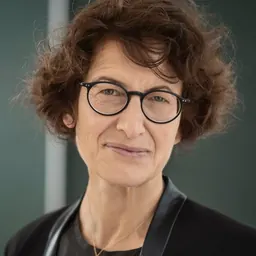
Sandrine Elizabeth Monique Heutz is a Professor of Functional Molecular Materials at Imperial College London. She works on organic and magnetically coupled molecular materials for spintronic applications. In 2008 Heutz was awarded the Institute of Materials, Minerals and Mining Silver Medal.
Early life and education Heutz studied chemistry at the University of Liège. She moved to Imperial College London for her doctoral studies, where she worked on thin film heterostructures. During her doctoral research Heutz worked with Dietrich Zahn at Chemnitz University of Technology.
Research and career After earning her PhD degree Heutz worked as a postdoctoral research fellow on solar cells at Imperial College London. She moved to University College London in 2004, where she started work on magnetic biosensors. Heutz joined Imperial College London in 2007 as a Royal Society Dorothy Hodgkin research fellow. Heutz specialises in the use of electron paramagnetic resonance (EPR) to monitor unpaired electrons within materials. She used EPR to monitor spins within copper phthalocyanine solar cells. Whilst working on new materials for photovoltaics, Heutz showed that electrons in copper phthalocyanine (a blue pigment found in a Bank of England £5 note) exist in a superposition of two different spin states. She demonstrated that copper phthalocyanine could be used for quantum computing, where information is stored as qubits as opposed to binary bits. She has shown that at low temperatures (100 K) cobalt phthalocyanine forms molecular structures with strong magnetic alignment. Heutz and her research group have developed flexible thin films of cobalt phthalocyanine for use in spintronic devices. Harrison contributed theoretical models of cobalt phthalocyanine, and demonstrated that by manipulating the angle between adjacent layers of cobalt phthalocyanine it is possible to improve the magnetic properties of the material. This finding explains how cobalt phthalocyanine demonstrates magnetic properties above liquid nitrogen temperatures. She demonstrated that the molecular orientation of pentacene within a solar cell could increase the power output.
Heutz was promoted to professor in 2019. She has appeared on the podcast Scientists Not the Science. Heutz is a member of the London Centre for Nanotechnology and the Henry Royce Institute at the University of Manchester.
Selected publications Her publications include;
Using Self‐Assembling Dipole Molecules to Improve Hole Injection in Conjugated Polymers Potential for spin-based information processing in a thin-film molecular semiconductor Molecular Thin Films: A New Type of Magnetic Switch
Awards and honours Heutz was awarded the 2008 Institute of Materials, Minerals and Mining (IOM3) silver medal for her research on organic thin films. In particular she had developed new electron - donor morphologies for efficient solar cells. Heutz was elected a Fellow of the Royal Society of Chemistry (FRSC) in 2018.
Don’t just read it —
keep it.
Full-length biographies made to live with: read them, listen on the way to work, watch them tonight.
- E-book
- Audio
- Video
Instant download · yours to keep · every purchase keeps this site free
Important facts
Related people
Same field, nearest in time





Frequently asked questions
Who was Sandrine Heutz?
Professor of Functional Molecular Materials
What was Sandrine Heutz's occupation?
Sandrine Heutz was a researcher.
Sources & further reading
Cite this page
APA: Biography.guide. (2026). Sandrine Heutz. https://biography.guide/sandrine-heutz/
MLA: "Sandrine Heutz." Biography.guide, https://biography.guide/sandrine-heutz/.
Chicago: "Sandrine Heutz." Biography.guide. https://biography.guide/sandrine-heutz/.
Data last updated: 2026-09-20 · Spot an error? Report a correction.
Page generated 2026-09-27 04:58 UTC