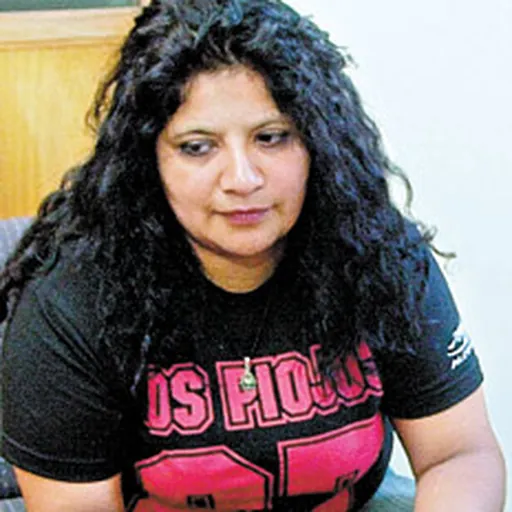
About Sandra Cabrera
Lived 1970 – 2004 (aged 33). Sandra Cabrera was an Argentine trade unionist.
Sandra Cabrera (27 October 1970 – 27 January 2004) was an Argentine street-based sex worker, trade unionist, and campaigner for sex workers' rights. She was murdered in 2004 in Rosario, Argentina by the police. Cabrera was murdered for speaking against the police, accusing them of being involved in organized crime, sexually exploiting minors, and for her defense of street workers' rights threatened brothel owners.
Life Cabrera was born in San Juan, Argentina
in 1970. She moved to Rosario in 1994, leaving two children with her mother. People who met her remember her eyes, dark enough to seem black, a wealth of black hair, and her direct gaze, sometimes interpreted as inquisitive,
sometimes as defiant.
At the time of her murder, she had been planning to travel to another city with a friend to attend a rock festival.
Her first contact with AMMAR (Association of Women Prostitutes of Argentina) occurred in 2000, but she didn't begin working with the union until 2001.
I was working in a corner of the Terminal area and a group of pimps and bouncers from a bar in the area beat me up pretty badly. I reported that in the media and there the girls from Buenos Aires showed up. At first I didn't take them seriously, but the following year, when a group of police beat up another coworker in the south area, we began to work with everything. — Sandra Cabrera but she also acknowledged Cabrera's effectiveness:
She cared about the others, the injustices spurred her on, she got what she wanted.
During Sandra Cabrera's murder investigation, a source inside the investigation told a news reporter that Cabrera had been defending herself on three fronts: the violence and risk of working on the street, the assaults arranged by the brothel businesses she and her independent street colleagues were competing with, and the harassment and threats from the police whose graft networks she was disrupting.
As part of her campaign for sex worker rights, Cabrera fought for the elimination of the articles of the provincial Misdemeanor Code that criminalized prostitution.
Following the complaint, some of the bars the two police chiefs had been protecting closed, and a few others stopped making payments to the police. One of the sex workers who joined Cabrera in the complaint testified during the murder investigation that Cabrera had expressed fear that the police would retaliate. Her body was two blocks from the Omnibus Terminal, There were no scuff marks on her sandals or clothes, indicating that she had not been dragged, but had been killed where she was found.
The investigating judge laid out three lines of investigation: she was killed by a client, she was killed by the brothel owners, or she was killed by the police. killed because they wanted to leave their pimps, who were paying the police.
The Santa Fe police killed the social activist Claudio Lepratti during the disturbances of 2001 when he tried to warn them off from firing at a school where children were eating lunch. At Cabrera's funeral procession, the AMMAR members shouted "We know, we know, that our colleague was killed by the police." On appeal, the judge's decision was overturned, and neither Parvlucyk nor anyone else has been tried for Cabrera's murder.
Public Morality police unit If the police were, in fact, trying to send a message to the new provincial administration, it backfired. Cabrera's murder gave the government the political cover it needed to eliminate the Public Morality section of the provincial police. High on the list of her legacies is the fact that two days after her murder, the Santa Fe Minister of Government announced that the Public Morality section would be dissolved and the officers that served in it would be distributed among different units. He said that the move had been under consideration since the beginning of the new administration:
But he acknowledged that he was making the announcement in the context of Cabrera's murder.
Misdemeanor Code On the other hand, the government wanted to amend, rather than repeal, the articles of the Misdemeanor Code that criminalized sex work and transgenderism. The political opposition favored straight repeal, but the government was concerned about voter reaction and opposition from the Church. While she didn't live to see the victory, she was part of the fight, and it was a more fundamental restructuring of society's relationship with sex work than eliminating a police unit.
Rosario Walter Miranda, who had been removed as chief of the Public Morality unit following Cabrera's complaint because he had been providing protection to brothels that trafficked underage girls and foreign women, as well as extorting bribes from street-based sex workers, continued to advance through the ranks. By 2012 he had become head of Regional Unit II, which gave him control of all provincial police forces in the city of Rosario. The brothels in the area around the bus terminal that he had been protecting were still there. During an investigation of trafficking in humans, a phone tap of one of the brothel owners recorded the owner asking how to go about selling cocaine. The answer was that he should bribe Hugo Tognoli, the highest ranking police officer in the province of Santa Fe. Laura Cosido, a judge in the Federal Chamber of Rosario, stated that "There was never such an open relationship between narcos and police." AMMAR, Cabrera's union, complained that the drug and human trafficking networks were the same.
Around the same time, Claudia Lucero was complaining that in spite of the revocation of the articles of the Misdemeanor Code that criminalized street prostitution, the police were still finding ways to extort money from street workers.
Shortly thereafter, sex work in Rosario went through the same change in law and enforcement that the rest of Argentina experienced. The anti-trafficking law, passed a few years earlier, began to be enforced consistently, ending the legal regulation of brothels by municipalities. One of the last cabarets in Rosario was closed when city inspectors found an entertainer performing oral sex on a customer. Announcing that they were closing the place, the inspectors were attacked by the madame and the female employees, who threw glasses and punched and kicked the inspectors. Driven into the street, they took refuge in a local bar where the women found them and again attacked, throwing and breaking tables and stealing the tape used to officially seal a closed business. Not everyone in Argentina embraced the new anti-trafficking regime.
Some of the women who had worked in the cabarets and whiskerías that fronted for brothels moved to private apartments operated by the same type of people who had operated the brothels.
The motels that once rented to independent sex workers now turn them away in order to avoid problems with the city. In response, some of the women have organized casitas, where a group of women rent a house and set aside a part of the earnings from each client session to cover the rent. Basically, women who were previously working in brothels are still working in brothels, and women who were previously independent are still independent. Georgina Orellano, secretary general of AMMAR as of 2017, says of the new legal regime that "It took all the activity to a much darker and hidden place." Another march in Rosario a month later was described in the same terms and included the same civic groups.
These marches have been repeated over the years on the anniversary of her murder, up to the present.
In 2012 the director Lucrecia Mastrangelo released a film titled, Sex, dignity and death: Sandra Cabrera, unpunished crime.
In 2017, a small public square in the area around the bus terminal where she had worked was named in her honor.
Don’t just read it —
keep it.
Full-length biographies made to live with: read them, listen on the way to work, watch them tonight.
- E-book
- Audio
- Video
Instant download · yours to keep · every purchase keeps this site free
Important facts
People in Sandra Cabrera's life
Named in this biography and alive at the same time

Related people
Same field, nearest in time




Contemporaries
People whose lives overlapped Sandra Cabrera's

Frequently asked questions
Who was Sandra Cabrera?
Argentinian trade unionist (1970-2004)
When was Sandra Cabrera born?
Sandra Cabrera was born on 27 October 1970 in San Juan.
When did Sandra Cabrera die?
Sandra Cabrera died on 27 January 2004 in Rosario.
What was Sandra Cabrera's occupation?
Sandra Cabrera was a trade unionist.
What nationality was Sandra Cabrera?
Sandra Cabrera was Argentine.
Sources & further reading
Cite this page
APA: Biography.guide. (2026). Sandra Cabrera. https://biography.guide/sandra-cabrera/
MLA: "Sandra Cabrera." Biography.guide, https://biography.guide/sandra-cabrera/.
Chicago: "Sandra Cabrera." Biography.guide. https://biography.guide/sandra-cabrera/.
Data last updated: 2026-09-21 · Spot an error? Report a correction.
Portrait: Wikimedia Commons · author & licence
Page generated 2026-09-27 05:00 UTC