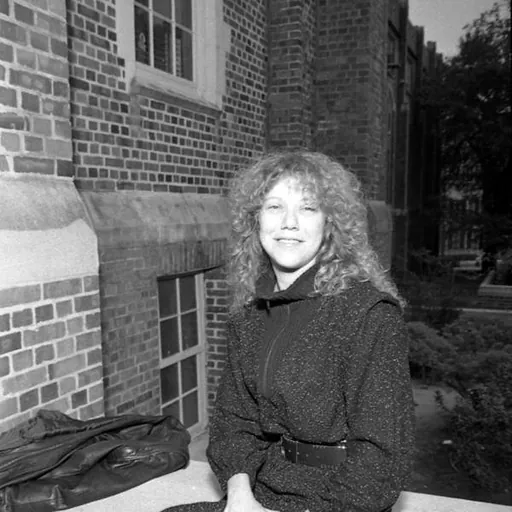
About Sally Banes
Lived 1950 – 2020 (aged 69). Sally Banes was an American writer, historian, critic, university teacher, theatrologist and theatre critic.
Sally Rachel Banes (October 9, 1950 – June 14, 2020) was a notable dance historian, writer, and critic.
Life, education, and performance career
Born and raised in Silver Spring, Maryland, a suburb of Washington, D.C., Banes studied dance, and particularly ballet, throughout her childhood. She attended the University of Chicago and graduated in 1972 with an interdisciplinary degree in criticism, art, and theater. While at college, she worked as a lighting assistant and wardrobe mistress. She also belonged to a group known as The Collective. Joining in 1970, Banes became one of several actors who met several times a week to collaborate on work. These collectively written theater pieces were performed in workshops as well as public performances.
After graduating college, Banes continued to live and work in Chicago. In 1974, she founded the Community Discount Players which was a loosely organized company of actors, dancers, filmmakers, and visual artists. Like The Collective, the Community Discount Players focused on collaboration to produce work and performances. She also founded MoMing, which was a collectively owned theater where actors and dancers could come to teach one another class. It also provided an environment for further collaborative efforts and the performance of these partnerships. This is where she first performed for Kenneth King. She also performed in ‘’Paris/Chacon,’’ a dance-theater collaboration by Meredith Monk and Ping Chong.
In 1976, Banes moved to New York City. She continued exploring the post-modern world and attended workshops with members of Judson Dance. She also performed for Simone Forti, Kenneth King, and Meredith Monk. As she grew older, Banes continued to take dance classes in both Chicago and New York City. She studied ballet with Ed Parish and Peter Saul. She also studied modern with Jim Self, Maggie Kast, and Shirley Mordine as well as taking class at both the Martha Graham and Merce Cunningham studios. At one point she raised $70,000 for an alternative multicultural bicentennial celebration. In 1978 Banes produced a film of Yvonne Rainer's 1966 dance piece "Trio A (The Mind is a Muscle, Part 1)."
While in New York, she continued her education by enrolling in NYU’s Department of Graduate Drama. She earned her PhD with a dissertation on Judson Dance Theater. This dissertation was later published as ‘’Democracy’s Body: Judson Dance Theater, 1962–1964.’’ While doing her doctorate work, she studied under and with some of the biggest names in dance research. Her doctoral advisor was Michael Kirby and she also learned from Deborah Jowitt, John Mueller, Dale Harris, Gretchen Schneider, David Vaughan, and Selma Jeanne Cohen. Some of her classmates were Sally Sommer, Barbara Barker, Brenda Dixon-Gottschild, and Joan Acocella.
Personal life Banes was married to fellow art and film philosopher Noël Carroll. In May 2002 Banes suffered a massive stroke, from which she never recovered. She remained cognitively and physically severely handicapped until her death of ovarian cancer on June 14, 2020. The second conference she presented "The Last Conversation: Eisenstein's Carmen Ballet".
Terpsichore in Sneakers: Post-modern Dance (1987)
This work is a history and critical study of post-modern dance. It specifically focuses on certain choreographers and their styles, motivations, goals, and works. The choreographers include Simone Forti, Yvonne Rainer, Steve Paxton, Trisha Brown, David Gordon, Deborah Hay, Lucinda Childs, Meredith Monk, Kenneth King, Douglas Dunn, and The Grand Union.
Rainer, Simone Forti, Steve Paxton, and other post-modern choreographers of the sixties were not united in terms of their aesthetic. Rather, they were united by their radical approach to choreography, their urge to reconceive the medium of dance. – Sally Banes, Terpsichore in Sneakers: Post-modern Dance
Democracy's Body: Judson Dance Theater, 1962–1964 (1993)
A history of the revolutionary Judson Dance Theater, whose choreographers and works represented the beginning of the post-modern movement, it not only tells the story of Judson Dance Theater but describes the dances produced by those in the group and the dynamics of the group's working relationships.
The choreographers of the Judson Dance Theater radically questioned dance aesthetics, both in their dances and in their weekly discussions. They rejected the codification of both ballet and modern dance. They questioned the traditional dance concert format and explored the nature of dance performance. They also discovered a cooperative method for producing dance concerts... Attracting a grassroots audience of Greenwich Village artists and intellectuals, the Judson Dance Theater affected the entire community and flourished as a popular center of experimentation. – Sally Banes, Democracy's Body: Judson Dance Theater, 1962–1964
Greenwich Village 1963: Avant-garde Performance and the Effervescent Body (1993)
This book focuses on the year 1963 and the changing face of the art world. It specifically focuses on Greenwich Village and the performing arts.
A distinctively twentieth-century, postwar, postindustrialist American avant-garde art: democratic yet sophisticated, vigorous and physical, playful yet down-to-earth, freely mixing high and low, academic and vernacular traditions, genres and media. There was a feeling – so unlike the early 1990s – that all things were possible... and permitted. – Sally Banes, Greenwich Village 1963: Avant-garde Performance and the Effervescent Body
Writing Dancing in the Age of Postmodernism (1994)
This book is an anthology of published and unpublished essays and talks about dance since the 1970s. Through this collection, as well as the evolution of her own writing and style of analysis, Banes explores the evolution of postmodern dance throughout the 60s, 70s, and 80s.
Perhaps to some readers this collection simply will appear to be a mélange. But I am convinced that it is emblematic of postmodernism, in a number of ways. It is, first of all, concerned with crossovers between 'high' and 'low' dance cultures – the avant-garde, the popular, the commercial, and the vernacular. Moreover, it analyzes relationships between mainstream dance and its counterstreams, which contest, challenge, subvert, and undermine the mainstream traditions. In terms of methodology, my approach is postmodernist in that it has a tendency toward the contextual, historical, and ethnographic. It is also concerned with bringing the margins to the center. – Sally Banes, Writing Dancing in the Age of Postmodernism
Dancing Women: Female Bodies on Stage (1998)
Banes' attempts to retell the familiar dance canonical history from the purely feminist perspective. She covers everything from mid nineteenth century Romantic ballet in France and Denmark to historical modern dance of the 1920s, 1930s, and 1940s in Germany and the United States to contemporary ballet from the 1930s to the 1950s in Europe and the United States.
In each chapter I focus on one or several dances, in order to retell the story of Western theatrical dancing from a woman-centered perspective. I analyze of representations of women are constructed in major works of the theatrical dance canon written by both men and women. Setting the creation of these works in socio-political and cultural context, I show that choreographers have created images of women that are shaped by – and that in part shape – society’s continuing debates about sexuality and female identity. I argue that the dance stage has often reflected and reinforced, but has also formed and in some cases criticized cultural conceptions of corporeality – in particular, conceptions of women’s bodies and identities – and that through dance, men’s attitudes toward women and women’s attitudes about themselves are literally given body on stage. – Sally Banes, Dancing Women: Female Bodies on Stage
Subversive Expectations: Performance Art and Paratheater in New York 1976–1985 (1998)
This book is a collection of Banes’ reviews and articles concerning New York performance art and paratheater from 1976 to 1985. These articles were published chiefly in the Village Voice and the SoHo Weekly News, two alternative publications based in New York City. This time period was the height of the performance art genre, which had surpassed other forms of avant-garde to become “the preeminent form of avant-garde art.” This volume contains 90 articles and reviews including those of Yvonne Rainer, Meredith Monk, The Ringling Brothers, and Whoopi Goldberg.
Unlike mainstream theater productions, which can flourish or die according to critical reaction, performance art – usually operating on a shoestring budget or with funding subsidies – did not depend on a critical mass of spectators for economic well-being. And alternative press critics like me certainly did not wield the make-or-break power of the mainstream press. In any case, most of the performances were one-night stands or short runs and had ended by the time my reviews were published. So I felt a certain freedom in knowing that my role as a critic was not that of a judge, arbiter of taste, or consumer guide. Rather, my role was to join a longer-term conversation about performance art in a public yet immediate way. – Sally Banes, Subversive Expectations: Performance Art and Paratheater in New York 1976–1985
Reinventing Dance in the 1960s: Everything was Possible (2003)
This book is a collection of essays analyzing the revolutionary and experimental art world of the 1960s. It consists of eleven essays, including one by Banes herself and a section of choreographers' statements from the White Oak PASTForward project, organized by Mikhail Baryshnikov. These choreographers include Trisha Brown, Lucinda Childs, Simone Forti, David Gordon, Deborah Hay, Steve Paxton, and Yvonne Rainer.
The 1960s was a decade of ferment in the arts, society, and politics. So many things that had been viewed complacently, in a world that seemed always to be the same as it ever was, were suddenly cast in a new light. And this led to a desire to cast off the old ways, to break all the rules, to find new directions and new freedoms. There were no limits, nothing that could not be tried, from rising up to protest injustices like racism, sexism, and the Vietnam War to ingesting mind-expanding drugs to sexual experimentation. – Sally Banes, Reinventing Dance in the 1960s: Everything was Possible
Before, Between, and Beyond: Three Decades of Dance Writing (2007)
This book is a collection of Banes' reviews history of dancers and choreographers. These reviews feature everything from early Bill T. Jones/Arnie Zane performances, to the beginnings of Pilobolus, to the discovery of breakdancing, to the world's introduction to Elizabeth Streb, as a performer.
Many of the emerging artists Banes reviewed are now luminaries of the historical canon... Like all collections of dance reviews, this one not only provides a valuable register of dances and dancers, it also points out the importance and responsibility of dance criticism as it engages with an art form whose history largely exists in movement, in a culture that privileges what can be written down. – Andrea Harris, Before, Between, and Beyond: Three Decades of Dance Writing that continue most recently until 2019, in Scott's A Primer on Aristotle's DRAMATICS (also known as the POETICS), espec. p. 103.
Awards and honors
In 2003, Banes won the Lifetime Achievement Award for her Outstanding Contribution to Dance Research from the Congress on Research in Dance. The Society of Dance History Scholars has also given her a similar lifetime achievement award and Banes has won a Bessie Award for her Lifetime Contribution to Dance Criticism.
Don’t just read it —
keep it.
Full-length biographies made to live with: read them, listen on the way to work, watch them tonight.
- E-book
- Audio
- Video
Instant download · yours to keep · every purchase keeps this site free
Important facts
Family & relationships
People in Sally Banes's life
Named in this biography and alive at the same time




Related people
Same field, nearest in time



Contemporaries
People whose lives overlapped Sally Banes's


Frequently asked questions
Who was Sally Banes?
Dance historian (1950-2020)
When was Sally Banes born?
Sally Banes was born on 9 October 1950 in Silver Spring.
When did Sally Banes die?
Sally Banes died on 14 June 2020 in Philadelphia.
What was Sally Banes's occupation?
Sally Banes was a writer, historian, critic, university teacher, theatrologist and theatre critic.
What nationality was Sally Banes?
Sally Banes was American.
Sources & further reading
Cite this page
APA: Biography.guide. (2026). Sally Banes. https://biography.guide/sally-banes/
MLA: "Sally Banes." Biography.guide, https://biography.guide/sally-banes/.
Chicago: "Sally Banes." Biography.guide. https://biography.guide/sally-banes/.
Data last updated: 2026-09-23 · Spot an error? Report a correction.
Portrait: Wikimedia Commons · author & licence
Page generated 2026-09-27 05:05 UTC