
About Sal Buscema
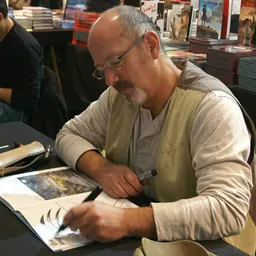
Lived 1936 – 2026 (aged 89). Sal Buscema was an American comics artist, comics creator and draftsperson.
Silvio Buscema was an American comics artist, primarily for Marvel Comics, where he had a ten-year run as artist of The Incredible Hulk and an eight-year run as artist of The Spectacular Spider-Man. He was the younger brother of comics artist John Buscema.
Early life, family and education Born in Brooklyn, New York City, on January 26, 1936, to Sicilian parents, Silvio "Sal" Buscema was the youngest of four siblings. His father, who was born in Italy and died in 1973, was a barber. Sal's brothers were Alfred and John, a celebrated comic book artist, and his sister was Carol.
As a youth, Buscema was a fan of Hal Foster's Prince Valiant comic strip, of George Tuska's comic book art, and of commercial illustrators such has Robert Fawcett and Norman Rockwell. He acknowledged that his artist brother John was "greatly responsible for me pursuing drawing. ... John was definitely an inspiration".
John and Sal attended the High School of Music & Art; Sal graduated in 1955.
Career Early years Buscema began working in the comic book industry as an inker in the early 1950s when his brother agreed to let him ink comics pages; this led to Sal helping John by doing occasional background art on Dell Comics series John was drawing.
After high school, Buscema found work at "a small, two-man advertising art studio in Manhattan" but was fired after three months of doing mostly production work. He went on to a larger commercial-art studio, where he was a gofer and a delivery person. He quit, then spent less than a year filling wedding-ring orders for the jewelry manufacturer J.R. Wood and Sons before being drafted into the peacetime U. S. Army in 1956. Classified as an "illustrator", he served with the Army Corps of Engineers stationed at Fort Belvoir in Virginia. He spent 21 months doing film strips and charts as training aids before being discharged. He attained the rank of specialist 3rd class, which he called "equivalent to corporal."
Buscema briefly returned to New York City to assist at a one-man art studio, but through a friend from the army, he secured a position at Creative Arts Studio in Washington, D.C. where he did illustrations for government agencies, including the Department of Agriculture and the Department of Defense. After living with his godparents for three months, Buscema and an Army buddy became roommates in Alexandria, Virginia.
In 1961, a call from his brother John brought Buscema to New York City to work with him at the advertising agency Alexander Chaite, Inc. After a year and a half, John returned to the comic book industry. Sal joined Mel Emde, a friend and colleague from Creative Arts Studio, who was opening his own company, Design Studio. Sal worked there until 1968.
Marvel Comics In 1968, Buscema began working for Marvel Comics, where John was already established as a freelance artist. Buscema had spent "every night for about a year" teaching himself "how to produce a dynamic page" in the Marvel Comics storytelling style, enduring harsh critiques from John. Sal recalled in the late 2000s:
The interview had come about after Buscema, at his brother's urging, had first written to Marvel production manager Sol Brodsky to introduce himself and his work. Brodsky had no assignments for him at the time, and Buscema "called him a couple of times just to bug him a little bit and let him know that I was still alive, and eventually the first job came through" in June 1968 — the 10-page Western feature "Gunhawk". "I think they just said, 'Sal, here's the plot, go to it,'" Buscema recalled in 2003.
John Buscema specifically asked for his brother as inker on The Silver Surfer, at the time a high-profile project dear to writer-editor Lee, who gave the character an unprecedented for the time double-sized, 64-page (with ads and covers) solo series priced at 25 cents, more than twice the price of the standard 32-page, 12-cent comic. Sal Buscema recalled,
Within a year, Buscema was penciling the superhero-team comic The Avengers, and for the next thirty years, he was one of the most prolific artists at the company. He recalled in the late 2000s, "At first I was very slow. If I knocked out six or eight pages a week I was happy. Then I started getting a little bit better, and I could probably do a couple of pages a day. But once I hit that five-year transitional period, I was like a machine. I could grind the stuff out. ... Everything just fell into place, and all of a sudden I found it very easy to do."
Buscema and writer Roy Thomas introduced the Squadron Sinister in The Avengers #69 (Oct. 1969) as a homage to the Justice League. The Thomas/Buscema team produced the last new story in The Uncanny X-Men before that series became all-reprints for several years, and created the super-villain Llyra in Sub-Mariner #32 (Dec. 1970). Buscema drew an Avengers story plotted by science fiction writer Harlan Ellison, which featured the debut of Psyklop. Writer Steve Englehart and Buscema launched Defenders as an ongoing series in August 1972 and introduced Valkyrie to the team in issue #4 (Feb. 1973). Buscema also worked with Englehart on Captain America; their 1972–1975 run on that title saw it become one of Marvel's top-sellers. The pair teamed on several issues of The Avengers as well With writer Steve Gerber, Buscema co-created Starhawk, adding the character to the roster of the future-based super-team, the Guardians of the Galaxy. In 2010, Comics Bulletin ranked Buscema's collaboration with Gerber on The Defenders first on its list of the Top 10 1970s Marvels.
With writer Bill Mantlo, Buscema created the supporting character Jean DeWolff in Marvel Team-Up #48 (Aug. 1976). Mantlo, a frequent collaborator, later said that Buscema was a formative influence on his plotting. Buscema was the original artist on The Spectacular Spider-Man, which debuted in December 1976. He and Jim Shooter created Graviton in The Avengers #158 (April 1977). The Rom series was launched by Mantlo and Buscema in December 1979. The Mantlo/Buscema collaboration on The Incredible Hulk included the creation of the U-Foes and the Soviet Super-Soldiers. Buscema had a 10-year run on that Hulk series, which he described as "robably one of the most enjoyable experiences of my career. The fact that the Hulk was my all-time favorite character might be a contributing factor. I never tired of the character. Every story was a new challenge." He became the artist on New Mutants, beginning with issue #4 (June 1983). Beginning in the late 1970s, Buscema generally inked his own work. In 1986, he began drawing Thor, working with writer Walt Simonson. and "The Child Within", written by J. M. DeMatteis, featuring the death of Harry Osborn in #200 (May 1993). In a 2002 interview, DeMatteis said, "I really loved the two years on Spectacular Spider-Man that I wrote with Sal Buscema drawing. Talk about underrated! Sal is one of the best storytellers and a wonderful collaborator. I loved that run."
From 1997 to 1999, Buscema worked for rival DC Comics, including penciling Batman, Superman, and Superboy stories, and inking the Creeper, Wonder Woman, and other characters' stories. In 2012, Buscema inked IDW Publishing's G.I. Joe Annual and the ongoing Dungeons and Dragons: Forgotten Realms series.
In 2017, he started inking long-time collaborator Ron Frenz on The Blue Baron, written by Darin Henry and published by the new company Sitcomics. Buscema collaborated with Tom DeFalco and Ron Frenz on The R.I.G.H.T. Project for Apex Comic Group. The one-shot comic book was crowdfunded via Indiegogo and sent to its backers in February 2022.
Personal life and death In February 1959, Buscema started dating Joan, a secretary at Creative Arts Studio in Washington, D.C., where he worked. They married in May 1960. Their first son, Joe, was born in 1968, followed by Tony and Mike.
Buscema acted in community theatre. He was recognized in 1987 with BRAPA (Blue Ridge Alliance of Performing Arts) for his portrayal of Tevye in Fiddler on the Roof in which he appeared at the Little Theatre of Alexandria, Virginia in 1998.
Buscema died in Gainesville, Virginia, on January 24, 2026, at the age of 89, two days before his 90th birthday.
Awards Buscema received the Inkpot Award in 2003 and the Hero Initiative Lifetime Achievement Award in September 2013 at the Baltimore Comic-Con. In 2013, Buscema received the Inkwell Awards' S.P.A.M.I. (Favorite Small Press and Mainstream-Independent) Award for his work on such titles as G.I. Joe Annual and Dungeons and Dragons: Forgotten Realms. In 2018, he was awarded the Inkwell Awards S.P.A.M.I. Award again, for his work on Rom. Buscema was awarded the Inkwell Awards Stacey Aragon Special Recognition Award (SASRA) in 2020. In 2021 Buscema was awarded the Inkwell Awards Joe Sinnott Hall of Fame Award for his inking career. In 2022, Sal Buscema won the Ringo Award as best inker for his work on Heroes Union #1.
Don’t just read it —
keep it.
Full-length biographies made to live with: read them, listen on the way to work, watch them tonight.
- E-book
- Audio
- Video
Instant download · yours to keep · every purchase keeps this site free
Important facts
People in Sal Buscema's life
Named in this biography and alive at the same time





Related people
Same field, nearest in time


Contemporaries
People whose lives overlapped Sal Buscema's






Frequently asked questions
Who was Sal Buscema?
American comic book artist
When was Sal Buscema born?
Sal Buscema was born on 26 January 1936 in Brooklyn.
When did Sal Buscema die?
Sal Buscema died on 24 January 2026 in Gainesville.
What was Sal Buscema's occupation?
Sal Buscema was a comics artist, comics creator and draftsperson.
What nationality was Sal Buscema?
Sal Buscema was American.
Sources & further reading
Cite this page
APA: Biography.guide. (2026). Sal Buscema. https://biography.guide/sal-buscema/
MLA: "Sal Buscema." Biography.guide, https://biography.guide/sal-buscema/.
Chicago: "Sal Buscema." Biography.guide. https://biography.guide/sal-buscema/.
Data last updated: 2026-09-20 · Spot an error? Report a correction.
Page generated 2026-09-27 05:13 UTC