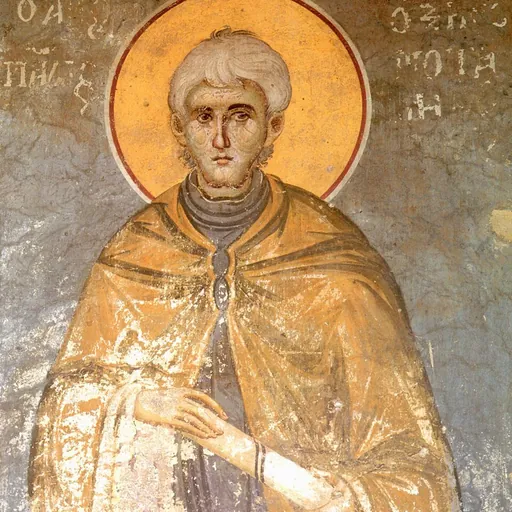
Saint Paul of Xeropotamou
9th-10th century Byzantine ascetic
About Saint Paul of Xeropotamou
Saint Paul of Xeropotamou was a Byzantine.
Paul of Xeropotamou was a Byzantine ascetic, lived between the 9th and the 10th century on Mount Athos, where he also restored and founded monasteries. He is commemorated in the Orthodox Church and his feast day is on 28 July.
Life The monk Paul of Xeropotamou, born Procopius, allegedly was the son of a Byzantine Emperor, which some sources anachronistically name as Michael I Rangabe.
Xeropotamou Monastery
Leaving everything worldly, replacing his rich clothes with beggar's rags, he went to Mount Athos, the Holy Mountain. In the place called Xeropotamou (, dry river), he built himself a cell in the ruins of a monastery once founded by the empress Pulcheria in honour of the Forty Martyrs. Procopius was tonsured monk by a hermit named Cosmas and he took the name Paul. The first rector of the new monastery was the venerable Paul himself, who also brought particles of the True Cross to this new monastery.
The saint who had been informed in advance of his death, called to himself the fathers of Xeropotamou and the new St. George's monastery and gave them their last instruction. On the day of his death, St. Paul put on his mantle, read the prayer of St. Ioannikios the Great, which he constantly said: "My hope is the Father, my refuge is the Son, my protection is the Holy Spirit: O Holy Trinity, glory to Thee," and communed of the Holy Mysteries of Christ.
St. Paul was the leading figure of the group of hermits at Mount Athos and he mobilized these ascetics to counter organized monasticism. Particularly, he was the primary opponent of Athanasius and his monastic proposals, accusing him of bringing worldly ways at Athos while also highlighting his exploitation of the hermits.
St. Paul had instructed that his body should be buried on the peninsula of Longos opposite the Holy Mountain. However, by the will of God, the waves pushed the ship all the way to the shores of Constantinople, where the Emperor and the Patriarch of Constantinople reverently accepted the body of the saint and solemnly laid him in the Hagia Sophia. After the sack of Constantinople by the Crusaders, the relics of St. Paul were transferred to Venice.
Don’t just read it —
keep it.
Full-length biographies made to live with: read them, listen on the way to work, watch them tonight.
- E-book
- Audio
- Video
Instant download · yours to keep · every purchase keeps this site free
Important facts
Frequently asked questions
Who was Saint Paul of Xeropotamou?
9th-10th century Byzantine ascetic
When was Saint Paul of Xeropotamou born?
Saint Paul of Xeropotamou was born in Byzantine Empire.
When did Saint Paul of Xeropotamou die?
Saint Paul of Xeropotamou died in Mount Athos.
What nationality was Saint Paul of Xeropotamou?
Saint Paul of Xeropotamou was Byzantine.
Sources & further reading
· Wikipedia: Saint Paul of Xeropotamou
· DBpedia: Paul of Xeropotamou
Cite this page
APA: Biography.guide. (2026). Saint Paul of Xeropotamou. https://biography.guide/saint-paul-of-xeropotamou/
MLA: "Saint Paul of Xeropotamou." Biography.guide, https://biography.guide/saint-paul-of-xeropotamou/.
Chicago: "Saint Paul of Xeropotamou." Biography.guide. https://biography.guide/saint-paul-of-xeropotamou/.
Data last updated: 2026-09-24 · Spot an error? Report a correction.
Portrait: Wikimedia Commons · author & licence
Page generated 2026-09-27 05:08 UTC