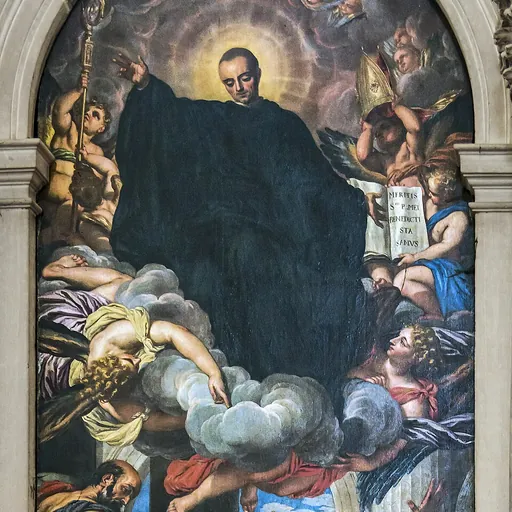
About Saint Maurus
Lived 512 – 584 (aged 72). Saint Maurus was a monk.
Saint Maurus (; ) (512–584) was a Benedictine monk best known as the first disciple of Benedict of Nursia. He is mentioned in Gregory the Great's biography of the latter as the first oblate, offered to the monastery by his noble Roman parents as a young boy to be brought up in the monastic life.
Four stories involving Maurus, recounted by Gregory, formed a pattern for the ideal formation of a Benedictine monk. The most famous of these involved Maurus's rescue of Placidus, a younger boy offered to Benedict alongside Maurus. The incident has been reproduced in many medieval and Renaissance paintings.
His feast is on 15 January 15 in the 2001 Roman Martyrology and on the same date along with Placid in the Proper Masses for the Use of the Benedictine Confederation.
Life of Saint Maurus
A long Life of St. Maurus was supposedly composed by one of Maurus's 6th-century contemporaries, completed around 604. This original Vita came into the possession of Abbot Odo of Glanfeuil, who found it to be in terrible condition and the Latin to be illegible. Thus, he sought to copy it while improving the language, publishing his version in 863. According to this account, the bishop of Le Mans, in western France, sent a delegation asking Benedict for a group of monks to travel from Benedict's new abbey of Monte Cassino to establish monastic life in France according to the Rule of St. Benedict. The Life recounts the long journey of Maurus and his companions from Italy to France, marked by many adventures and miracles, as Maurus is transformed from a youthful disciple of Benedict into a powerful, miracle-working holy man in his own right. According to this account, after the great pilgrimage to Francia, Maurus founded Glanfeuil Abbey as the first Benedictine monastery in Gaul. It was located on the south bank of the Loire river, a few miles east of Angers. The nave of its thirteenth-century church and some vineyards remain today (according to tradition, the chenin grape was first cultivated at this monastery).
Some have thought the Vita to be a forgery by Odo of Glanfeuil. Most famously Hippolyte Delehaye, who called it so in an off-hand comment in his Introduction to Hagiography. However, there is no general academic consensus on the authenticity of the Vita. The Bollandists noted in the conclusion of their discussion of the Vita that "Odo would indeed have earned greater gratitude from a curious posterity if he had published it as he found it, or if he wished to add anything, had done so in a separate commentary." Scholars such as Beda Adlhoch, meanwhile, defended a more reliable Odo.
Benedictine tradition
Maurus was born c. 510, the son of Equitius, a Roman nobleman. At the age of about twelve, Maurus was entrusted to the care of Benedict at Subiaco to be educated. Gregory the Great in the Dialogues recounts a tale wherein the young oblate Placidus was sent to fetch water from the lake and was carried away by the current. Realizing this, Benedict sent Maurus to rescue the boy. Hurrying to reach Placidus, Maurus ran out upon the water. After bringing Placidus back to shore, Maurus attributed the miracle to the prayers of Benedict; the abbot, to his disciple's obedience.
Maurus was ordained a deacon and, subsequently, Benedict, before leaving for Monte Cassino, appointed him coadjutor at Subiaco. During his tenure, various miraculous cures were attributed to his prayers.
Veneration
Maurus was originally buried in the abbey church at Glanfeuil. When, in 868, Odo and the monks of Glanfeuil were obliged to flee to Paris in the face of Vikings marauding along the Loire, the remains of Maurus were translated to the abbey of Saint-Pierre-des-Fossés, later renamed Saint-Maur-des-Fossés. In 1750, the relics were relocated to Saint-Germain-des-Prés,
The Blessing of Saint Maur is customarily bestowed on the sick with a relic of the true Cross, in hopes of assisting to restore their health. Since it is often impossible to have a relic of the True Cross, in 1959, the Sacred Congregation of Rites granted permission to use the medal of St. Benedict in place of the relic of the True Cross to confer the Blessing.
The Congregation of St. Maur took its name from him. The surname "Seymour" is derived from Saint Maur.
Saint Maur International School of Yokohama, Japan's first international school, was founded by French and Irish nuns of the Congregation of the Infant Jesus (also known as the Dames of Saint Maur) in 1872, and was named after Saint Maur.
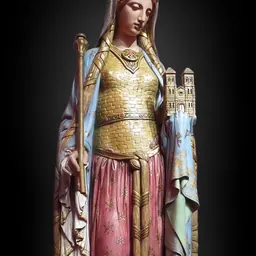
Iconography In Christian iconography, Maurus is depicted as a young man in the habit of a Benedictine monk, usually holding an abbot's pectoral cross or sometimes with a spade (an allusion to the monastery of Saint-Maur-des-Fossés, literally "Saint Maurus of the Ditches"). Another of Maurus' attributes is a crutch, in reference to his patronage of disabled people. He was invoked especially against fever, and also against rheumatism, epilepsy, and gout. He is also sometimes depicted with a scale, a reference to the implement used to measure a monk's daily ration of bread, which Benedict gave him when he left Montecassino for France. The monks of Fossés, near Paris (from which the community of Glanfeuil had fled the Vikings in 868), used this implement throughout the Middle Ages.
Don’t just read it —
keep it.
Full-length biographies made to live with: read them, listen on the way to work, watch them tonight.
- E-book
- Audio
- Video
Instant download · yours to keep · every purchase keeps this site free
Important facts
People in Saint Maurus's life
Named in this biography and alive at the same time
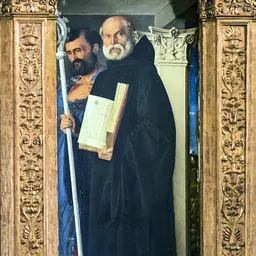
Related people
Same field, nearest in time


Contemporaries
People whose lives overlapped Saint Maurus's



Frequently asked questions
Who was Saint Maurus?
first disciple of St. Benedict of Nursia
When was Saint Maurus born?
Saint Maurus was born on 1 January 512 in Rome.
When did Saint Maurus die?
Saint Maurus died on 15 January 584 in Gaul.
What was Saint Maurus's occupation?
Saint Maurus was a monk.
What nationality was Saint Maurus?
Saint Maurus's recorded nationality: Ostrogothic Kingdom.
Sources & further reading
Cite this page
APA: Biography.guide. (2026). Saint Maurus. https://biography.guide/saint-maurus/
MLA: "Saint Maurus." Biography.guide, https://biography.guide/saint-maurus/.
Chicago: "Saint Maurus." Biography.guide. https://biography.guide/saint-maurus/.
Data last updated: 2026-09-23 · Spot an error? Report a correction.
Portrait: Wikimedia Commons · author & licence
Page generated 2026-09-27 05:06 UTC