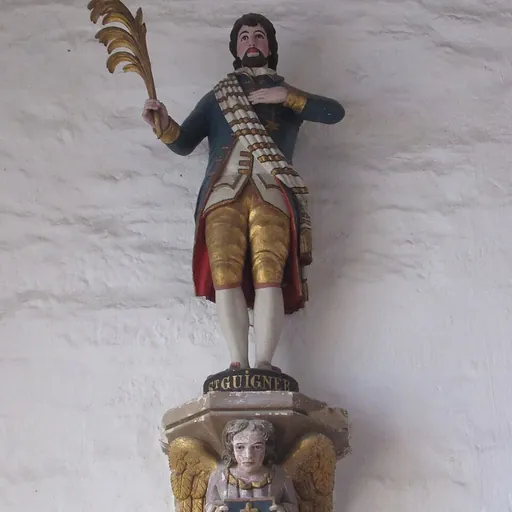
Saint Gwinear
Cornish saint
About Saint Gwinear
Gwinear, Guigner, was a Celtic martyr, one of only two early Cornish saints whose biographies survived the Reformation. The Life of Gwinear was written in the early 14th century by a priest named Anselm, and has sometimes been printed among the works of Anselm of Canterbury. His feast day is March 23.
Born in Ireland with the Irish name of Fingar, he was converted to Christianity by Saint Patrick and after spending time in Brittany went with 7 (or 777) companions to Cornwall, landing at Hayle, where he was martyred by King Teudar. Gwinear was said to have died with his followers by being thrown into a pit of reptiles. An alternative version sets the story in Brittany with Guigner being martyred at the hands of Prince Tewdwr.
The Victorian clergyman, hagiographer and antiquary Sabine Baring-Gould believed that an Irish group, driven from their homeland in Ossory in the fifth century, invaded Penwith (="pen-gwaeth", the "bloody headland"), and that the legend of Gwinear was a distorted recollection of these events.
Don’t just read it —
keep it.
Full-length biographies made to live with: read them, listen on the way to work, watch them tonight.
- E-book
- Audio
- Video
Instant download · yours to keep · every purchase keeps this site free
Important facts
Frequently asked questions
Who was Saint Gwinear?
cornish saint
When was Saint Gwinear born?
Saint Gwinear was born in Ireland.
When did Saint Gwinear die?
Saint Gwinear died in Cornwall, Hayle.
Sources & further reading
Cite this page
APA: Biography.guide. (2026). Saint Gwinear. https://biography.guide/saint-gwinear/
MLA: "Saint Gwinear." Biography.guide, https://biography.guide/saint-gwinear/.
Chicago: "Saint Gwinear." Biography.guide. https://biography.guide/saint-gwinear/.
Data last updated: 2026-09-23 · Spot an error? Report a correction.
Portrait: Wikimedia Commons · author & licence
Page generated 2026-09-27 05:05 UTC