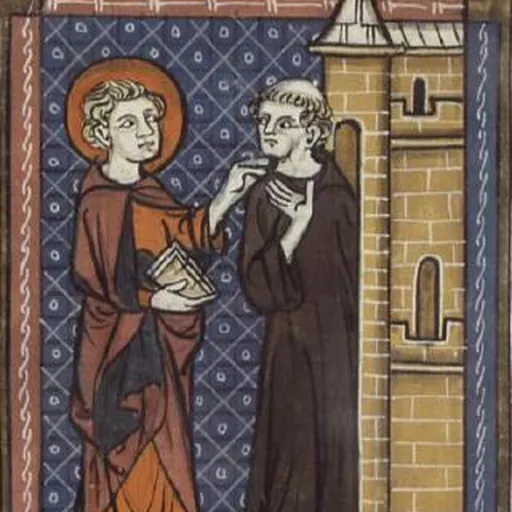
Saint Fursey
Catholic and Orthodox saint, born around 567 in Ireland and died in the Merovingian kingdom of Austrasia around 648
About Saint Fursey
Lived 567 – 650 (aged 82–83). Saint Fursey was an Irish monk.
Saint Fursey (also known as Fursa, Fursy, Forseus, and Furseus: died 650) was an Irish monk who did much to establish Christianity throughout the British Isles and particularly in East Anglia. He reportedly experienced angelic visions of the afterlife. Fursey is one of the Four Comely Saints.
Early life He was born in the region of modern-day Connacht supposedly the son of Fintan and grandson of Finlog, pagan king of the area. His mother was Gelges, the Christian daughter of Aed-Finn, king of Connacht. He was born probably amongst the Hy-Bruin, and was baptised by St Brendan the Traveller, his father's uncle, who then ruled a monastery in the Island of Oirbsen, now called Inisquin in Lough Corrib. He was educated by St Brendan's monks, and when he became of the proper age he was inducted into the monastery at Inisquin (near Galway), under the Abbot St Meldan, his "soul-friend" (anam-chura), where he devoted himself to religious life. His great sanctity was early discerned, and there is a legend that here, through his prayers, twin children of a chieftain related to King Brendinus were raised from the dead. He built his own monastery at Killursa outside the town of Headford in modern County Galway and he became the patron saint of the Parish of Headford.
Visions He was said to have been something of an ascetic, wearing thin clothing year round. Aspirants came in numbers to place themselves under his rule, but he wished to secure also some of his relatives for the new monastery. For this purpose he set out with some monks for Munster, but on coming near his father's home he was seized with an apparently mortal illness. He fell into a trance from the ninth hour of the day to cock-crow, and while in this state received the first of the ecstatic visions which have made him famous in medieval literature.
The conversion of the Kingdom of East Anglia to Christianity began under Raedwald, but halted with the martyrdom of Raedwald's successor, his son Eorpwald. Sigeberht of East Anglia was already Christian when he took the throne around 630. By 633, Sigeberht of East Anglia had established the first East Anglian bishopric at Dommoc and appointed a Burgundian Bishop named Felix.
Here he laboured for some years converting the Picts and Saxons. After Sigeberht was slain by an army led by Penda of Mercia, it is recorded that his successor King Anna of East Anglia, and his nobles, further endowed the monastery at Cnobheresburg. Three miracles are recorded of Fursey's life in this monastery. He then retired for a year to live with Ultan the life of an anchorite. However, as great numbers continued to visit him, and as war threatened in East Anglia, he left Foillan as abbot and proceeded to Lagny, in France around 644.
Mission in Neustria He arrived in France in 648. Passing through Ponthieu, in a village near Mézerolles he found grief and lamentation on all sides, for the only son of Duke Hayson, the lord of that area, was dead. At the prayer of Fursey the body was restored. Pursuing his journey to Neustria he cured many infirmities on the way. He converted a robber, who had attacked the monks in a wood near Corbie, and his family through miracles. He also cured the inhospitable worldling Ermelinda, who had refused to harbour the weary travellers. His fame preceded him to Péronne, where he was joyfully received by Erchinoald, and through his prayers obtained the reprieve of six criminals. He was offered any site in the king's dominions for a monastery. He selected Latiniacum (Lagny), close to Chelles and about six miles from Paris, a spot beside the Marne, at that time covered with shady woods and abounding in fruitful vineyards. Here he built his monastery and three chapels, one dedicated to Jesus Christ the Saviour, one to St Peter, and the third, an unpretending structure, was later dedicated to St Fursey himself. Many of his Irish countrymen were attracted to his rule at Lagny, including Emilian, Eloquius, Mombulus, Adalgisius, Etto, Bertuin, Fredegand, Lactan, and Malguil.
His journeys continued and many churches in Picardy are dedicated to him. He received some premonitions of his end, and set out to visit his brothers Foillan and Ultan who had by this time recruited the scattered monks of Cnobheresburg and re-established that monastery.
Death He died about 650 at Mézerolles while on a journey. The village was for some time called Forsheim, which translated as the house of Fursey. He was buried in a church (built specially by Earconwald) in Péronne which has claimed him as patron ever since.
In popular culture James Joyce mentions S. Fursa in his book Ulysses, among a list of mostly Irish heroes and heroines. The Unfortunate Fursey, a popular comic novel by Mervyn Wall describes the saint as a hapless poor soul tormented by visions of buxom women of a type that could only be imagined by the sex-starved Irish ecclesiastics, and bargaining with demons to escape the torments of religion.
Don’t just read it —
keep it.
Full-length biographies made to live with: read them, listen on the way to work, watch them tonight.
- E-book
- Audio
- Video
Instant download · yours to keep · every purchase keeps this site free
Important facts
People in Saint Fursey's life
Named in this biography and alive at the same time

Related people
Same field, nearest in time


Contemporaries
People whose lives overlapped Saint Fursey's


Frequently asked questions
Who was Saint Fursey?
Catholic and Orthodox saint, born around 567 in Ireland and died in the Merovingian kingdom of Austrasia around 648
When was Saint Fursey born?
Saint Fursey was born in 567 in Ireland.
When did Saint Fursey die?
Saint Fursey died in 650 in Ponthieu.
What was Saint Fursey's occupation?
Saint Fursey was a monk.
What nationality was Saint Fursey?
Saint Fursey was Irish.
Sources & further reading
Cite this page
APA: Biography.guide. (2026). Saint Fursey. https://biography.guide/saint-fursey/
MLA: "Saint Fursey." Biography.guide, https://biography.guide/saint-fursey/.
Chicago: "Saint Fursey." Biography.guide. https://biography.guide/saint-fursey/.
Data last updated: 2026-09-21 · Spot an error? Report a correction.
Portrait: Wikimedia Commons · author & licence
Page generated 2026-09-27 04:58 UTC