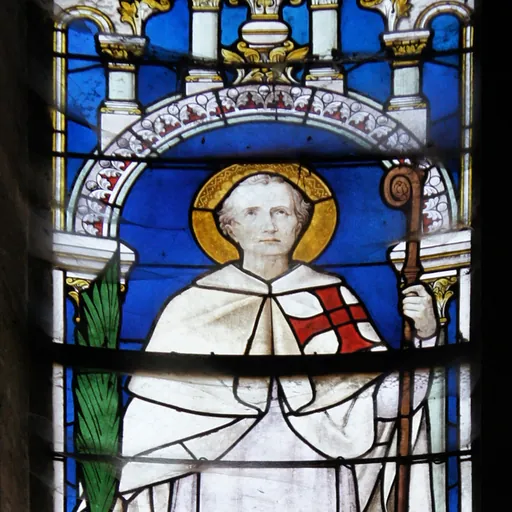
Saint Ernest
German saint
About Saint Ernest
Lived 1116 – 1148 (aged 31–32). Saint Ernest was a German religious.
Life
Ernest is a Germanic name meaning severe. Not much is known about Saint Ernest's life. He was born of a noble family in Steisslingen, Germany, and along with his two brothers became important patrons of reformed monasteries in Swabia. How and when Ernst entered the religious life is not clear. A donation to Zwiefalten by the three brothers from 1131 suggests they might have taken monastic vows as early as that time, while the later Vita Ernusti claims he was a child oblate. Because the Hirsau rule, which Zwiefalten followed, did not permit child oblates, this later tradition is likely invented.
The Crusade
When St. Bernard called for participation in the Second Crusade to defend the Latin Kingdom and roll back Zengi's advances in Syria, the German king Conrad III, along with many other nobles and churchmen, including Ernest, responded. Ernest attached himself to a contingent of pilgrims and fighters led by the king's brother, bishop Otto of Freising. The crusade was not successful. The German armies suffered massive attrition on their march through Asia Minor and those few who did make it to join the other Crusader forces led by the French king Louis VII in the Holy Land eventually retreated from an ill-considered siege of Damascus in July 1148 and returned home in ignominy.
Otto of Freising's group progressed along the southwestern coastal route across Anatolia from Ephesus to Laodicea before making for the coast and securing naval passage to Antioch. They suffered nearly the whole way from severe hunger and other deprivations, including ambushes by Turkish forces in which numerous Christians were taken prisoner or killed.
Martyrdom
St. Ernest himself did not reach Jerusalem. There are no eyewitness or near-contemporary accounts of what happened to him, but a later twelfth-century hagiography, the Vita S. Ernusti abbatis, written at Zwiefalten, describes how he was taken captive by Saracens in an ambush, and then, along with 40 other Christian prisoners selected for their youth and comeliness, brought to Mecca and presented to the "king of Persia." In the vita's account, the king orders Ernest and the other Christians to venerate his pagan gods, but Ernest steadfastly refuses. Brutally tortured, he is brought once again before the idols and told to worship them. Instead, he stones the idols with rocks, smashing them to pieces. Ernest is then killed by having his viscera drawn out of his navel and wound around a rod.
The story contains a number of fanciful elements, but reproduces in particular the popular medieval image of Muslims as idolaters, a myth that Otto of Freising himself went to some lengths to dispel in his chronicle On the History of the Two Cities.
Don’t just read it —
keep it.
Full-length biographies made to live with: read them, listen on the way to work, watch them tonight.
- E-book
- Audio
- Video
Instant download · yours to keep · every purchase keeps this site free
Important facts
People in Saint Ernest's life
Named in this biography and alive at the same time

Related people
Same field, nearest in time



Contemporaries
People whose lives overlapped Saint Ernest's




Frequently asked questions
Who was Saint Ernest?
German saint
When was Saint Ernest born?
Saint Ernest was born in 1116 in Steißlingen.
When did Saint Ernest die?
Saint Ernest died on 7 November 1148 in Mecca.
What was Saint Ernest's occupation?
Saint Ernest was a religious.
What nationality was Saint Ernest?
Saint Ernest was German.
Sources & further reading
Cite this page
APA: Biography.guide. (2026). Saint Ernest. https://biography.guide/saint-ernest/
MLA: "Saint Ernest." Biography.guide, https://biography.guide/saint-ernest/.
Chicago: "Saint Ernest." Biography.guide. https://biography.guide/saint-ernest/.
Data last updated: 2026-09-23 · Spot an error? Report a correction.
Portrait: Wikimedia Commons · author & licence
Page generated 2026-09-27 05:07 UTC