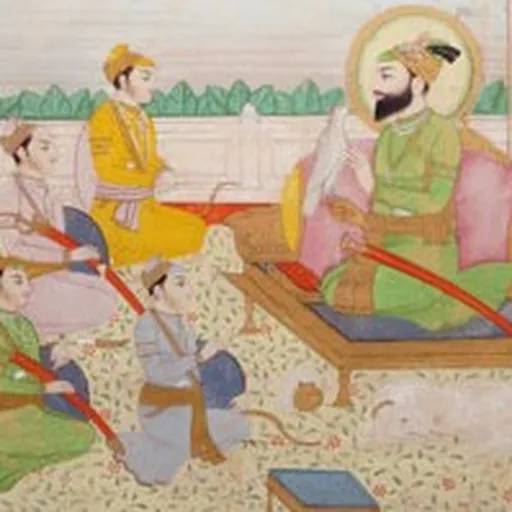
Sahibzada Zorawar Singh
Sikh martyr
About Sahibzada Zorawar Singh
Lived 1696 – 1705 (aged 9).
Zorawar Singh (, pronunciation: ; 17 November 1696 – 26 December 1704 ), alternatively spelt as Jorawar Singh, was a son of Guru Gobind Singh. Zorawar was executed in the court of Wazir Khan, the Mughal Governor of Sirhind.
Background In 1699, the Pahari Rajas of the Shiwalik Hills, frustrated with increasing Sikh ascendancy in the region, requested aid from Aurangzeb; their combined forces took on the Khalsa, led by Guru Gobind Singh, at Anandapur but were defeated. Another faceoff followed in the neighboring Nirmoh but ended in Sikh victory; there was probably another conflict in Anandapur (c. 1702) to the same outcome. Knowing the enemy’s deceit, the Guru tested their sincerity by sending out bullock carts filled with worthless items, which were immediately looted. Despite this betrayal, continued pressure from his followers and mother left him with no choice but to agree to leave. On the night of 20–21 December 1704, under cold winds and rain, the Guru’s family and a group of Sikhs left first, led by Udai Singh, while the Guru planned to follow. However, as they moved out, the Mughals and hill forces broke their oath and attacked, leading to the chaotic and tragic Battle of Sarsa, where the Sikhs were scattered, and many lost their lives. Some Sikh accounts note Singh's two younger sons — Zorawar Singh and Fateh Singh — to have successfully fought at Chamkaur before being captured. Other accounts note that they along with their grandmother had been separated from the Sikh retinue while migrating away from Anandapur; subsequently, they were betrayed by local officials and handed over to the Mughals.
Wazir Khan was furious that he had failed to capture the Guru Gobind Singh. In his frustration, he decided to target the young sons of the Guru. On 24 December 1704, the two boys were brought before his court in a grand public gathering. Hundreds of armed soldiers stood around them to intimidate them. The Nawab’s men told the boys that their father, Guru Gobind Singh, their older brothers, and all Sikhs had been killed. They were offered a safe and comfortable life if they agreed to convert to Islam. However, the young princes boldly refused the offer, showing no fear. They reminded the court that their grandfather, Guru Tegh Bahadur, had also refused to convert to Islam and was martyred for his faith. A courtier named Suchanand Khatri insulted them, saying that the children of a snake are always venomous. Wazir Khan ordered their execution. In early Sikh accounts, they were simply beheaded, but in popular Sikh tradition, they are believed to have been "bricked" (entombed) alive, sentencing them to be bricked up in a wall. Even as they were placed inside, the boys remained steadfast in their faith. Enraged by their defiance, the soldiers pushed down the temporary wall made of mud and bricks. Finally, on 27 December 1704, the young princes were beheaded, and their bodies were disrespectfully discarded. Upon seeing their lifeless bodies, Mata Gujri could not bear the pain and passed away.
Legacy A kind-hearted wealthy man named Diwan Todar Mal, who was a banker, took the responsibility of giving the children and Mata Gujri a proper cremation. He bought a piece of land for their funeral by laying gold coins on the ground as payment. The place where their bodies were discarded is now known as Gurdwara Fatehgarh Sahib. Another Gurdwara, called Joti Sarup, marks the site where their cremation took place Fatehgarh Sahib. Every year, two fairs are held at Gurdwara Fatehgarh Sahib—one in December to honor the children’s martyrdom and another in March during the festival of Hola Mohalla. Near Sirhind, there is also a memorial dedicated to Mata Gujri,
Don’t just read it —
keep it.
Full-length biographies made to live with: read them, listen on the way to work, watch them tonight.
- E-book
- Audio
- Video
Instant download · yours to keep · every purchase keeps this site free
Important facts
Family & relationships
People in Sahibzada Zorawar Singh's life
Named in this biography and alive at the same time



Frequently asked questions
Who was Sahibzada Zorawar Singh?
Sikh martyr
When was Sahibzada Zorawar Singh born?
Sahibzada Zorawar Singh was born on 17 November 1696 in Anandpur Sahib.
When did Sahibzada Zorawar Singh die?
Sahibzada Zorawar Singh died on 12 December 1705 in Sirhind-Fategarh.
Sources & further reading
· Wikipedia: Sahibzada Zorawar Singh
· DBpedia: Zorawar Singh (Sikhism)
Cite this page
APA: Biography.guide. (2026). Sahibzada Zorawar Singh. https://biography.guide/sahibzada-zorawar-singh/
MLA: "Sahibzada Zorawar Singh." Biography.guide, https://biography.guide/sahibzada-zorawar-singh/.
Chicago: "Sahibzada Zorawar Singh." Biography.guide. https://biography.guide/sahibzada-zorawar-singh/.
Data last updated: 2026-09-24 · Spot an error? Report a correction.
Portrait: Wikimedia Commons · author & licence
Page generated 2026-09-27 05:09 UTC