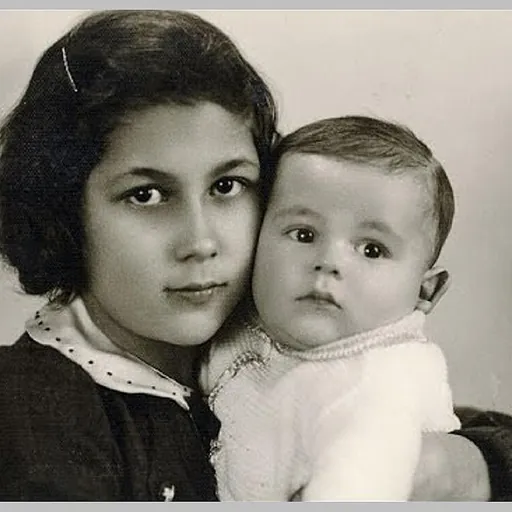
About Rutka Laskier
Lived 1929 – 1943 (aged 13–14). Rutka Laskier was a Polish diarist and writer.
Ruth "Rutka" Laskier (12 June 1929 – December 1943) was a Jewish Polish diarist who is best known for her 1943 diary chronicling three months of her life during the Holocaust in Poland. She was murdered at Auschwitz concentration camp in 1943 at the age of fourteen. Her manuscript, authenticated by Yad Vashem, was published in the Polish language in early 2006. English and Hebrew translations were released the following year. It has been compared to the diary of Anne Frank.
Laskier's diary has been a focus of a 2009 BBC documentary and of the 2024 musical Rutka.
Biography Rutka Laskier was born in Kraków Her family was well-off. Her grandfather served as co-owner of Laskier-Kleinberg & Co, a milling company that owned and operated a grist mill.
Rutka moved with her family to the southern Polish city of Będzin, whence her paternal grandparents hailed. Following the German invasion of Poland, while in the Będzin Ghetto, Rutka Laskier, age 14, wrote a 60-page diary in Polish, chronicling several months of her life under the Nazi rule in 1943. Her diary remained in the hands of Rutka's surviving friend for 64 years and was not released to the public until 2005.
The Holocaust Laskier's family was forced to move to the newly formed Jewish Ghetto in Będzin during the Holocaust in World War II. Rutka was deported from the ghetto and was believed to have been murdered in a gas chamber, age 14, along with her mother and brother, upon arrival with her family at the Auschwitz concentration camp in August 1943. Rutka begged Zofia to take her to the electric fence so she could kill herself, but an SS guard following them would not allow it. Rutka was then taken directly to the crematory.
Rutka's father was the only member of the family who survived the Holocaust. Following World War II, he emigrated to Israel, where he remarried and had another daughter, Zahava Scherz. He died in 1986. According to Zahava Scherz, interviewed in the BBC documentary The Secret Diary of the Holocaust (broadcast in January 2009), he never told Scherz about Rutka until she discovered a photo album when she herself was 14, which contained a picture of Rutka with her younger brother. Scherz asked her father who they were, and he answered her truthfully, but never spoke of it again. She went on to explain that she only learned of the existence of Rutka's diary in 2006, and she expressed how much it has meant to her to be able to get to know her half-sister through Rutka's words.
Discovery of the diary In 1943, while writing the diary, Laskier shared it with Stanisława Sapińska (21 years old, at that time), whom she had befriended after Laskier's family moved into a home owned by Sapińska's Roman Catholic family, which had been confiscated by the Nazis so that it could be included in the ghetto.
After the ghetto was evacuated and all its inhabitants sent to the death camp, Sapińska returned to the house and retrieved the diary. She kept it in her home library for 63 years and did not share it with anyone but members of her immediate family. In 2005, Adam Szydłowski, the chairman of the Center of Jewish Culture of the Zagłębie Region of Poland, was told by one of Sapińska's nieces about the existence of the diary.
With help from Sapińska's nephew, he obtained a photocopy of the diary and was instrumental in the publishing of its Polish-language edition. Its publication by Yad Vashem Publications was commemorated with a ceremony in Jerusalem by Yad Vashem (the Holocaust Martyrs' and Heroes' Remembrance Authority), Israel's Holocaust museum, on 4 June 2007, in which Zahava Scherz took part. At this ceremony, Sapińska also donated the original diary to Yad Vashem.
The diary was authenticated by Yad Vashem. It has been compared to the diary of Anne Frank, the best known Holocaust-era diary. Coincidentally, Rutka Laskier was born the same day as Anne Frank,
Publication of the diary The manuscript, as edited by Stanisław Bubin, was published in the Polish language by Polkapresse in early 2006. In June 2007, Yad Vashem Publications published English and Hebrew translations of the diary, entitled Rutka's Notebook: January–April 1943.
Adaptations Laskier's diary is the focus of the 2009 BBC One documentary The Secret Diary of the Holocaust The musical Rutka is based on Laskier's diary.
Don’t just read it —
keep it.
Full-length biographies made to live with: read them, listen on the way to work, watch them tonight.
- E-book
- Audio
- Video
Instant download · yours to keep · every purchase keeps this site free
Important facts
People in Rutka Laskier's life
Named in this biography and alive at the same time
Related people
Same field, nearest in time



Frequently asked questions
Who was Rutka Laskier?
diarist
When was Rutka Laskier born?
Rutka Laskier was born on 12 June 1929 in Kraków.
When did Rutka Laskier die?
Rutka Laskier died in 1943 in Auschwitz.
What was Rutka Laskier's occupation?
Rutka Laskier was a diarist and writer.
What nationality was Rutka Laskier?
Rutka Laskier was Polish.
Sources & further reading
Cite this page
APA: Biography.guide. (2026). Rutka Laskier. https://biography.guide/rutka-laskier/
MLA: "Rutka Laskier." Biography.guide, https://biography.guide/rutka-laskier/.
Chicago: "Rutka Laskier." Biography.guide. https://biography.guide/rutka-laskier/.
Data last updated: 2026-09-22 · Spot an error? Report a correction.
Portrait: Wikimedia Commons · author & licence
Page generated 2026-09-27 05:03 UTC