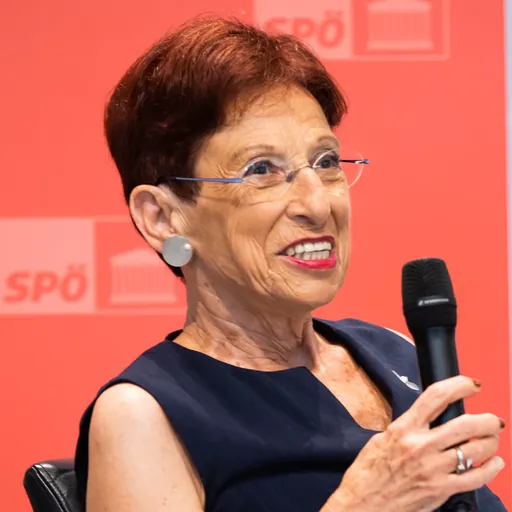
About Ruth Wodak
Born 1950. Ruth Wodak is an Austrian linguist, professor and university teacher.
Ruth Wodak (born 12 July 1950 in London) is an Austrian linguist and Emerita Distinguished Professor of Discourse Studies at Lancaster University. She is also University Professor emerita at the University of Vienna, where she served as full professor of Applied Linguistics since 1991.
Wodak is known as a leading figure in critical discourse studies (CDS), with research spanning discourse theory, gender studies, national and European identity politics and the politics of the past, racism, antisemitism, far-right-wing populism, political and media communication, and interdisciplinary methodological innovations.
She is a member of the editorial boards of multiple linguistic journals and co-editor of Discourse and Society and Critical Discourse Studies. Wodak was the founding editor, alongside Paul Chilton, of the book series Discourse Approaches to Politics, Society and Culture (DAPSAC) and of the peer-reviewed journal Language and Politics.
She has received numerous distinctions for her scholarly achievements, including two honorary doctorates, as well as major awards such as the Wittgenstein Prize, Austria’s highest scientific honour.
Early life and education Wodak was born on 12 July 1950 in London, United Kingdom, to Austrian refugee parents. Her father, Walter Wodak, who was born into a Jewish family in Vienna, served in the British Army during the Second World War. After 1945, he returned to Vienna and was subsequently invited to join the Austrian diplomatic service. He later served as an Austrian diplomat at the Austrian embassy in London, where her parents remained until 1950.
Her mother, Erna, daughter of a rabbi in Vienna, had to flee Vienna 1938 and was able to complete her PhD thesis in Manchester, with a grant by the British government for refugees who had not been able to complete their studies after March 1938 and the so-called Anschluss auf Austria to Nazi-Germany. During her childhood, Ruth Wodak lived in several European cities due to her father’s diplomatic postings, including Paris, Belgrade, Moscow, and Vienna, where she spent most of her formative years. She completed her Habilitation (second book, tenure) in Applied Linguistics in 1980, with a book, translated into the English 1986, titled Language Behavior in Therapy Groups.
Career Wodak began her academic career in 1971 as a research assistant at the University of Vienna’s Department of Linguistics. From 1975 to 1983, she worked as a university assistant, and until 1991, she was an associate professor in applied linguistics, including sociolinguistics and psycholinguistics.
In 1991, she was offered a full professorship both at the University of Michigan, which she declined, and at Vienna University. Between 1999 and 2002, she served as visiting professor at the Austrian Academy of Sciences where her research center Discourse, Politics, Identity was located. From 2000 - 2003, she also co-directed the Austrian National Focal Point of the European Agency for Fundamental Rights (then EUMC).
In 2004, Wodak moved to Lancaster University in the United Kingdom (head-hunted as successor to Norman Fairclough), where she served as Distinguished Professor in Discourse Studies until 2016 and continues as emerita.
Throughout her career, she has held numerous visiting professorships and fellowships, including at the European University Institute, Georgetown University, University of Malmö, Norwich University, Örebro University, and Uppsala University.
Since 2010, Wodak has been a member of the Academia Europaea, and in 2013, she was elected to the British Academy of Social Sciences.
Rather than repeating individual appointments, her global academic engagement and recognition are more comprehensively reflected in a long-form interview conducted on the occasion of her 70th birthday, published in 2022 in Zeitschrift für Diskursforschung.
Research Wodak’s research spans a broad interdisciplinary agenda within Critical Discourse Studies and Sociolinguistics. In this earlier phase, she conducted empirical and ethnographic analyses of discourse in institutional settings such as courts, hospitals, schools, and bureaucratic and European Union organizations, examining how language structures professional practices, authority, and decision-making. In parallel, her work in gender studies explored discursive practices in female socialization, including interactions between mothers and daughters, gendered communication in both private and institutional contexts, and the role of language in reproducing social inequalities.
Building on these foundations, Wodak’s later and ongoing research integrates linguistic analysis with ethnography, argumentation theory, rhetoric, pragmatics, and text linguistics to investigate identity politics, xenophobia, and the politics of memory in national and European contexts. Her work demonstrates how discourses operate across institutional, social, and political domains to construct identities, sustain power relations, and shape social hierarchies over time.
Wodak’s monograph, The Politics of Fear: The Shameless Normalisation of Far-right Discourse, was published in a fully revised and expanded second edition in 2020 (Sage, 2021), The German version was translated from the English original. The book is also translated into Russian, Chinese, Korean, Bosnian, Spanish, etc...The work examines the rhetoric, strategies, and argumentation of far-right political movements in Europe and the United States, with particular attention to the interactions between politics and the media through detailed case studies. Central themes include the recontextualization and glocalization of images and posters across various European far-right parties, as well as the increasing influence of social media.
In addition, Ruth Wodak, together with Michael Meyer, edited the third revised edition of Methods of Critical Discourse Studies (Sage, 2015),
Alongside her methodological work, Wodak has produced a substantial body of publications on nationalism, history, and political discourse. She has also co-edited the volume The Discursive Construction of History: Remembering the German Wehrmacht’s War of Annihilation (2008), which analyses how the war crimes of the German Wehrmacht have been publicly debated and represented, reflecting her long-standing engagement with memory politics and historical discourse.
In addition to these books, Wodak has published extensively in edited volumes and journals on topics such as political communication, right-wing populism, and discourse theory. Analyzing Fascist Discourse (2013), and Right-Wing Populism in Europe (2013), as well as numerous widely cited articles and chapters that have shaped the development of critical discourse studies as an interdisciplinary field.
In 2013, Wodak co-authored two volumes on right-wing populist discourse: Analysis of European Fascism: Fascism in Text and Talk (with John Richardson, Routledge) and Right-wing Populism in Europe: Politics and Discourse (with Maijd KhosraviNik and Brigitte Mral, Bloomsbury). Rantt, Euronews, and the online platforms OpenDemocracy and the Center for the Analysis of the Radical Right (CARR).
Another monograph, The Discourse of Politics in Action: Politics as Usual, was published in a second revised edition in 2011 (Palgrave Macmillan). The Handbook of Sociolinguistics (with Paul Kerswill and Barbara Johnstone, 2013), and The Handbook of Language and Politics (with Bernhard Forchtner, 2018, Routledge).
Her more recent book-length publications include a 2020 volume co-authored with Rudolf de Cillia and collaborators, and a 2022 book co-authored with Markus Rheindorf, further extending her work on discourse, politics, nationalism, and society. Beyond these books, her work has been widely translated into multiple languages and disseminated internationally. She has published a large number of peer-reviewed journal articles and book chapters, making substantial contributions to critical discourse studies,
She was elected Fellow of the Academy of Social Sciences in 2013.
Ruth Wodak has been a Fulbright Austria Scholar at Stanford University. She has held visiting professorships at Uppsala University, University of Minnesota, and Georgetown University, and a Leverhulme Visiting Professorship at the University of East Anglia.
In 2023 Wodak received an honorary degree from the University of Warwick.
Selected bibliography Books
Edited books
Don’t just read it —
keep it.
Full-length biographies made to live with: read them, listen on the way to work, watch them tonight.
- E-book
- Audio
- Video
Instant download · yours to keep · every purchase keeps this site free
Important facts
People in Ruth Wodak's life
Named in this biography and alive at the same time






Related people
Same field, nearest in time


Contemporaries
People whose lives overlapped Ruth Wodak's


Frequently asked questions
Who is Ruth Wodak?
Austrian linguist (1950-)
When was Ruth Wodak born?
Ruth Wodak was born on 12 July 1950 in London.
What is Ruth Wodak's occupation?
Ruth Wodak is a linguist, professor and university teacher.
What nationality is Ruth Wodak?
Ruth Wodak is Austrian.
Sources & further reading
Cite this page
APA: Biography.guide. (2026). Ruth Wodak. https://biography.guide/ruth-wodak/
MLA: "Ruth Wodak." Biography.guide, https://biography.guide/ruth-wodak/.
Chicago: "Ruth Wodak." Biography.guide. https://biography.guide/ruth-wodak/.
Data last updated: 2026-09-22 · Spot an error? Report a correction.
Portrait: Wikimedia Commons · author & licence
Page generated 2026-09-27 05:01 UTC