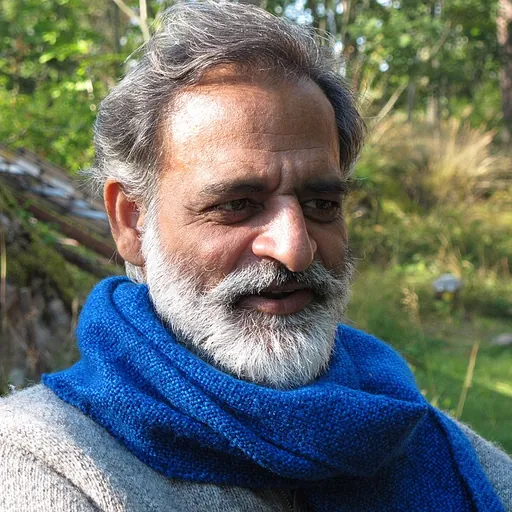
About Rustam Singh
Born 1955. Rustam Singh is a scientist and poet.
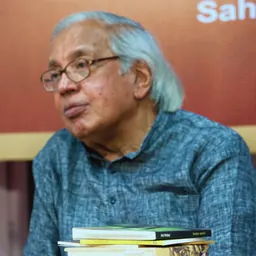
Rustam Singh (born 16 May 1955) is an Indian poet, philosopher, translator and editor. He writes poetry in Hindi (under the name Rustam) and theoretical and philosophical papers and essays in English. He is regarded as an important Hindi poet of this period. His poems have been translated into many Indian and foreign languages including English, Telugu, Marathi, Malayalam, Panjabi, Swedish, Norwegian and Estonian. Doris Kareva, well known Estonian and European poet, has written about his poetry: "Rustam is a poet with a rare wavelength. His calm, clear and concise sentences create an atmosphere of slightly eerie intensity. His visions tempt one to look over the edge, into the depth of nothingness, sensing distant echoes of Beckett or Chirico." Apart from his books, his poems have appeared in many important literary journals, magazines and blogs, such as Sakshatkaar, Poorvagrah, Bahuvachan, Jansatta, Pratilipi, Indian Literature, International Quarterly, Aufgabe, LyrikVannen, etc. Some of the recent publication of his poems in Hindi was in the online literary magazines Samalochan, Janakipul and Sadaneera.
In his philosophical essays, Rustam Singh dwells on subjects such as love, loss, separation, death, time, being, existence, violence, the self and the other, and on the controversial relation between humans and nonhuman animals and other entities in nature. In the process he throws up a number of new concepts such as dialogicality (which he has redefined), non-dialogicality, the dialogical self, the non-dialogical self, the weight of the self, the selfless-one, the other-than-self, humans-as-monsters and so on. While doing this he displays a variety of writing styles, rare in modern Indian philosophical writing.
Life and career Rustam Singh was born in Jadla, a village in Nawanshehr district in the state of Punjab, India, where his father had been allotted land after he migrated from Gobindpura in district Gujrat of present-day Pakistan during partition of India in 1947. Later, the family settled in Tohana town in Haryana, where he got his early school and college education. In his teens, he was a mechanic, a lathe operator and a welder for a short period.
Over the years, Rustam Singh has held the following research and editorial positions, among others: Assistant editor of Economic and Political Weekly, Bombay (1993–94); Editor of Summerhill IIAS Review, a journal of Indian Institute of Advanced Study, Shimla (1998-1999); Member of the editorial board of Studies in Humanities and Social Sciences, a journal of Indian Institute of Advanced Study, Shimla (1998–1999) Founder editor of Hindi: Language, Discourse, Writing (along with Ashok Vajpeyi who was its general editor), a journal of Mahatma Gandhi Antarrashtriya Hindi Vishwavidyalaya (Mahatma Gandhi International Hindi University), then located partly at New Delhi and partly at Wardha (1999-2003); Visiting scholar at Centre for Philosophy, Jawaharlal Nehru University, New Delhi (2007). Fellow and senior editor at Eklavya Foundation, an NGO working in the field of school education in Madhya Pradesh, India (2005-2007); and Violence and Marxism: Marx to Mao, Aakar Books, New Delhi, 2015 ( (pb) and (hb)); Literature, Philosophy, Political Theory: Selected Essays, Aakar Books, New Delhi, 2022 . This book is for sale and distribution in South Asia only. There is also a Routledge edition of this book for sale in the rest of the world, that is, outside South Asia. Literature, Philosophy, Political Theory: Selected Essays, Routledge, London and New York, 2026 .
Papers and essays Rustam Singh's theoretical and philosophical papers and essays include the following: "Status of Violence in Marx’s Theory of Revolution", Economic and Political Weekly, Vol. XXIV, No. 4 (January 28, 1989); "Restoring Revolutionary Theory: Towards an Understanding of Lenin’s The State and Revolution", Economic and Political Weekly, Vol. XXIV, No. 43 (October 28, 1989); "Violence in the Leninist Revolution", Economic and Political Weekly, Vol. XXV, No. 52 (December 29, 1990); "Cohen’s Second Coming: Pitfalls of Analytical Interpretation of Marx", Punjab Journal of Politics, Vol. XVII, No. 1 (June 1993); "Man, Political Man, Political Theory", Economic and Political Weekly, Vol. XXIX, No. 31 (July 30, 1994); "Reflections on a form", Seminar, 440 (April 1996); "Ontology of wage labour", Seminar, 452 (April 1997); "Feeling Politics: Reinstating the Subjective Self", Economic and Political Weekly, Vol. XXXII, No. 33-34 (August 16–23, 1997); "Dialogicality and Being: A Fragment", Studies in Humanities and Social Sciences, Vol. V, No. 1 (Summer 1998), IIAS, Shimla; "Death and the Self", Pratilipi, June 2008; "To be Regardful of the Earth", Pratilipi, August 2008; "To be Fortunate", Pratilipi, June 2010; "Beginning an Essay", Pratilipi, November 2010; "Simulating: The Heart Breaking", Comparative and Continental Philosophy, Vol. 4, No. 2 (2012); "Roots of Violence: Jīva, Life and Other Things", in Saitya Brata Das and Soumyabrata Choudhury (eds.), The Weight of Violence: Religion, Language, Politics, Oxford University Press, New Delhi, 2015 . "Not This, Not That: Maurice Blanchot and Poststructuralism", Comparative and Continental Philosophy, Vol. 8, No. 1 (2016); "Not This, Not That: Maurice Blanchot and Poststructuralism", in Franson Manjali and Marc Crepon (eds.), Philosophy, Language and the Political: Poststructuralism in Perspective, Aakar Books, New Delhi, 2018 ; and "Visual Objects: Types, Forms and Status", New Horizons: A Multidisciplinary Research Journal, Vol. XV (August 2018). .
Translations of Singh's work Rustam Singh's selected poems in English were published in 2026. This volume is titled The Rock Was Turning into Fire, Red River, New Delhi, 2026 .
The other English translations of his poems have appeared in International Quarterly (USA), Indian Literature, and Aufgabe (USA). Apart from English and other Indian languages, Singh's poems have been translated into Swedish, Norwegian and Estonian.The Swedish translations of his poems, by the Swedish poet and novelist Agneta Pleijel, were published in the Swedish poetry magazine LyrikVannen. The translations of his poems in Estonian, by the Estonian poet Doris Kareva, have appeared in the Estonian magazine Sirp.
Further, his book A Story of Political Ideas for Young Readers, Volume 1: Socrates, Plato, Aristotle, Machiavelli has been translated into and published in Hindi.
Some of his philosophical essays, for example "Remembering a Century: Mourning a Lack and a Loss of Power", "Ruptured (in) Writing", and "Roots of Violence: Jīva, Life and Other Things", too, have been translated into and published in Hindi.
Translations by Rustam Singh Rustam Singh has translated the following books into Hindi: (With Teji Grover) Hedda Gabler by Henrik Ibsen, under the title Hedda Gabler, Vani Prakashan, New Delhi, 2006 ; (With Teji Grover) Master Builder by Henrik Ibsen, under the title Master Builder, Vani Prakashan, New Delhi, 2006 ; A selection of poems by the Norwegian poet Olav Hauge, under the title Saat Havayen, Vani Prakashan, New Delhi, 2008 ; and A selection of poems by the Norwegian poet and novelist Lars Amund Vaage, under the title Shabd Ke Peechhe Chhaya Hai, Vani Prakashan, New Delhi, 2014 . A selection of poems (with Teji Grover) of the Estonian poet Doris Kareva, under the title Aag Jo Jalati Nahin , Rajkamal Prakashan, New Delhi, 2021. A selection of poems of seven Panjabi poets, under the title Saat Panjabi Kavi, Surya prakashan Mandir, Bikaner, 2023 . A selection of poems of the French poet Annie Deveaux Berthelot, under the title Main Tumhen Patjhad Mein Milne Aoungi , Des Plumes Press, Faridabad, 2025. Raza's Bindu by Ritu Khoda and Vanita Pai, under the title Bindu, published by Eklavya, Bhopal, in 2014 . It's a book for children on the well-known Indian painter Syed Haider Raza. The book was originally published in English by Scholastic, India. Jab Main Ghar Pahuncha To Ghoda Ja Chuka Tha, a story book for children by Hans Sande, published by Eklavya, Bhopal, in 2021 Aa Jao Ab Raat, a story book for children by Hans Sande, published by Eklavya, Bhopal, in 2021 .
Books Edited by Rustam Singh In 2025 Rustam Singh put together and edited a collection of poems by eighteen Hindi poets. This volume is titled Kuchh Alag Swar: Atharah Samkaleen Hindi Kavi, Surya Prakashan Mandir, Bikaner, 2025 .
Readings Apart from giving readings of his poems in India, Rustam Singh has read his poems in other countries as well. For example, in 2008 he read his poems in the international poetry festival organised by the Baltic Centre for Writers and Translators, Visby, Sweden. The Swedish translations of his poems were read out by Birgitta Wallin, editor of the Swedish cultural magazine Karavan. In the same year, he read his poems at the poetry festival celebrating the birth centenary of the Norwegian poet Olav Hauge at the village of Ulvik in north-western Norway where Hauge had lived all his life. In 2011, he read his poems during the India Festival at Trondheim, Norway.
Ideas and arguments
Dialogicality A key idea of Rustam Singh is his idea of the "dialogicality" of the socio-historical world, laid out primarily in his essay "Dialogicality and Being: A Fragment", but also in "Man, Political Man, Political Theory", published earlier. Singh cites Charles Darwin's On the Origin of Species to assert that even trees and plants, as living beings, indulge in this kind of behaviour by denying food to other trees and plants, of their own species and also of other species.
From the concept of jīva, Singh moves on to a discussion of the concept of life, because there can be no jīva without life. He argues that it is not just jīva that kills or extinguishes the life in other jīvas, it is also life that extinguishes life. This is so because life itself, which resides in jīva, wants to keep itself alive. And in order to do that it propels jīva to kill and/or consume other jīvas. This means that life has an agency of its own which is independent of the agency of jīva. But it also means that, as Singh puts it, "more than the nature of jīva, it is the nature of life itself in which the roots of violence lie. For, the nature of jīva comes from the nature of life. In a way, jīva is only a vehicle through which life manifests its nature."
And here, Singh makes a novel observation about life. He says that since life is found scattered in jīvas, and therefore when one jīva is killed, it is only a piece of life that dies, there is no such entity as Life, with a capital L. In other words, "life is not that One entity that we often take it to be: there are pieces of what we call life and they are as many as there are jīvas. Further, the nature of these pieces is such that they cannot come together and become one entity."
It is due to this scattered nature of life—a scattering in which the life in one jīva is not connected with or a part of the life in other jīvas—that the life in one jīva is able to kill or extinguish the life in another jīva. And here again Singh comes up with a rather unusual view of life. According to him, what these observations show is that "what we know and revere as life cannot keep itself alive without causing death, which is the death of jīvas. Life, as such, is a harbinger of death..." It "is not that benign entity which it is held forth as being." Rather, "it is the most demonic thing around" and is the cause of "an unimaginable number of deaths...on the earth every day."
According to Singh, humans claim to be different from and superior to other jīvas due to their "'superior' ability to think." However, Singh argues that this is more or less a false claim, for this so-called ability to think has not stopped humans from killing and consuming other jīvas. In fact, due to this very ability they have become even more sophisticated killers and torturers, where the victims of their skills are not only the non-human jīvas but also the human jīvas. The only thing humans seem to have achieved through this ability is that they have stopped eating other humans. Nevertheless, they have not stopped killing them and "hurting them and other jīvas in all those innumerable ways which humans have invented."
Following from this, Singh concludes that it is not enough for humans to have the ability to think. What is also important is the kind of thinking they do and the direction in which it takes them. And here, Singh mentions a very different kind of thinking, too, that exists among humans, namely the thinking that "humans should not kill and hurt other jīvas, including their own kind." However, despite the existence of this alternative thinking, they seem to have gone further in the other direction, pointed out earlier. So that, to quote Singh:...the thinking which leads to such complex acts of violence has, to a large degree, become disconnected from our life as jīva. And to the same degree, humans are no longer jīvas—as the non-human forms of jīva still are—but have become something other than jīva, something which is much more complex than jīva but is also much more vicious and cruel...in such a way that the 'human' in the human jīvas no longer remains human but rather becomes a monster—still retaining the human form.
According to Singh, humans have emerged as a big monster on the earth, and, in fact, they are the only monster the earth has. A factor that has intensified the effect of their monstrosity is the increase in their population in the last few centuries. "The size of their population has pushed up enormously the amount of violence they perpetrate," including the violence caused by the amount of things they use and consume, both living and nonliving. The latter, in Singh's opinion, is the second leading cause of the violence in the world. Singh believes that "whenever they are in a position to do so, humans tend to use and consume almost everything in excess, and it is this fact [which] is the most crucial in any discussion of consumption in connection with violence."
Singh makes three new and significant observations in connection with the human tendency to consume in excess. Firstly, it is a tendency "whose emergence makes humans different from other jīvas in as fundamental a way as the so-called ability to think." Secondly, the emergence of this tendency is "the most fundamental event in the evolution of human nature," and it is much more fundamental than the emergence of their ability to think. Finally, this tendency "has little connection with thinking;" under the influence of this tendency humans act fairly "blindly" and therefore it is "almost like a drive."
Another activity that humans do quite blindly is what they call the pursuit of knowledge and they have been busy pursuing the latter since ancient times. This pursuit as well as the indiscriminate use of the knowledge it produces, according to Singh, is the third basic cause of the violence on the earth.
What kind of knowledge do humans try to acquire? "It is the knowledge about the world and about things in general, both living and nonliving; knowledge about themselves, their mind and body; knowledge about histories, economies and societies."
Apparently, this knowledge is acquired for the well-being of humans. But Singh believes that this activity is motivated by all kinds of aims and purposes, including the aim of destroying other people. Further, he argues that not all the ways and means of acquiring this knowledge are benign. Moreover, this knowledge has "played a major role in damaging the earth and nature and in killing and harming the human and other jīvas, and it is still playing this role." "As such, the desire to acquire knowledge incessantly and indiscriminately, which has turned into a habit and already looks like a drive, is one more thing that holds a central place in the monstrosity of humans."
In Singh's view, a lot of human knowledge acquired under the influence of this desire is not only artificial but also excessive. It is artificial in the sense that, unlike most other jīvas, it is no longer acquired by the use of senses while living a life in nature. Rather, it is acquired through the faculty of thinking which has largely become disconnected with and distant from nature. And it is excessive in that a lot of this knowledge is not really required. Singh mentions the following examples, out of many others, to substantiate his point: "(1) the knowledge that tells humans how to make nuclear and chemical weapons; (2) the knowledge that enables them to clone animals and will possibly also enable them to clone humans; (3) the knowledge that reveals to them the sex of a foetus; (4) the knowledge that allows them to genetically modify crops and vegetables, and possibly in the future also humans; (5) even the knowledge of the inner structure of a plant, tree, or flower."
Don’t just read it —
keep it.
Full-length biographies made to live with: read them, listen on the way to work, watch them tonight.
- E-book
- Audio
- Video
Instant download · yours to keep · every purchase keeps this site free
Important facts
People in Rustam Singh's life
Named in this biography and alive at the same time




Related people
Same field, nearest in time
Contemporaries
People whose lives overlapped Rustam Singh's

Frequently asked questions
Who is Rustam Singh?
Indian poet, philosopher, translator and editor
When was Rustam Singh born?
Rustam Singh was born on 16 May 1955.
What is Rustam Singh's occupation?
Rustam Singh is a scientist and poet.
Sources & further reading
· DBpedia: Rustam Singh (poet)
Cite this page
APA: Biography.guide. (2026). Rustam Singh. https://biography.guide/rustam-singh/
MLA: "Rustam Singh." Biography.guide, https://biography.guide/rustam-singh/.
Chicago: "Rustam Singh." Biography.guide. https://biography.guide/rustam-singh/.
Data last updated: 2026-09-21 · Spot an error? Report a correction.
Portrait: Wikimedia Commons · author & licence
Page generated 2026-09-27 05:00 UTC