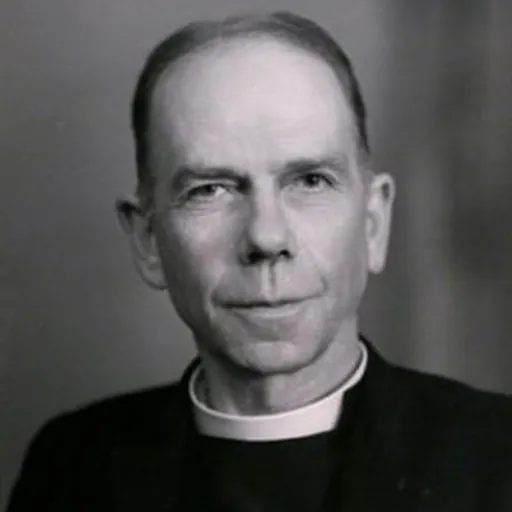
About Russell Barry
Lived 1890 – 1976 (aged 85–86). Russell Barry was a British anglican priest and chaplain.
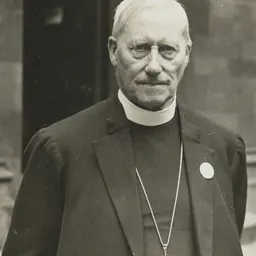
Frank Russell Barry (28 January 189024 October 1976) was an Anglican bishop and author who served as Bishop of Southwell for over 20 years in the middle of the 20th century.
Family and education Born in Rochester, Kent, Barry was the son of another priest, George Duncan Barry, who served as curate of St Peter's Rochester then of St Mark's Surbiton, and was later Rector of Bratton Fleming; then ordained priest the following Trinity (30 May 1915) — both times by Charles Gore, Bishop of Oxford, at Cuddesdon Parish Church; very exceptionally, he was not ordained to a title post but to officiate throughout the diocese. In 1929, he married Lilian Janet Gray; they had one child, a daughter. As TCF he was awarded the Distinguished Service Order and Mentioned in Despatches. The citation for his DSO referred to his actions near Mouquet Farm during the Battle of the Somme. 'For conspicuous gallantry and devotion to duty. He tended and dressed the wounded under very heavy fire with the greatest courage and determination. He set a splendid example throughout the operation'. He was also awarded the Montenegrin medal. In 1923, Barry was appointed Archdeacon in Egypt and Chaplain of All Saints', Cairo (Anglican Diocese of Egypt); but returned to England the same year to become Professor of New Testament Interpretation at King's College London. Later, in 1929, he was honoured with a Fellowship of King's College London (FKC). He was also a Chaplain to the King, 1930–1941, and Canon Theologian of Liverpool Cathedral, 1932–1933. He served there for 22 years before retiring to Borrowdale; he resigned his See in October 1963. During his episcopate, his hearing loss worsened and he suffered depression; he was a notable liberal and theologically progressive on matters such as homosexuality and remarriage of divorcés. Death and legacy In retirement, he divided his time between a house in the Lake District and a flat in Westminster, where he died on 24 October 1976, following a coronary in June that year. He was buried in Borrowdale churchyard rather than his further cathedral at Southwell Minster, where there is nonetheless a memorial plaque.
He was honoured by the universities of St Andrews and Nottingham and by Lambeth as a Doctor of Divinity. As an academic theologian, he was extensively published; as both writer and preacher, his specialism was the popular exposition of Christianity — his most noted work was The Relevance of Christianity (1931). In 1923, he was one of the authors — with his friend Mervyn Haigh — of A New Prayer Book (called the Grey Book), one of several proposed drafts in the development of the abortive 1928 prayer book. Barry also served on the archbishops' commission on doctrine starting in 1923.
Don’t just read it —
keep it.
Full-length biographies made to live with: read them, listen on the way to work, watch them tonight.
- E-book
- Audio
- Video
Instant download · yours to keep · every purchase keeps this site free
Important facts
People in Russell Barry's life
Named in this biography and alive at the same time



Related people
Same field, nearest in time

Contemporaries
People whose lives overlapped Russell Barry's




Frequently asked questions
Who was Russell Barry?
British bishop
When was Russell Barry born?
Russell Barry was born in 1890.
When did Russell Barry die?
Russell Barry died in 1976.
What was Russell Barry's occupation?
Russell Barry was an anglican priest and chaplain.
What nationality was Russell Barry?
Russell Barry was British.
Sources & further reading
Cite this page
APA: Biography.guide. (2026). Russell Barry. https://biography.guide/russell-barry/
MLA: "Russell Barry." Biography.guide, https://biography.guide/russell-barry/.
Chicago: "Russell Barry." Biography.guide. https://biography.guide/russell-barry/.
Data last updated: 2026-09-23 · Spot an error? Report a correction.
Portrait: Wikimedia Commons · author & licence
Page generated 2026-09-27 05:05 UTC