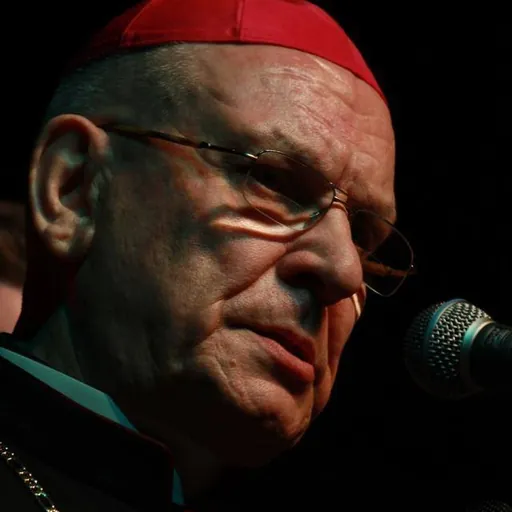
About Rudolf Baláž
Lived 1940 – 2011 (aged 70). Rudolf Baláž was a Czech catholic priest and catholic bishop.
Rudolf Baláž (20 November 1940 in Nevoľné – 27 July 2011 in Banská Bystrica) was a Slovak Bishop of the Roman Catholic Diocese of Banská Bystrica from 1990 until his death in 2011. Baláž was ordained as a Catholic priest on 23 June 1963.
Immediately after his ordination, Baláž became a target of the communist regime in Czechoslovakia due to his independence, his appeal among young people, and his refusal to cooperate with state authorities. After participating in the 1966 millennium celebrations of the Polish Church, he was subjected to intensive surveillance and interrogation by the State Security. In 1971 he was stripped of his state permission to serve publicly as a priest and was forced to work for more than a decade as a laborer, tractor driver, and truck driver. During this period he remained active in the clandestine pastoral network, organizing retreats, producing religious materials, and maintaining contact with figures of the underground Church, including Cardinal Ján Korec.
Bishop Following the political thaw of the 1980s, Baláž returned to official ministry and became an important link between the legal and underground Church. In March 1990 Pope John Paul II appointed him Bishop of Banská Bystrica. As a Bishop, Baláž reorganized diocesan structures, supported the development of Catholic media and educational institutions, and defended ecclesial independence from political influence. During the 1990s he became one of the few high-ranking Church leaders in Slovakia to openly criticize the authoritarian tendencies of Vladimír Mečiar. His public interventions, including speeches at civic demonstrations, positioned him as a significant moral authority in the emerging public sphere.
Baláž was also the target of political pressure and intelligence operations, most notably the 1995 “triptych affair,” in which the Slovak Information Service attempted to implicate him in an alleged illegal art sale. The subsequent unauthorized police search of the diocesan offices provoked national and international criticism and was widely interpreted as an effort to intimidate the Church. Despite persecution by the state, Balaž played a key role in establishing institutions such as Rádio Lumen, TV Lux, the Catholic University in Ružomberok, and the Saint Agatha Breast Cancer Center.
Don’t just read it —
keep it.
Full-length biographies made to live with: read them, listen on the way to work, watch them tonight.
- E-book
- Audio
- Video
Instant download · yours to keep · every purchase keeps this site free
Important facts
People in Rudolf Baláž's life
Named in this biography and alive at the same time



Related people
Same field, nearest in time

Contemporaries
People whose lives overlapped Rudolf Baláž's



Frequently asked questions
Who was Rudolf Baláž?
Roman Catholic bishop (1940–2011)
When was Rudolf Baláž born?
Rudolf Baláž was born on 20 November 1940 in Nevoľné.
When did Rudolf Baláž die?
Rudolf Baláž died on 27 July 2011 in Banská Bystrica.
What was Rudolf Baláž's occupation?
Rudolf Baláž was a catholic priest and catholic bishop.
What nationality was Rudolf Baláž?
Rudolf Baláž was Czech.
Sources & further reading
Cite this page
APA: Biography.guide. (2026). Rudolf Baláž. https://biography.guide/rudolf-balaz/
MLA: "Rudolf Baláž." Biography.guide, https://biography.guide/rudolf-balaz/.
Chicago: "Rudolf Baláž." Biography.guide. https://biography.guide/rudolf-balaz/.
Data last updated: 2026-09-20 · Spot an error? Report a correction.
Portrait: Wikimedia Commons · author & licence
Page generated 2026-09-27 04:57 UTC