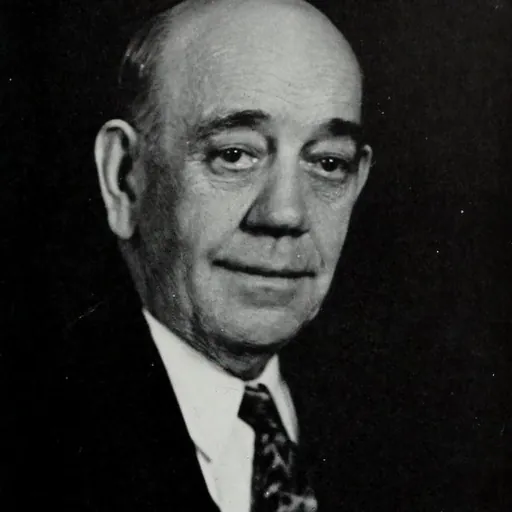
About Ruby Laffoon
Lived 1869 – 1941 (aged 72). Ruby Laffoon was an American democratic Party, lawyer and judge.
Ruby Laffoon (January 15, 1869 – March 1, 1941) was an American attorney and politician who served as the 43rd governor of Kentucky from 1931 to 1935. A Kentucky native, at age 17, Laffoon moved to Washington, D.C., to live with his uncle, U.S. Representative Polk Laffoon. He developed an interest in politics and returned to Kentucky, where he compiled a mixed record of victories and defeats in elections at the county and state levels. In 1931, he was chosen as the Democratic gubernatorial nominee by a nominating convention, not a primary, making him the only Kentucky gubernatorial candidate to be chosen by a convention after 1903. In the general election, he defeated Republican William B. Harrison by what was then the largest margin of victory in Kentucky gubernatorial history.
Dubbed "the terrible Turk from Madisonville", He was the third child and only son of John Bledsoe Laffoon Jr. and Martha Henrietta (née Earle) Laffoon. According to Laffoon biographer Vernon Gipson, his parents could not decide on a name for their new child, and for several years, referred to him only as "Bud".
The Laffoons were primarily farmers but also had some experience in politics. Ruby Laffoon's grandfather, John Bledsoe Laffoon Sr., migrated to Kentucky from South Carolina in 1815 and served one term in the Kentucky House of Representatives.
Laffoon's early education was obtained in the public schools of Madisonville. While there, one of his teachers was his sister, Susan Isabella Laffoon, who was only 16 years old. At age 15, while plowing a field, Laffoon was kicked in the hip by a mule, requiring a six-week stay in a Nashville hospital. In the winter of the same year, he slipped on some ice and re-injured the hip. As a result of these injuries, his right leg was one-and-a-half inches shorter than his left leg, requiring him to wear special shoes and walk with a cane and a limp for the rest of his life. After his injury, Laffoon's parents decided that he could not make his living as a farmer and sent him to the private school of W. C. O'Bryan. By age 17, he was teaching in the common schools of Charleston in Hopkins County.
Legal and early political career In 1886, Laffoon moved to Washington, D.C., to live with his uncle, U.S. Representative Polk Laffoon. There he served as a messenger in the office of Judge C. R. Faulkner, director of the pension office. On October 17, 1888, he matriculated to Washington and Lee University, where he earned a law degree in 1890. He returned to Madisonville, was admitted to the bar, and began practicing in the office of Judge William H. Yost. In 1892, he was elected city attorney of Madisonville over Ward Headley.
Laffoon married Mary "May" Bryant Nisbet on January 31, 1894, at, the Lucille Hotel in Madisonville. The couple had three daughters. Besides supporting her husband's political endeavors, May Laffoon was also active in politics. She was a delegate-at-large to every Democratic National Convention between 1932 and 1960, and actively campaigned for Franklin D. Roosevelt during his first run for the presidency. To supplement the family's income, Ruby Laffoon became a partner in the Madisonville branch of the Phoenix Insurance Company in 1897. He sold his interest in the company in 1901, the same year he made a second bid to become county attorney. He won the election over Thomas E. Finley by a vote of 3,335 to 2,910. In 1905, he was re-elected to his post, marking the first time in the history of Hopkins County that the county attorney had been re-elected.
In 1907, Laffoon sought the office of state treasurer. In 1911, he ran for state auditor, but lost in the primary to Henry M. Bosworth. That same year, he was elected as one of Hopkins County's delegates to the state Democratic convention. A bill passed in the state legislature in 1912 created a State Insurance Rating Board under the office of state auditor, and Bosworth appointed Laffoon chairman of the board due to his experience in the insurance field and as a reward for his loyalty to the party. In 1915, Laffoon sought the post of Commonwealth's Attorney for the Fourth Judicial District, which comprised Hopkins, Caldwell, Crittenden, and Livingston counties. He lost in the primary to J. Elliott Baker, but the Republican candidate, Charles Ferguson, won the general election.
Governor of Kentucky In 1931, Laffoon sought the Democratic gubernatorial nomination. As a result of factional infighting within the Democratic party, the Democrats opted for a nominating convention instead of a primary to choose their nominee for governor. It was the first nominating convention held by the Democrats since the Music Hall Convention that nominated William Goebel in 1899, and it was the only one held after 1903. The convention was held in Lexington on May 12, 1931. Laffoon gained the support of several important leaders within the party, including Ben Johnson, Thomas Rhea, M. M. Logan, Allie Young, and William J. Fields. He was selected in a landslide over a myriad of candidates, including sitting lieutenant governor James Breathitt Jr.
Despite his physical disability, Laffoon waged a vigorous campaign across the state. During campaign stops, he interspersed political commentary with passages from the Bible. The Louisville Courier-Journal objected to his campaign style and gave a tentative endorsement to the Republican William B. Harrison, the mayor of Louisville. During his term as governor, Laffoon commissioned 2,368 honorary colonels, the most ever by a Kentucky governor. His best known commission was to Harland Sanders, who used the title "Colonel" when he opened his chain of Kentucky Fried Chicken restaurants.
Fight for a sales tax Laffoon's administration was confronted by the economic difficulties of the Great Depression. On March 2, 1932, a mob of 100 anti-tax protesters stormed the governor's mansion, damaging some items inside. In an attempt to get the tax passed, Laffoon agreed to seek only a 1 percent tax.
Happy Chandler, Laffoon's lieutenant governor, opposed his call for a state sales tax. The sales tax proposal caused a rift in the Democratic party generally and in Laffoon's administration specifically. Consequently, all of Kentucky's representatives that year were elected at-large. The Louisville Courier-Journal called the 1932 legislative session "about the worst legislative session in Kentucky's history". He twice extended the holiday, which finally ended on March 18. Responding to complaints of low prices by farmers, he closed burley tobacco markets in December of that year. Kentucky was also unable to secure significant financial assistance under President Franklin D. Roosevelt's New Deal because the state was often unable to raise the required matching funds. However, in August 1933, he did call a special session to debate a "gross receipts tax", which was essentially a sales tax by another name. Additional revenue was generated by increasing the tax on whiskey from 2 cents to 5 cents per gallon. Some of them made death threats against Laffoon, and the Kentucky National Guard surrounded the governor's mansion to protect him. This move was made in order to groom Rhea to be the next governor. Due to the influence of Laffoon and Rhea, the Democratic Party again chose a nominating convention in lieu of a primary to choose their gubernatorial candidate. The convention was scheduled for May 14, 1935, in Lexington.
On January 5, 1935, Laffoon traveled to Washington, D.C. to meet with President Roosevelt. Although Laffoon said the purpose of his trip was to discuss further federal aid for Kentucky, his opponents maintained he had gone to explain the lack of a primary to the president. (Roosevelt had written a letter to the state Democratic Central Committee encouraging them to adopt a primary.) Due to Laffoon's absence from the state, Lieutenant Governor Chandler was left as acting governor under the provisions of the Kentucky Constitution. On February 6, Chandler issued a proclamation calling a special session of the legislature on February 8 to consider a bill requiring a primary election to select nominees for all state offices. Laffoon rushed back to the state, arriving in Ashland on February 7, and immediately issued a proclamation revoking Chandler's call. Franklin County legislator John Gatewood obtained an injunction against Laffoon's order, and pro-primary legislators gathered in Frankfort on February 8. These members failed to achieve a quorum on February 8, 9 and 11. On February 11, six legislators sought a declaratory judgment to see if Laffoon's revocation was legal. The Franklin County Circuit Court upheld Chandler's call and invalidated Laffoon's revocation, and the Kentucky Court of Appeals, then the court of last resort in the state, upheld this decision by a 4–3 majority.
On February 13, the Kentucky House achieved a quorum, and the Senate did so the following day. Having lost the battle against the special session, Laffoon proposed a primary with a run-off if no candidate received a majority on the first ballot. Supporters of a single primary found they did not have the votes in the legislature to pass it, so they agreed to a double primary, which Laffoon signed into law on February 27, 1935.
Seven candidates declared their candidacy for the Democratic nomination, including Rhea and Lieutenant Governor Chandler. Former governor Beckham was not a candidate; his only son had died in late 1934, devastating his family and leaving his wife strongly opposed to another political campaign. Two candidates dropped out of the race prior to the election.
On the day of the primary, Adjutant General Denhardt took National Guard troops into Harlan County, which was known for its history of election violence. The troops questioned voters, examined ballot boxes, and made several arrests. These actions were in direct violation of a restraining order issued by circuit court judge James M. Gilbert, but Denhardt claimed to be acting on orders from Laffoon. Denhardt later reported that "We stopped the most stupendous, well-planned election steal ever attempted in Kentucky. Chandler would have gotten 15,000 votes had we not been here."
In the primary, Rhea achieved a plurality of the votes, but not a majority. Chandler had the next highest vote total, and the two faced each other in a run-off on September 7, 1935. In the run-off, Chandler defeated Rhea, securing the nomination for governor. Laffoon and Rhea, along with most of Laffoon's administration, bolted the party and supported Republican nominee King Swope. Despite losing the support of his predecessor, Chandler went on to win the general election. In his last days in office, Laffoon issued pardons for Denhardt and others charged in connection with the National Guard's interference with the primary in Harlan County. These were among a record 560 pardons issued by Laffoon, most of which were to relieve prison crowding. Term-limited by the state constitution, he returned to private life following his four years in office.
Shortly after Chandler's inauguration, attorney general Beverly M. Vincent opined that Kentucky Colonel commissions expired at the end of the commissioning governor's term. Laffoon vigorously defended the commissions he had issued and those issued by his predecessors. On April 27, 1936, when both Governor Chandler and Lieutenant Governor Keen Johnson attended a baseball game in Cincinnati, President Pro Tem of the Senate James Eugene Wise was left as acting governor and recommissioned all 17,000 existing colonels.
Laffoon was a member of the Democratic National Committee in 1936, but decided not to attend the national convention. He chose Urey Woodson to serve as his proxy, but Woodson declined to attend as well and turned the proxy over to Fred M. Vinson. Laffoon also backed Senator M. M. Logan's re-election bid in 1936. He was a delegate to the Democratic National Convention in 1940, and despite his differences with President Roosevelt during his gubernatorial term, he supported Roosevelt's re-election.
Defying a doctor's order not to work for two weeks due to high blood pressure, Laffoon presided for three days as a special judge in the Union County Circuit Court in February 1941. On February 17, 1941, he returned home early from his law office due to a bout of dizziness. He was buried in Grapevine Cemetery in Madisonville.
Don’t just read it —
keep it.
Full-length biographies made to live with: read them, listen on the way to work, watch them tonight.
- E-book
- Audio
- Video
Instant download · yours to keep · every purchase keeps this site free
Important facts
People in Ruby Laffoon's life
Named in this biography and alive at the same time





Contemporaries
People whose lives overlapped Ruby Laffoon's





Frequently asked questions
Who was Ruby Laffoon?
American politician (1869–1941)
When was Ruby Laffoon born?
Ruby Laffoon was born on 15 January 1869 in Madisonville.
When did Ruby Laffoon die?
Ruby Laffoon died on 1 March 1941 in Madisonville.
What was Ruby Laffoon's occupation?
Ruby Laffoon was a democratic Party, lawyer and judge.
What nationality was Ruby Laffoon?
Ruby Laffoon was American.
Sources & further reading
Cite this page
APA: Biography.guide. (2026). Ruby Laffoon. https://biography.guide/ruby-laffoon/
MLA: "Ruby Laffoon." Biography.guide, https://biography.guide/ruby-laffoon/.
Chicago: "Ruby Laffoon." Biography.guide. https://biography.guide/ruby-laffoon/.
Data last updated: 2026-09-23 · Spot an error? Report a correction.
Portrait: Wikimedia Commons · author & licence
Page generated 2026-09-27 05:05 UTC