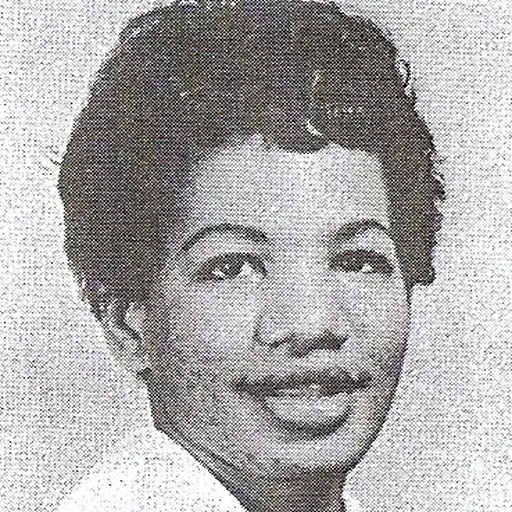
About Ruby Doris Smith-Robinson
Lived 1942 – 1967 (aged 25). Ruby Doris Smith-Robinson was an American activist.
Ruby Doris Smith-Robinson (April 25, 1942 – October 7, 1967) worked with the Student Nonviolent Coordinating Committee (SNCC) from its earliest days in 1960 until her death in October 1967. She served the organization as an activist in the field and as an administrator in the Atlanta central office. She eventually succeeded James Forman as SNCC's executive secretary and was the only woman ever to serve in this capacity. She was well respected by her SNCC colleagues and others within the movement for her work ethic and dedication to those around her. SNCC Freedom Singer Matthew Jones recalled, "You could feel her power in SNCC on a daily basis". Jack Minnis, director of SNCC's opposition research unit, insisted that people could not fool her. Over the course of her life, she served 100 days in prison for the movement. The Smith children lived a comfortable existence in their separate Black world. Their parents made their earnings off of Black patronage rather than from the support of whites, which showed Ruby from a young age the power and independence that Black people could have. They had strong adult support, and they had their own churches, schools, and social activities.
No matter how insulated they were, however, the reality of American racism and segregation intruded from time to time. Smith-Robinson recalled her feelings about segregation in those early years saying, "I was conscious of my Blackness. Every young Negro growing up in the South has thoughts about the racial situation." Her sister Catherine remembers that even as an adolescent, Ruby said to her, "I know what my life and mission is…It's to set the Black people free. I will never rest until it happens. I will die for that cause." A specific encounter she had with segregation as a young girl was on a summer day when she and her sister went to the drugstore for an ice cream cone. The clerk used his hands to grab her cone and handed it to her. She replied saying, "I won't be eating that one" because she knew that they used tissues to grab cones for the white customers.
Atlanta Student Movement
Young Ruby, like many young Black Americans of her generation, became convinced that change was possible. When she entered Spelman College in 1959, she quickly became involved in the Atlanta Student Movement after being inspired by the Greensboro North Carolina lunch counter sit-in, which prevented blacks from eating at the same lunch counter as white people did during her sophomore year. She participated in many sit-ins and was arrested a few times after getting involved in the Atlanta Student Movement. She regularly picketed and protested with her colleagues in a bid to integrate Atlanta.
In the summer of 1960, though many students involved in the Atlanta Student Movement were no longer on campus, Smith-Robinson continued to organize. This included initiating an economic boycott and kneel-ins at whites churches. The slogan she created for the boycott was "have integration will shop, have segregation will not." Even on days when no one else was there to protest, she picketed outside the A&P grocery store alone.
After Ruby served time in prison for taking part in the Freedom Rides, she was a student conferee at a student leadership seminar taking part in Nashville, Tennessee. Here she raised the issue of attacks within the black community and the need to deal with problems among fraternities and sororities. She noticed that the majority of graduates from the universities that produced the most doctors and lawyers were light-skinned and connected to fraternities. She discovered that this was due to the fact that fraternity brothers were on the admissions committees. The movement's focus needed to be also within the black community. The following year, she argued that blacks must maintain the dominance of the SNCC after the organization had become dependent on whites for financial and political help. She suggested that they recruit southerners and set a limit on how many northerners they accepted since they sometimes caused tension within SNCC. One of her coworkers believed she "had been anti-white for years", although others dispute this since later on in her involvement in SNCC, one of her closest friends was white. She maintained much of the black nationalist agenda without being anti-white. For many years, she was suspected of being the author of the anonymously submitted paper "The Position of Women in SNCC" from the 1964 SNCC staff meeting in Waveland, Mississippi, since credited, principally, to Casey Hayden and Mary King. Smith-Robinson was responsible for providing logistics and support for the many community organizing initiatives SNCC began in the south and north during the group's Black Power campaign. During the same election, Stokely Carmichael was voted in as chairman, which transformed the organization since he was perceived as militant and anti-white. She died on October 7, 1967, aged 25.
Don’t just read it —
keep it.
Full-length biographies made to live with: read them, listen on the way to work, watch them tonight.
- E-book
- Audio
- Video
Instant download · yours to keep · every purchase keeps this site free
Important facts
People in Ruby Doris Smith-Robinson's life
Named in this biography and alive at the same time





Related people
Same field, nearest in time





Contemporaries
People whose lives overlapped Ruby Doris Smith-Robinson's


Frequently asked questions
Who was Ruby Doris Smith-Robinson?
American activist (1942–1967)
When was Ruby Doris Smith-Robinson born?
Ruby Doris Smith-Robinson was born on 25 April 1942 in Atlanta.
When did Ruby Doris Smith-Robinson die?
Ruby Doris Smith-Robinson died on 9 October 1967.
What was Ruby Doris Smith-Robinson's occupation?
Ruby Doris Smith-Robinson was an activist.
What nationality was Ruby Doris Smith-Robinson?
Ruby Doris Smith-Robinson was American.
Sources & further reading
· Wikipedia: Ruby Doris Smith-Robinson
· DBpedia: Ruby Doris Smith-Robinson
Cite this page
APA: Biography.guide. (2026). Ruby Doris Smith-Robinson. https://biography.guide/ruby-doris-smith-robinson/
MLA: "Ruby Doris Smith-Robinson." Biography.guide, https://biography.guide/ruby-doris-smith-robinson/.
Chicago: "Ruby Doris Smith-Robinson." Biography.guide. https://biography.guide/ruby-doris-smith-robinson/.
Data last updated: 2026-09-23 · Spot an error? Report a correction.
Portrait: Wikimedia Commons · author & licence
Page generated 2026-09-27 05:07 UTC