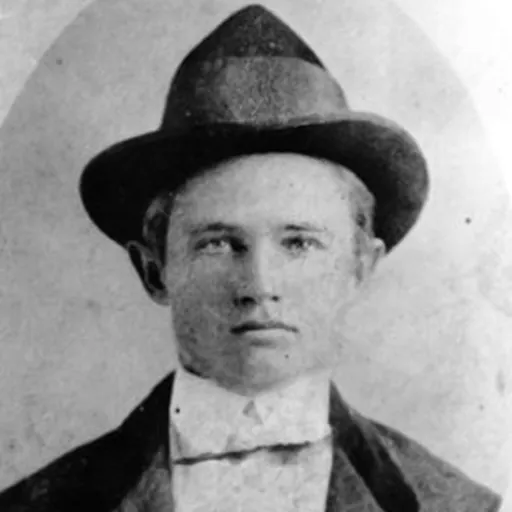
Rube Burrow
American outlaw and train robber
About Rube Burrow
Lived 1855 – 1890 (aged 34). Rube Burrow was an American.
Reuben Houston Burrow (December 11, 1855 – October 9, 1890) was a train-robber and outlaw in the Southern and Southwestern United States. During the final years of the American frontier, he became one of the most infamous and hunted men in the Old West since Jesse James. From 1886 to 1890, he and his gang robbed express trains in Alabama, Arkansas, Louisiana, the Indian Territory and Texas while pursued by hundreds of lawmen throughout the southern half of the United States, including the Pinkerton National Detective Agency.
Biography
Early life Born in Lamar County, Alabama on December 11, 1855, Rube Burrow worked on the family farm in Alabama until the age of 18 when he moved to Stephenville, Texas to work on his uncle's ranch. By all accounts, Burrow fully intended to become a rancher by saving up enough money to buy a farm, marry and start a family. He attempted farming but his wife, Virginia Catherine Alverson Burrow, died of yellow fever in 1881, leaving him to care for two small children. He remarried in 1884 and moved to Alexander, Texas, but when his crops failed he turned to robbing trains with his brother Jim in 1886.
His unexpected turn to crime occurred on December 11, 1886 when he and his brother Jim teamed with W.L Brock, Leonard Brock, Henderson Brumley, and Nep Thornton ) as the passengers were able to hide most of their valuables by the time the outlaws passed through. In one of the cars, a U.S. Army sergeant of 24th Infantry Regiment (United States) Although how much Burrow escaped with is not known, it was apparently enough for Burrows to rob a second train at the same spot on September 20, 1887. On the second occasion, news reports estimated Burrows and his gang escaped anywhere from $1,200 to between $12,000 and $30,000. Because the Southern Express Company was a client of the Pinkerton Detective Agency, the robbery came to the attention of Pinkerton detectives, lawmen and bounty hunters alike. Within five days, Pinkerton men came up with their first major lead. A deputy sheriff had reported that he had encountered three suspicious looking men on the day of the robbery. All three escaped, however one of the men left behind a raincoat which was eventually traced to a store in Dublin, Texas. The sales clerk identified the man who bought the coat as Jim Brock. Once in custody, Brock quickly confessed to participating in the robbery and named Burrow as the ringleader. Jim was taken into custody and sent to jail in Texarkana where he would die from tuberculosis on October 5, 1888. who in falling knocked the pistol out of Wilkinson's hand.
Although Burrow was usually a cautious and detailed planner, he began to develop a reckless attitude which was further encouraged by his recent series of near escapes. Shortly after the gunfight at Montgomery, Burrow shot and killed Lamar County Postmaster Mose Graves in July 1889 during a heated argument when Graves demanded that Burrows sign for delivery of a package. The uncharacteristically cold-blooded murder of the postmaster turned the local residents against him and forced him to flee the county. Rube Burrow was captured by Jesse Hildreth and Frank Marshall, with the help of two planters, John McDuffie and Jeff "Dixie" Carter, at George Ford’s cabin in Myrtlewood, Marengo County, Alabama. McDuffie had suspected Burrow would be in the area and warned Hildreth to be on the lookout. When Burrow showed up at Ford's cabin, Hildreth was inside and was able to get word back to McDuffie. Hildreth and Marshall jumped Burrow and held him for McDuffie and Carter. They took him to the jail in Linden, Alabama, with Burrow entertaining them all the way with funny stories. Rube offered Hildreth a hundred dollars if he would let him go. Hildreth said "I couldn't use it then, cause you'd kill me first".
In the early morning of December 9, 1890, Burrow complained of hunger and talked his jailers into handing him his bag, which had some ginger snaps inside. It also contained a gun, and Burrow held it at the head of one of the guards. He escaped, locking two guards (including McDuffie) in his cell, and taking another guard with him to find Carter at Glass's store to get back money that had been taken from him. Burrow reportedly believed Dixie Carter was Nick Carter, the fictional detective. Carter was in the store, and when he came outside, he and Burrow exchanged gunfire. Afterwards, Burrow was dead in the street and Carter was wounded.
Burrow’s body was shipped by train back to Lamar County. It was reported that on a stop in Birmingham, thousands viewed the corpse and people snatched buttons from his coat, cut hair from his head, and even his boots were stolen. Burrow's father Allen Burrow met the train in Sulligent. It was reported that the train attendants threw the coffin at his feet. "It is Rube," he reportedly said. Allen Burrow carried his son's body back to his home community near Vernon and buried him in Fellowship Cemetery.
In December 1890, accomplice Jackson committed suicide in the Jackson Penitentiary by jumping from his gallery. and died April 20, 1895.
Paul Picerni played Burrow in a 1955 episode of the syndicated television series Stories of the Century, starring and narrated by Jim Davis.
Don’t just read it —
keep it.
Full-length biographies made to live with: read them, listen on the way to work, watch them tonight.
- E-book
- Audio
- Video
Instant download · yours to keep · every purchase keeps this site free
Important facts
People in Rube Burrow's life
Named in this biography and alive at the same time



Contemporaries
People whose lives overlapped Rube Burrow's



Frequently asked questions
Who was Rube Burrow?
American outlaw and train robber (1855-1890)
When was Rube Burrow born?
Rube Burrow was born on 11 December 1855 in Lamar County.
When did Rube Burrow die?
Rube Burrow died on 9 October 1890 in Marengo County.
What nationality was Rube Burrow?
Rube Burrow was American.
Sources & further reading
Cite this page
APA: Biography.guide. (2026). Rube Burrow. https://biography.guide/rube-burrow/
MLA: "Rube Burrow." Biography.guide, https://biography.guide/rube-burrow/.
Chicago: "Rube Burrow." Biography.guide. https://biography.guide/rube-burrow/.
Data last updated: 2026-09-23 · Spot an error? Report a correction.
Portrait: Wikimedia Commons · author & licence
Page generated 2026-09-27 05:06 UTC