
About Roza Shanina
Lived 1924 – 1945 (aged 20). Roza Shanina was a Russian sniper, educator and military personnel.
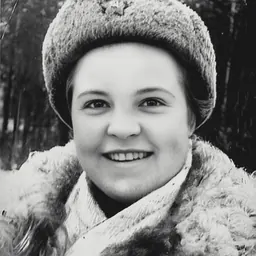
Roza Georgiyevna Shanina (, ; 3 April 1924 – 28 January 1945) was a Soviet sniper during World War II who was credited with over 50 kills. Shanina volunteered for the military after the death of her brother in 1941 and chose to be a sniper on the front line. Praised for her shooting accuracy, Shanina was capable of precisely hitting enemy personnel and making doublets (two target hits by two rounds fired in quick succession).
In 1944, a Canadian newspaper described Shanina as "the unseen terror of East Prussia". She became the first servicewoman of the 3rd Belorussian Front to receive the Order of Glory. Shanina was killed in action during the East Prussian Offensive while shielding the severely wounded commander of an artillery unit. Shanina's actions received praise during her lifetime, but conflicted with the Soviet policy of sparing snipers from heavy battles. Shanina kept a war diary that was first published in 1965 and later translated into English.
Early life
Roza Shanina was born on 3 April 1924 in the Russian village of Edma in Arkhangelsk Oblast in the Soviet Union to Anna Alexeyevna Shanina, a kolkhoz milkmaid, and Georgiy (Yegor) Mikhailovich Shanin, a logger who had been disabled by a wound received during World War I. Roza was reportedly named after the Marxist revolutionary Rosa Luxemburg and had six siblings: one sister Yuliya and five brothers: Mikhail, Fyodor, Sergei, Pavel, and Marat. The Shanins also raised three orphans. Roza was above average height, with light brown hair and blue eyes, and spoke in a Northern Russian dialect. After finishing four classes of elementary school in Yedma, Shanina continued her education in the village of Bereznik. As there was no school transport at the time, when she was in grades five through seven Roza had to walk to Bereznik to attend middle school. Shanina left home with little money and almost no possessions; and before moving to the college dormitory she lived with her elder brother Fyodor. In 1938, Shanina became a member of the Soviet youth movement Komsomol.
Two years later, Soviet secondary education institutes introduced tuition fees, and the scholarship fund was cut. Shanina received little financial support from home and on 11 September 1941, she took a job in kindergarten No. 2 (lately known as Beryozka) in Arkhangelsk, with which she was offered a free apartment. when the Soviet Union was in the grip of World War II.
Tour of duty
Shanina in November 1944, wearing a male-issue wool field shirt and woollen skirt. The shirt was khaki, while the skirt was dark blue. Following the German invasion of the Soviet Union, Arkhangelsk was bombed by the Luftwaffe, and Shanina and other townspeople were involved in firefighting and mounted voluntary vigils on rooftops to protect the kindergarten. Shanina's two elder brothers had volunteered for the military. In December 1941, a death notification was received for her 19-year-old brother Mikhail, who had died during the siege of Leningrad. In response, Shanina went to the military commissariat to ask for permission to serve. In February 1942, Soviet women between the ages of 16 and 45 became eligible for the military draft, but Shanina was not drafted that month, as the local military commissariat wanted to spare her from the draft. She first learned to shoot at a shooting range. She was asked to stay as an instructor there, but refused due to a call of duty. In 1941–1945 a total of 2,484 Soviet female snipers were deployed for the war and their combined tally of kills is estimated to be at least 11,280.
After the momentous victory in the Battle of Stalingrad, the Soviets mounted nationwide counter-offensives and Shanina on 2 April 1944 joined the 184th Rifle Division, where a separate female sniper platoon had been formed. Shanina was appointed a commander of that platoon. Concerned, the other women ran up saying, "That was a fascist you finished off!"
For her actions in the battle for the village of Kozyi Gory (Smolensk Oblast), Shanina was awarded her first military decoration, the Order of Glory 3rd Class, on 18 April 1944. She became the first servicewoman of the 3rd Belorussian Front to receive that order. According to the commendation list of Major Degtyarev (the commander of the 1138th Rifle Regiment), she received the award for killing 13 enemy soldiers while subjected to artillery and machine gun fire between 6 and 11 April. and despite the Soviet policy of sparing snipers, Shanina asked to be sent to the front line. Although her request was refused, she went anyway. Shanina was later sanctioned for going to the front line without permission, but did not face a court martial. She wanted to be attached to a battalion or a reconnaissance company, turning to the commander of the 5th Army, Nikolai Krylov. Shanina also wrote twice to Joseph Stalin with the same request.
From 26 to 28 June 1944, Shanina participated in the elimination of the encircled German troops near Vitebsk during the Vitebsk–Orsha Offensive. As the Soviet army advanced further westward, from 8 to 13 July of the same year, Shanina and her sisters-in-arms took part in the battle for Vilnius, Shanina successfully used counter-sniper tactics against a German cuckoo sniper hidden in a tree, by waiting until dusk when the space between the tree branches would be backlit by sunlight and the sniper's nest became visible. On one occasion, Shanina also made use of selective fire from a submachine gun.
Diary
Shanina enjoyed writing and would often send letters to her home village and to her friends in Arkhangelsk. there were some furtive exceptions, such as The Front Diary by Izrael Kukuyev and The Chronicle of War by Muzagit Hayrutdinov. To preserve military secrecy, Shanina termed the killed and wounded "blacks" and "reds" respectively in her diary.
After Shanina's death, the diary, consisting of three thick notebooks, was kept by the war correspondent Pyotr Molchanov for twenty years in Kiev. An abridged version was published in the magazine Yunost in 1965, and the diary was transferred to the Regional Museum of Arkhangelsk Oblast. In 2020, the English translation of the diary by A. G. Mogan was published. Another edition of her diary, translated by David Foreman and introduced by firearms author John Walter, was published in 2021 by Greenhill Books.
East Prussia In August 1944, advancing Soviet troops had reached the Soviet border with East Prussia and by 31 August of that year Shanina's battle count reached 42 kills. At that time, two Canadian newspapers, the Ottawa Citizen and Leader-Post, reported that according to an official dispatch from the Šešupė River front, Shanina killed five Germans in one day as she crouched in a sniper hideout. of which 15 were made on German soil and seven during an offensive. On 17 September, Unichtozhim Vraga credited Shanina with 51 hits. She was among the first female snipers to receive the Medal for Courage. Shanina was awarded the medal on 27 December for the gallant posture displayed during a German counter-offensive on 26 October. There Shanina fought together with Captain Igor Aseyev, a Hero of the Soviet Union, and witnessed his death on 26 October. Shanina, who served as an assistant platoon commander, was ordered to commit the female snipers to combat. Shanina had hoped to go to university after the war, or if that was not possible, to raise orphans. (fifty-four, according to other sources ), including twelve kills during the Battle of Vilnius, with sixty-two enemies knocked out of action. and in the newspaper Krasnaya Zvezda, which said that Shanina was one of the best snipers in her unit and that even veteran soldiers were inferior to her in shooting accuracy. Shanina's exploits were also reported in the Western press, particularly in Canadian newspapers, where she was called "the unseen terror of East Prussia". She paid no special attention to the achieved renown, and once wrote that she had been overrated. On 16 January 1945, Shanina wrote in her war diary: "...but what have I actually done? No more than I have to as a Soviet person, having stood up to defend the motherland." In the same entry, she wrote that she had no fear and that she had even agreed to go "to a melee combat." The next day, Shanina wrote in a letter that she might be on the verge of being killed because her battalion had lost 72 out of 78 people. Despite attempts to save her, Shanina died the following day Shanina was initially buried in Reichau (now Cherepanovo) or, according to some sources, under a spreading pear tree on the shore of the Alle River (now the Lava),
Posthumous honours In 1964–65 a renewed interest in Shanina arose in the Soviet press, largely due to the publication of her diary. The newspaper Severny Komsomolets asked Shanina's contemporaries to write what they knew about her. In Arkhangelsk, regular shooting competitions were organized among members of the paramilitary DOSAAF sport organisation for the Roza Shanina Prize, The village of Malinovka in Ustyansky District started to hold annual cross-country ski races for the Roza Shanina Prize.
In 1985, the Council of Veterans of the Russian Central Women Sniper Academy unsuccessfully requested the Supreme Soviet of the Soviet Union to posthumously bestow the Order of Glory 1st Class on Shanina (which would have made her a Full Cavalier of that order). In the same year, Russian author Nikolai Zhuravlyov published the book Posle boya vernulas (Returned After Battle). Its title refers to Shanina's words, "I will return after the battle," which she uttered after receiving a note from her battalion commander urging her to return to the rear immediately. A small memorial stele dedicated to Shanina (part of a three-piece monument) was erected in Bogdanovsky settlement, Ustyansky District.
In 2000, Shanina's name appeared on the war memorial stone of the Siberian State Technological University, although there is no evidence she had any affiliation with it during her life. Russian author Viktor Logvinov controversially wrote in the 1970s that Shanina had studied in the Siberian Forestry Institute and that she was the daughter of an "old Krasnoyarsk communist". The claim was continued by Krasnoyarsk publications in later years, particularly in 2005. In 2013, a wall of memory, featuring graffiti portraits of six Russian war honorees, including Roza Shanina, was opened in Arkhangelsk.
Character and personal life
The war correspondent Pyotr Molchanov, who had frequently met Shanina at the front, described her as a person of unusual will with a genuine, bright nature. According to Shanina's sister-in-arms Lidiya Vdovina, Roza used to sing her favourite war song "Oy tumany moi, rastumany" ("O My Mists") each time she cleaned her weapon. and valued courage and the absence of egotism in people.
Don’t just read it —
keep it.
Full-length biographies made to live with: read them, listen on the way to work, watch them tonight.
- E-book
- Audio
- Video
Instant download · yours to keep · every purchase keeps this site free
Important facts
People in Roza Shanina's life
Named in this biography and alive at the same time



Related people
Same field, nearest in time


Contemporaries
People whose lives overlapped Roza Shanina's



Frequently asked questions
Who was Roza Shanina?
Soviet sniper
When was Roza Shanina born?
Roza Shanina was born on 3 April 1924 in Edma.
When did Roza Shanina die?
Roza Shanina died on 28 January 1945 in Cherepanovo.
What was Roza Shanina's occupation?
Roza Shanina was a sniper, educator and military personnel.
What nationality was Roza Shanina?
Roza Shanina was Russian.
Sources & further reading
Cite this page
APA: Biography.guide. (2026). Roza Shanina. https://biography.guide/roza-shanina/
MLA: "Roza Shanina." Biography.guide, https://biography.guide/roza-shanina/.
Chicago: "Roza Shanina." Biography.guide. https://biography.guide/roza-shanina/.
Data last updated: 2026-09-25 · Spot an error? Report a correction.
Page generated 2026-09-27 05:10 UTC