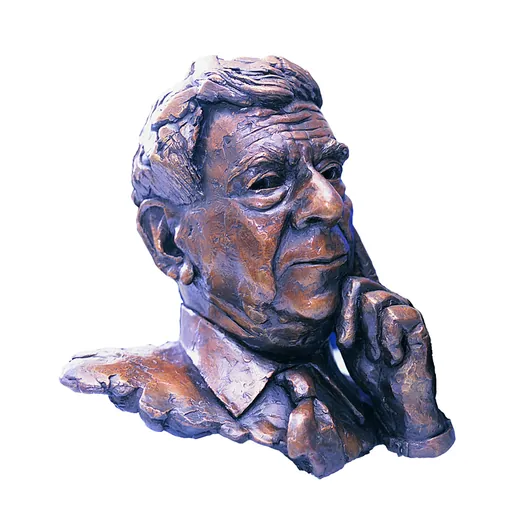
Roy Yorke Calne
British scientist
About Roy Yorke Calne
Lived 1930 – 2024 (aged 93). Roy Yorke Calne was a British transplant surgeon, university teacher, professor of surgery, physician and surgeon.
Sir Roy Yorke Calne (30 December 1930 – 6 January 2024) was a British surgeon and pioneer in organ transplantation. He was part of the team that performed the first liver transplantation operation in Europe in 1968, the world's first liver, heart and lung transplantation in 1987, the first intestinal transplant in the UK in 1992 and the first successful combined stomach, intestine, pancreas, liver and kidney cluster transplantation in 1994.
In 1960, Calne showed that 6-mercaptopurine (6-MP) could prolong the survival of a transplanted kidney in a dog, and later showed that azathioprine was more effective. Through the mid-1960s, he worked to develop solutions in surgical techniques and organ rejection. In the late 1970s, he began to experiment with the immunosuppressant ciclosporin A, which was then introduced into regular use to prevent organ rejection.
Calne was elected to the Royal Society in 1974, and was awarded the 1988 Cameron Prize for Therapeutics of the University of Edinburgh. He was awarded the 1984 Lister Medal, and knighted two years later. In 1990, he received the Ellison-Cliffe Medal from the Royal Society of Medicine. In 2012, he shared a Lasker-DeBakey Clinical Medical Research Award with Thomas Starzl.
Early life and education Roy Calne was born in Richmond, Surrey on 30 December 1930, to Joseph, a car engineer, and his wife Eileen (née Gubbay). He was the elder of two sons; his younger brother Donald later became a neurologist in Canada. Twice, he was evacuated to Ludlow, Shropshire. For his national service, he served in the Royal Army Medical Corps between 1953 and 1955, being stationed with the Gurkhas. After unsuccessful attempts at rat kidney grafts, he repeated the dog experiments of Jim Dempster and confirmed his findings of unsuccessful survival of kidneys with lethal doses of radiation. When either of these drugs was used in humans, survival rates remained low, and by 1963, Calne doubted successful transplantation. Through the mid-1960s, he worked to develop solutions in surgical techniques and organ rejection. Calne then performed the first liver transplantation operation in Europe in 1968. By 1978, it was being used to prevent organ rejection in transplant operations.
Later career Calne performed the world's first liver, heart and lung transplantation with John Wallwork in 1987, the first intestinal transplant in the UK in 1992 and the first successful combined stomach, intestine, pancreas, liver and kidney cluster transplantion in 1994. In 1995, he stated that xenotransplantation "is just around the corner, but it may be a very long corner."
Calne was a Fellow of the Royal Society and was Professor of Surgery at Cambridge University between 1965 and 1998 where he initiated the kidney transplant programme. He was the Yeoh Ghim Seng Visiting professor of surgery at the National University of Singapore. In 1988 he performed a liver transplant on the Scottish painter John Bellany, who began to paint self-portraits while still in intensive care and had completed 60 during his hospital stay. Bellany gave Calne painting lessons and the two became friends, painting portraits of each other. One of his portraits of Bellany was exhibited by the Royal Academy. The corresponding Lister Oration, given at the Royal College of Surgeons of England on 21 May 1985, is titled "Organ transplantation: from laboratory to clinic".
Calne was knighted in the 1986 Birthday Honours. In 1990, he received the Ellison-Cliffe Medal from the Royal Society of Medicine. In 2012, he shared a Lasker-DeBakey Clinical Medical Research Award with Thomas Starzl "for the development of liver transplantation, which has restored normal life to thousands of patients with end-stage liver disease". He was awarded a Pride of Britain Award in 2014. and he was an Honorary Vice-president of the Cambridge University Lawn Tennis Club.
Personal In 1956, Calne married Patricia Whelan, a nurse, and they had six children; four daughters and two sons.
Selected publications Articles
(Co-author) (Co-author)
Books Ellis, Harold, 1926–, Calne, Roy Y. (Roy Yorke), Sir, 1930– and Christopher Watson (2011) Lecture notes on general surgery (Twelfth edition). Oxford : Wiley Blackwell. . Calne, Roy Y. (Roy Yorke), Sir, 1930– (1970) A Gift of Life: Observations on Organ Transplantation. New York : Basic Books. , Calne, Roy Y. (Roy Yorke), Sir, 1930– (1996) Art, Surgery and Transplantation. London : Williams & Wilkins Europe. ,
Don’t just read it —
keep it.
Full-length biographies made to live with: read them, listen on the way to work, watch them tonight.
- E-book
- Audio
- Video
Instant download · yours to keep · every purchase keeps this site free
Important facts
People in Roy Yorke Calne's life
Named in this biography and alive at the same time




Related people
Same field, nearest in time
Contemporaries
People whose lives overlapped Roy Yorke Calne's
Frequently asked questions
Who was Roy Yorke Calne?
British scientist (1930–2024)
When was Roy Yorke Calne born?
Roy Yorke Calne was born on 30 December 1930 in Richmond.
When did Roy Yorke Calne die?
Roy Yorke Calne died on 6 January 2024 in Cambridge.
What was Roy Yorke Calne's occupation?
Roy Yorke Calne was a transplant surgeon, university teacher, professor of surgery, physician and surgeon.
What nationality was Roy Yorke Calne?
Roy Yorke Calne was British.
Sources & further reading
Cite this page
APA: Biography.guide. (2026). Roy Yorke Calne. https://biography.guide/roy-yorke-calne/
MLA: "Roy Yorke Calne." Biography.guide, https://biography.guide/roy-yorke-calne/.
Chicago: "Roy Yorke Calne." Biography.guide. https://biography.guide/roy-yorke-calne/.
Data last updated: 2026-09-22 · Spot an error? Report a correction.
Portrait: Wikimedia Commons · author & licence
Page generated 2026-09-27 05:02 UTC