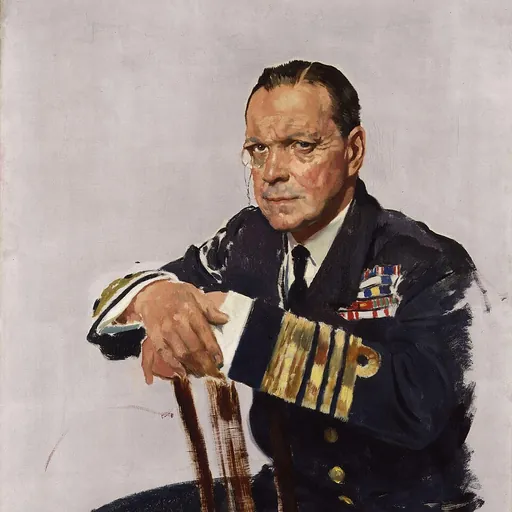
Rosslyn Wemyss, 1st Baron Wester Wemyss
Royal Navy admiral of the fleet
About Rosslyn Wemyss, 1st Baron Wester Wemyss
Lived 1864 – 1933 (aged 69). Rosslyn Wemyss, 1st Baron Wester Wemyss was a British naval officer, politician and admiral.
Admiral of the Fleet Rosslyn Erskine Wemyss, 1st Baron Wester Wemyss, (12 April 1864 – 24 May 1933), known as Sir Rosslyn Wemyss between 1916 and 1919, was a Royal Navy officer. During the First World War, he served as commander of the 12th Cruiser Squadron and then as Governor of Moudros before leading the British landings at Cape Helles and at Suvla Bay during the Gallipoli campaign. He went on to be Commander of the East Indies & Egyptian Squadron in January 1916 and then First Sea Lord in December 1917, in which role he encouraged Admiral Roger Keyes, Commander of the Dover Patrol, to undertake more vigorous operations in the Channel, ultimately leading to the launch of the Zeebrugge Raid in April 1918.
Early life and naval career
Born the youngest son of James Hay Erskine Wemyss and Millicent Ann Mary Kennedy Wemyss (née Erskine), Wemyss (pronounced "Weems") he was raised at the ancestral home of Wemyss Castle on the Fife coast.
He joined the Royal Navy as a cadet in the training ship HMS Britannia in 1877. He was posted to the corvette HMS Bacchante in July 1879, having been promoted to midshipman on 23 September 1879, he transferred to the battleship HMS Northumberland in the Channel Squadron in 1883. he joined the Royal Yacht HMY Osborne in October 1887 and then transferred to the battleship HMS Anson in the Channel Squadron in September 1889. he transferred to the cruiser HMS Niobe on the Cape of Good Hope Station, which served as a troopship for prisoners of war during the Second Boer War. but was shortly thereafter invited by the Duke of York to become second-in-command of the ocean liner SS Ophir during the royal cruise March–October 1901 to open the Parliament of Australia and visit Commonwealth countries to thank them for their support during the Boer War. he became an extra equerry to the Duke (now Prince of Wales) on 19 November 1901 and was appointed a Member (fourth class) of the Royal Victorian Order (MVO) on 24 December 1901. He was briefly posted to the President for temporary service at the Admiralty in October 1902, but the following month was on 25 November 1902 appointed in command of the old battleship HMS Superb, in Fleet Reserve at Portsmouth. He became Captain of the Royal Naval College, Osborne in August 1903. Appointed a Naval Aide-de-Camp to the King on 14 March 1910, he took part in the funeral of King Edward VII in May 1910 and became an extra equerry to King George V on 10 June 1910, he was appointed a Companion of the Order of St Michael and St George on 17 January 1911. Promoted to rear admiral on 19 April 1911, he became Commander of the 2nd Battle Squadron of the Home Fleet in October 1912.
Wemyss became Commander of the East Indies & Egyptian Squadron in January 1916 where he supported military operations on the Palestine Front. Promoted to vice-admiral on 6 December 1916, he was appointed a Commander of the French Legion of Honour on 23 March 1917 and a Grand Officer of the Order of the Crown of Italy on 11 August 1917.
Returning to the Admiralty, Wemyss was appointed Second Sea Lord in September 1917 and then Deputy First Sea Lord in October 1917. Following Sir Eric Geddes's decision to dismiss the First Sea Lord, Admiral Sir John Jellicoe, Wemyss was appointed Jellicoe's replacement in December 1917. and represented Britain at the Armistice in November 1918. and the French Croix de Guerre on 15 February 1919. He was also promoted to full admiral on 21 February 1919, awarded the Grand Cross of the Romanian Order of the Crown on 17 March 1919 and presented with the American Distinguished Service Medal on 16 September 1919.
Wemyss (third from right) negotiating the ceasefire at the end of the First World War. Foch (Supreme Allied Commander) standing, his chief of staff Weygand sitting on the right. Wemyss was the senior British representative at the signing of the armistice that ended active hostilities in the war. It was Wemyss who made the decision, much to the anger of British Prime Minister David Lloyd George, to have the ceasefire to come into effect at 11.00 a.m. Lloyd George wanted it to take place at 2.30 p.m. so that he could make the announcement in the House of Commons. Wemyss realised that 11 a.m on the 11th day of the 11th month had a strong, poetic quality about it; besides, by 2.30 p.m. more soldiers could be unnecessarily killed. After attending the Paris Peace Conference as Britain's naval representative and arranging for the end of the food blockade and hence unblocking the negotiations, Wemyss resigned in November 1919 following persistent calls for Sir David Beatty to be given his job.
Wemyss was promoted to Admiral of the Fleet on 1 November 1919. In retirement he wrote his memoirs under the title The Navy in the Dardanelles Campaign and became a Non-Executive Director of Cable & Wireless.
Don’t just read it —
keep it.
Full-length biographies made to live with: read them, listen on the way to work, watch them tonight.
- E-book
- Audio
- Video
Instant download · yours to keep · every purchase keeps this site free
Important facts
People in Rosslyn Wemyss, 1st Baron Wester Wemyss's life
Named in this biography and alive at the same time



Related people
Same field, nearest in time

Contemporaries
People whose lives overlapped Rosslyn Wemyss, 1st Baron Wester Wemyss's



Frequently asked questions
Who was Rosslyn Wemyss, 1st Baron Wester Wemyss?
Royal Navy admiral of the fleet (1864-1933)
When was Rosslyn Wemyss, 1st Baron Wester Wemyss born?
Rosslyn Wemyss, 1st Baron Wester Wemyss was born on 12 April 1864 in London.
When did Rosslyn Wemyss, 1st Baron Wester Wemyss die?
Rosslyn Wemyss, 1st Baron Wester Wemyss died on 24 May 1933 in Cannes.
What was Rosslyn Wemyss, 1st Baron Wester Wemyss's occupation?
Rosslyn Wemyss, 1st Baron Wester Wemyss was a naval officer, politician and admiral.
What nationality was Rosslyn Wemyss, 1st Baron Wester Wemyss?
Rosslyn Wemyss, 1st Baron Wester Wemyss was British.
Sources & further reading
· Wikipedia: Rosslyn Wemyss, 1st Baron Wester Wemyss
· DBpedia: Rosslyn Wemyss, 1st Baron Wester Wemyss
Cite this page
APA: Biography.guide. (2026). Rosslyn Wemyss, 1st Baron Wester Wemyss. https://biography.guide/rosslyn-wemyss-1st-baron-wester-wemyss/
MLA: "Rosslyn Wemyss, 1st Baron Wester Wemyss." Biography.guide, https://biography.guide/rosslyn-wemyss-1st-baron-wester-wemyss/.
Chicago: "Rosslyn Wemyss, 1st Baron Wester Wemyss." Biography.guide. https://biography.guide/rosslyn-wemyss-1st-baron-wester-wemyss/.
Data last updated: 2026-09-21 · Spot an error? Report a correction.
Portrait: Wikimedia Commons · author & licence
Page generated 2026-09-27 04:59 UTC