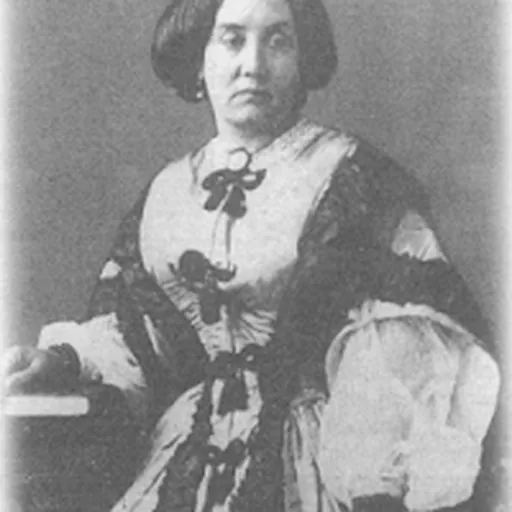
About Rosa Guerra
Lived 1834 – 1864 (aged 29–30). Rosa Guerra was an Argentine writer, journalist, poet, playwright and teacher.
Rosa Guerra (1834 – August 18, 1864) was an Argentine educator, journalist and writer. She was a pioneering woman in Argentine literature. Guerra defended the idea that women should not be confined to household duties, but were born to be educated. She is most known for her rendition of Lucia Miranda.
Biography Rosa Guerra was born in Buenos Aires, 1834. For her schooling, she attended an all girls school. Like most women at the time, Guerra, became a teacher to make money. Later on in her education career she advanced to becoming a principal of a school in Buenos Aires. She founded two newspapers, La Camelia, dedicated to spreading ideas associated with equality between the sexes, and La Educación a religious, poetic and literary newspaper. Guerra taught her readers about the hardships of being a woman in a heavily male profession. She also affiliated with the newspapers La Nación Argentina, El Nacional, and La Tribuna. She published the novel Lucía Miranda on the subject of the captive; La Camelia; and a drama in verse, Clemencia. Posthumously, her book of poems, Desahogos del corazón (Relief from the heart), was published. Her audiences were not only adults, but also children. Her children's books like, Julia and Her Education, focused on the challenges of becoming educated as a female. Her novels are read today to call attention to Latin American female writers during the 1800s.
La Camelia Guerra began her career as a journalist in 1852 at age 18 with La Camelia. There is no coincidence that 1852 is also the same year that Juan Manuel de Rosas was removed from power in Buenos Aires. Rosas ran a dictatorship that greatly limited the press. When he was removed, there were many female writers who were motivated to restart their careers. The critic Néstor Tomás Auza states, however, that there were actually 31 issues. The newspaper was written mostly by women, and was financed by subscription. At first, Guerra denied her participation in the project, La Camelia struggled to gain support, because of the Catholic church. The Catholic Church did not believe that women should have advanced education and jobs in society, besides the job of being a mother. and that was also addressed by Eduarda Mansilla in her homonymous novel. There was a renowned fear of white women being held captive by indigenous Argentine people. Rosa Guerra initially wrote the novel for a newly married couple in 1860. Guerra's novel tells the story of Lucía Miranda, the wife of a Spaniard who accompanies Sebastián Gaboto on his expedition through the Río de la Plata and is captured by the Amerindians in the destruction of Fort Sancti Spiritus. The novel presents a model of a rebellious Christian woman. In Guerra's version, she focused on the physical appearance of Lucia in contrast Chief Mangora. This led some people to believe she was promoting intimate relationships between white woman and indigenous people. Guerra calls attention to the idea that if Lucia had more education, she would have been more cautious around Chief Mangora.
Don’t just read it —
keep it.
Full-length biographies made to live with: read them, listen on the way to work, watch them tonight.
- E-book
- Audio
- Video
Instant download · yours to keep · every purchase keeps this site free
Important facts
People in Rosa Guerra's life
Named in this biography and alive at the same time
Related people
Same field, nearest in time


Contemporaries
People whose lives overlapped Rosa Guerra's




Frequently asked questions
Who was Rosa Guerra?
Argentine educator, journalist, writer (1804-1864)
When was Rosa Guerra born?
Rosa Guerra was born in 1834 in Buenos Aires.
When did Rosa Guerra die?
Rosa Guerra died on 18 August 1864.
What was Rosa Guerra's occupation?
Rosa Guerra was a writer, journalist, poet, playwright and teacher.
What nationality was Rosa Guerra?
Rosa Guerra was Argentine.
Sources & further reading
Cite this page
APA: Biography.guide. (2026). Rosa Guerra. https://biography.guide/rosa-guerra/
MLA: "Rosa Guerra." Biography.guide, https://biography.guide/rosa-guerra/.
Chicago: "Rosa Guerra." Biography.guide. https://biography.guide/rosa-guerra/.
Data last updated: 2026-09-20 · Spot an error? Report a correction.
Portrait: Wikimedia Commons · author & licence
Page generated 2026-09-27 04:57 UTC