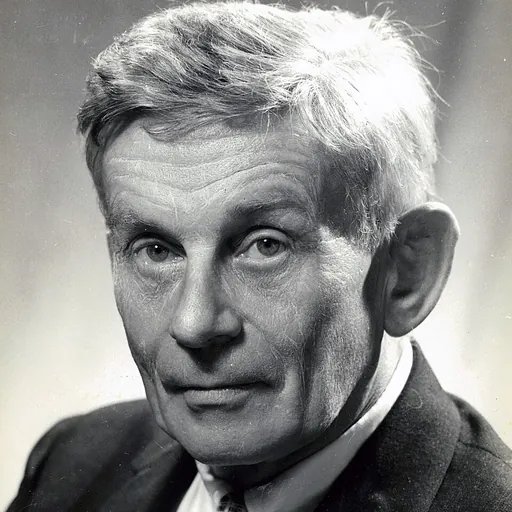
Ronald McCuaig
Australian journalist, literary critic, and children's writer
About Ronald McCuaig
Lived 1908 – 1993 (aged 84). Ronald McCuaig was an Australian journalist, children's writer and poet.
Ronald McCuaig (2 April 19081 March 1993) was an Australian poet, journalist, literary critic, humorist and children's author. He was described by Geoffrey Dutton as "Australia's first modern poet" and Kenneth Slessor included him in "the front rank of Australian poets". His work was the subject of one of Douglas Stewart's 1977 Boyer Lectures for the ABC. Most of his poems were first published in The Bulletin, which he joined as a member of staff in 1949, becoming short story editor from 1950 to 1960. In Norway he is well known for his children's book Fresi Fantastika, translated into Norwegian in 1975, originally published as Gangles in English in 1972.
Personal life
McCuaig's parents lived at Mayfield, on the rural fringe of Newcastle. In 1915, when McCuaig was seven BHP established an iron and steel works at the nearby suburb of Port Waratah. His mother died the same year. BHP's iron and steel works are depicted in Berceuse de Newcastle, the poem which opens McCuaig's Selected Poems (1992):
Ronald's father worked in a warehouse as an ironmonger. After the death of his wife he brought up Ronald on his own. He was a quiet man with a love of Banjo Paterson, and passed his interests on to his son. When he was eleven Ronald spent ten days on a relative's farm remembered in ten poems which make up Holiday Farm, a sequence he wrote in 1953 and first published in book form eight years later in The Ballad of Bloodthirsty Bessie and Other Poems. On Fridays after school Ronald visited his father in his office. At the end of the working day, when the warehouse closed, father and son went to a cafe for a meal then to a show, or to the School of Arts in Hunter Street, where they sat on the upstairs veranda and took in the scene:
Peter Kirkpatrick, in "Thus Quod McCuaig" (Southerly, 1991) writes that "McCuaig's earliest collection of verse, Vaudeville, was written in an astonishing two months at the end of 1933. The sexual candour of many of these poems of urban life meant they were unacceptable to the conservative literary journals and presses, so after four years of trying to find a publisher the author decided to publish them himself. Seven printers refused to touch the job, though, fearing prosecution." The book finally appeared in 1938.
Kenneth Slessor, writing for Smith's Weekly, called Vaudeville "the most remarkable book of Australian poetry published this year." Douglas Stewart described McCuaig's work as both astonishing and outrageous. Peter Kirkpatrick described McCuaig as "one of Australia's finest lyric poets." Douglas Stewart noted sales of thousands of copies were due in part to the Americans in Australia at the time buying up just about all the books in Sydney and clamouring for more. The first story The Fairy in the Suitcase, features a fairy skipping naked out of its suitcase producing any number of bottles of beer her lucky owner cares to ask for. Also included was McCuaig's appreciation of Kenneth Slessor's poetry, the first extensive essay on Slessor ever to be published. Tales out of Bed also included essays on T. S. Eliot and the poetry of Leon Gellert. for his contribution to Australian Literature. The award was instigated by board member Geoffrey Dutton with support from Elizabeth Riddell and Barry Humphries in an attempt to gain recognition for McCuaig. where he said Kenneth Slessor was usually considered to be the first Australian modernist poet but that McCauig was slightly ahead of him. This was because Slessor was held back by the influence of Norman Lindsay who was a romanticist in an Australian group of writers and artists practising what Dutton called "fossilised 19th century diction" which had "no relation to the present day world". Dutton went on to explain T. S. Eliot had published The Waste Land in 1922 but was largely unknown or considered irrelevant in Australia in the 1920s. Slessor and McCuaig were both followers of French modernism but more so with McCuaig who was not (unlike Slessor) under the "powerful influence of Norman Lindsay". The review was favourable, ranking Slessor above C.J. Brennan and W.B. Yeats. It was written a year before "Five Bells" which marked Slessor's move to modernism, a move inspired, according to Rundle and others, by McCuaig. The review therefore covers the pre-modernist parts of Slessor's poetry.
In 1954 McCuaig was the editor of an anthology Australian Poetry published by Angus and Robertson greeted upon its arrival by William T. Fleming in Meanjin as "frankly depressing". Fleming finds, in comparison with overseas anthologies, the collection guilty of unimaginative use of rhyme, crude prosody, heavy-handed abstraction and fashionable obscurity. He finds the ballads entirely without poetic merit and blames The Bulletin (where McCuaig worked) for their inclusion. Helen Heney on the other hand in her Southerly review of Australian Poetry 1954 doesn't find the need to compare Australian poetry with overseas models and admires the wry, dry, slightly harsh Australian aroma. She rates most highly Judith Wright's "Request to a Year" while finding some other offerings including the poem "Tower View, Maitland", "unprecise and mentally formless".
In contrast to his rather savage treatment by some in the academic poetry establishment McCuaig was a rather even-handed and positive critic, not easily displeased and only occasionally disappointed. In his review of Australian Poetry, 1951-1952 selected by Kenneth Mackenzie (Angus and Robertson, 1952) he takes pleasure in the efforts of Rosemary Dobson, David Campbell, Hal Porter, Elizabeth Riddell, Douglas Stewart, Vivian Smith, Peter Hopeghood and Nancy Keesing; is ambivalent about Ray Mathew and Roland Robinson; and is only mildly critical of Rex Ingamells and Ian Mudie.
Critical reception Despite recognition by his peers around the time of Vaudeville and later by Geoffrey Dutton, Kenneth Slessor, Douglas Stewart and Peter Kirkpatrick
Academic establishment critics were sometimes scathing. New Zealand born A. D. Moody, while senior lecturer at the University of Melbourne 1958-1964 in his 1961 Poetry Chronicle included McCuaig among the "anti-poetry versifiers who seem bent, whether out of ignorance or indifference or contempt, upon debasing their medium". He singled out McCuaig in particular in saying his "tone and attitudes are fairly consistently man-to-man-over-the-beer-keg".
In 2010 essayist Guy Rundle remarked McCuaig's greatest contribution to Australian poetry "may well be that he encouraged his friend and fellow journalist-poet Kenneth Slessor to a more ambitious aesthetic, thus helping him to bust out of his late Georgianism and into the full modernity of 'Five Bells". Rundle's assessment was that McCuaig could hit a "cool and stylish note in his verse, although much of it dips too far into the twee and whimsical for contemporary tastes".
Laurence Bourke in Southerly (1992) rates McCuaig's body of work as represented by Selected Poems (1992) more highly than Rundle (who was anyway using him more as an example of creative drive unassisted by the state or the status quo and not critiquing him as such). Bourke echoes Geoffrey Dutton's call for McCuaig's repatriation as an important literary figure but disputes the label "modernist". He argued to call Vaudeville "modernist" distorts "either the literary term or the poems". He prefers the term "modern", a term he notes Dutton used. Burke also considers the ballads and songs of childhood written from 1953 to 1959 the highlight of the collection, and argues these are "not modernist in any useful sense of the term."
Elkin in Poems from Literature and from Life, in Southerly, reviewing The Ballad of Bloodthirsty Bessie, and Other Poems takes the complete opposite view to Moody, arguing it is in the boisterous tales and ballads McCuaig is fully himself, especially "Mokie's Madrigal", and "The Ballad of Bloodthirsty Bessie" which he regards as "altogether delightful — fantastic but not strained, consistent, full of life, and quite un-literary ... the rollicking tale of a country virgin who kills her lovers — sailors lured inland to work on the farm by Bessie's shrewd old father — in order to save them from the sin of sexual indulgence."
Alan Gould in his contemporary 1992 review of McCaug's Selected Poems (1992) dismisses the light verse, praises a lightness of touch in The Wanton Goldfish and judges McCuaig's best work to be not his modernist poems of sexual candour but his poems of charmed innocence in works such as Au Tombeau de Mon Pere.
Gary Catalano in Rude life and immaculate art is another who considers the group of autobiographical poems about his childhood in Newcastle (containing Au Tombeau de Mon Pere) grouped together under the title of Scenes from Childhood in both The Ballad of Bloodthirsty Bessie and other Poems and Selected Poems, are McCuaig's major achievement, and Au Tombeau de Mon Pere his best poem.
Don’t just read it —
keep it.
Full-length biographies made to live with: read them, listen on the way to work, watch them tonight.
- E-book
- Audio
- Video
Instant download · yours to keep · every purchase keeps this site free
Important facts
People in Ronald McCuaig's life
Named in this biography and alive at the same time







Related people
Same field, nearest in time



Contemporaries
People whose lives overlapped Ronald McCuaig's

Frequently asked questions
Who was Ronald McCuaig?
Australian journalist, literary critic, and children's writer
When was Ronald McCuaig born?
Ronald McCuaig was born on 2 April 1908 in Newcastle.
When did Ronald McCuaig die?
Ronald McCuaig died on 1 March 1993 in Sydney.
What was Ronald McCuaig's occupation?
Ronald McCuaig was a journalist, children's writer and poet.
What nationality was Ronald McCuaig?
Ronald McCuaig was Australian.
Sources & further reading
Cite this page
APA: Biography.guide. (2026). Ronald McCuaig. https://biography.guide/ronald-mccuaig/
MLA: "Ronald McCuaig." Biography.guide, https://biography.guide/ronald-mccuaig/.
Chicago: "Ronald McCuaig." Biography.guide. https://biography.guide/ronald-mccuaig/.
Data last updated: 2026-09-22 · Spot an error? Report a correction.
Portrait: Wikimedia Commons · author & licence
Page generated 2026-09-27 05:04 UTC