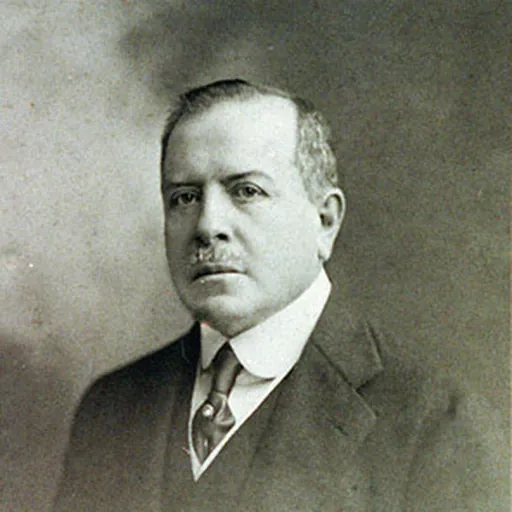
About Rómulo Cúneo Vidal
Lived 1856 – 1931 (aged 74). Rómulo Cúneo Vidal was a Peruvian writer and diplomat.
Juan Rómulo Cúneo y Vidal (Arica; — Callao; ) was a Peruvian intellectual, historian, writer and diplomat. As Juan Pagador, he wrote books about Peruvian history, literature, biography, toponymy and heraldry. In addition to his native Spanish, he was also fluent in Quechua, Aymara, French, Greek, Italian, and English.
He served as Peru's consul to the Chilean city of Antofagasta from 1903 to 1908. During the Chilean–Peruvian territorial dispute, he campaigned for the return of the provinces of Tacna and Arica to Peru through commercial and diplomatic means.
Biography Cúneo was born in Arica, where he was baptised at the Parish of Saint Mark by priest Felipe Mazuelos. His parents were Luis Cúneo and Rosario Vidal, while his godfather was Juan Vaccaro. His early studies took place at both Arica and Tacna. In 1864, he travelled to Europe, where he studied at Milan's Istituto Tecnico Superiore and at the École pratique des hautes études in Paris.
He returned to Peru in 1881, by which point his birthplace was under military occupation by Chile following a land campaign during the ongoing War of the Pacific. He nevertheless moved to the city, where he edited in 1882 the pro-Peruvian newspaper Los Andes, among other publications. He married Elisa Harrison. In 1893, Tacna was the site of Constancia y Concordia, a Masonic lodge presided over by Cúneo that worked to preserve Peruvian values in the then disputed territories. In 1904, the lodge integrated the members of Fraternidad Universal and Morro de Arica, two other lodges from Arica.
He served as consul of Peru in Antofagasta, also representing Bolivia, from 1903 to 1908.
Works Unpublished works by Cúneo include El monstruo e Hijas de virreyes (novel), Atahualpa (a historical drama in two parts), Víctor G. Mantilla, un poeta de los días del cautiverio and En pleno azur, libro de los diálogos del almo Perú.
Literary works Pagadorianas. La mujer en la literatura (1892) España. Impresiones de un sudamericano (1911) Cristóbal Colón, genovés (1921) Tierra Santa (1925)
Historiographic works Historia de las insurrecciones de Tacna por la independencia del Perú (1921, 1977) Vida del conquistador Francisco Pizarro y de sus hermanos (1931, 1977) Historia de la fundación de la ciudad de San Marcos de Arica (1977) Historia de los antiguos cacicazgos hereditarios del Perú (1977) Tradiciones y leyendas de Arica, Tarapacá y Atacama (1977) Precursores y mártires de la Independencia del Perú (1977) Enciclopedia incana (1977) Diccionario histórico-biográfico del sur del Perú (1977)
Don’t just read it —
keep it.
Full-length biographies made to live with: read them, listen on the way to work, watch them tonight.
- E-book
- Audio
- Video
Instant download · yours to keep · every purchase keeps this site free
Important facts
Related people
Same field, nearest in time


Contemporaries
People whose lives overlapped Rómulo Cúneo Vidal's




Frequently asked questions
Who was Rómulo Cúneo Vidal?
Peruvian writer (1856-1931)
When was Rómulo Cúneo Vidal born?
Rómulo Cúneo Vidal was born on 24 June 1856 in Arica.
When did Rómulo Cúneo Vidal die?
Rómulo Cúneo Vidal died on 8 April 1931 in La Punta.
What was Rómulo Cúneo Vidal's occupation?
Rómulo Cúneo Vidal was a writer and diplomat.
What nationality was Rómulo Cúneo Vidal?
Rómulo Cúneo Vidal was Peruvian.
Sources & further reading
· Wikipedia: Rómulo Cúneo Vidal
· DBpedia: Rómulo Cúneo y Vidal
Cite this page
APA: Biography.guide. (2026). Rómulo Cúneo Vidal. https://biography.guide/romulo-cuneo-vidal/
MLA: "Rómulo Cúneo Vidal." Biography.guide, https://biography.guide/romulo-cuneo-vidal/.
Chicago: "Rómulo Cúneo Vidal." Biography.guide. https://biography.guide/romulo-cuneo-vidal/.
Data last updated: 2026-09-21 · Spot an error? Report a correction.
Portrait: Wikimedia Commons · author & licence
Page generated 2026-09-27 05:00 UTC