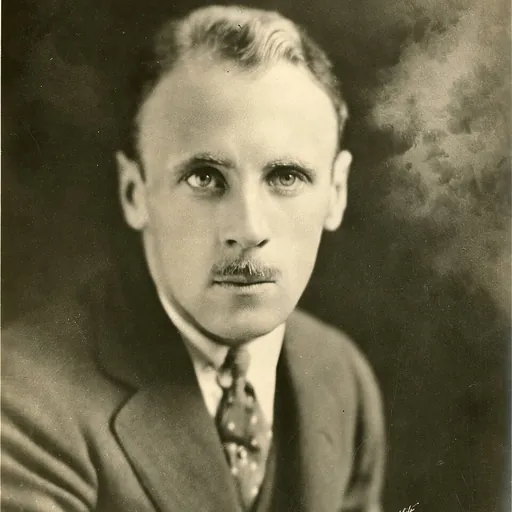
About Roland Young
Lived 1887 – 1953 (aged 65). Roland Young was a British stage actor, film actor and actor.
Roland Young (11 November 1887 – 5 June 1953) was an English-born actor. He began his acting career on the London stage, but later found success in America and received an Academy Award nomination for his role in the film Topper.
In 1960, Young was posthumously honored with two stars on the Hollywood Walk of Fame for his contributions in the television and motion pictures industries.
Early life Born in London, England, Young was the son of an architect, and early indications were that he would pursue the father's career. He was educated at Sherborne School, Sherborne, Dorset and University College London before being accepted into the Royal Academy of Dramatic Art where his classmate was Gordon Richards.
Career Young made his first stage appearance in London's West End in Find the Woman in 1908, and in 1912 he made his Broadway debut in Hindle Wakes. For the next few years, he alternated between New York and London. He made his film debut in the 1922 silent film Sherlock Holmes, in which he played Watson opposite John Barrymore as Holmes.
He signed a contract with Metro-Goldwyn-Mayer and made his talkie debut in The Unholy Night (1929), directed by Lionel Barrymore. He was loaned to Warner Bros. to appear in Her Private Life (also 1929), with Billie Dove and Fox Film Corporation, winning critical approval for his comedic performance as Jeanette MacDonald's husband in Don't Bet on Women (1931). He was again paired with MacDonald Annabelle's Affairs (1931), a talkie version of Good Gracious Annabelle!. He appeared in Cecil B. de Mille's The Squaw Man, and played opposite Alfred Lunt and Lynn Fontanne in The Guardsman (both 1931). He appeared with Evelyn Brent in Columbia's The Pagan Lady (also 1931) and Pola Negri in RKO's A Woman Commands (1932). His final film under his MGM contract was Lovers Courageous (1932), opposite Robert Montgomery. He had a starring role in a risqué comedy for Fox entitled Pleasure Cruise (1933) alongside Genevieve Tobin.
Freelance performer Charlie Ruggles (far left), Cary Grant (2nd from left), Lili Damita (centre), and Young (right) in film This is the Night (1932)Young began to work as a freelance performer and found himself in constant demand. He appeared with Jeanette MacDonald, Genevieve Tobin and Maurice Chevalier in One Hour With You (1932) and with Kay Francis in Street of Women (1932). Alexander Korda invited him to return to Britain to make his British film debut in Wedding Rehearsal (1932). He returned to Hollywood and appeared in a diverse group of films that included comedies, murder mysteries, and dramas, and also worked on Broadway. Among his films of this period were Ruggles of Red Gap (1935), David Copperfield (1935) (playing Uriah Heep), and the H. G. Wells fantasy The Man Who Could Work Miracles (1936).
In 1937, he achieved one of the most important successes of his career in Topper, as a bank president haunted by the ghosts of his clients, played by Cary Grant and Constance Bennett. It was one of the most successful films of the year, and Young was nominated for the Academy Award for Best Supporting Actor. Topper's wife was played by Billie Burke, who wrote in her memoir that Young "was dry and always fun to work with". They also appeared together in The Young in Heart (1938), Dulcy (1940) and both of the Topper sequels, Topper Takes a Trip (1938) and Topper Returns (1941). He continued to play supporting roles in comedies such as Yes, My Darling Daughter, with Fay Bainter and Priscilla Lane, but over the next few years the importance of his roles again decreased. He achieved another success as Uncle Willie in The Philadelphia Story (1940) with Katharine Hepburn, Cary Grant and James Stewart. His last starring role was in the final instalment of the Topper series, Topper Returns in 1941, with Billie Burke, Joan Blondell and Carole Landis.
Artwork
As a visual artist, Young drew caricatures of notables, some of which appeared in Life magazine in the early 1920s. In 1925, a collection was published in the form of a limited-edition book, Actors and Others. A similar volume, Not For Children, was issued in 1930.
Later life and career He continued working steadily through the 1940s, playing small roles opposite some of Hollywood's leading actresses, such as Joan Crawford, Marlene Dietrich, Paulette Goddard and Greta Garbo in her final film, Two-Faced Woman (1941). In 1945, he began his own radio show and appeared in the film adaption of Agatha Christie's And Then There Were None. By the end of the decade his film career had declined, and his final films, including The Great Lover (1949), in which he played a murderer opposite Bob Hope, and Fred Astaire's Let's Dance (1950), were not successful.
In the 1950s, Young appeared on several episodic television series, including Lux Video Theatre, Studio One, Pulitzer Prize Playhouse and The Chevrolet Tele-Theatre.
Recognition Young has two stars on the Hollywood Walk of Fame, one for film at 6523 Hollywood Blvd. and another for television at 6315 Hollywood Blvd. Both were dedicated 8 February 1960.
Filmography Year Film Role Director Notes 1922 Sherlock Holmes Dr. Watson Albert Parker 1924 Grit Houdini Hart Frank Tuttle Lost film 1926 Camille Lord Kyne Ralph Barton Short 1928 Walls Tell Tales Short 1929 Her Private Life Charteris Alexander Korda The Unholy Night Lord Montague Lionel Barrymore Wise Girls Duke Merrill E. Mason Hopper 1930 The Bishop Murder Case Sigurd Arnesson Nick Grinde Madam Satan Jimmy Wade Cecil B. DeMille New Moon Count Strogoff Jack Conway 1931 Don't Bet on Women Herbert Drake William K. Howard The Prodigal Doc aka Somerset Greenman Harry A. Pollard Annabelle's Affairs Roland Wimbleton Alfred L. Werker The Squaw Man Sir John Applegate Cecil B. DeMille The Pagan Lady Dr. Heath John Francis Dillon 1931 The Guardsman The Critic Harold S. Bucquet 1932 Lovers Courageous Jeffrey Robert Z. Leonard A Woman Commands King Alexander E. J. Babille One Hour with You Professor Olivier Ernst Lubitsch This Is the Night Gerald Gray Frank Tuttle Street of Women Linkhorne 'Link' Gibson Archie Mayo Wedding Rehearsal The Marquis of Buckminster Alexander Korda They Just Had to Get Married Hillary Hume Edward Ludwig 1933 A Lady's Profession Lord Reginald Withers Norman Z. McLeod Pleasure Cruise Andrew Poole Frank Tuttle Blind Adventure The Burglar Ernest B. Schoedsack His Double Life Priam Farrel William C. deMille 1934 Here is My Heart Prince Nicholas/Nicki Frank Tuttle 1935 David Copperfield Uriah Heep George Cukor Ruggles of Red Gap George – Earl of Burnstead Leo McCarey 1936 The Unguarded Hour Bunny Sam Wood One Rainy Afternoon Maillot Rowland V. Lee Give Me Your Heart Tubbs Barrow Archie Mayo 1937 The Man Who Could Work Miracles George McWhirter Fotheringay Lothar Mendes Gypsy Alan Brooks Roy William Neill Call It a Day Frank Haines Archie Mayo King Solomon's Mines Commander John Good Geoffrey Barkas Topper Mr. Cosmo Topper Norman Z. McLeod Academy Award nomination – Best Supporting Actor Ali Baba Goes to Town Sultan David Butler 1938 Sailing Along Anthony Gulliver Sonnie Hale The Young in Heart 'Sahib' Carleton Richard Wallace Topper Takes a Trip Mr. Cosmo Topper Norman Z. McLeod 1939 Yes, My Darling Daughter Titus Jaywood William Keighley Here I Am a Stranger Prof. Daniels Roy Del Ruth The Night of Nights Barry Keith-Trimble Lewis Milestone 1940 He Married His Wife Bill Carter Roy Del Ruth Star Dust Thomas Brooke Walter Lang Irene Mr. Smith Herbert Wilcox Private Affairs Amos Bullerton Albert S. Rogell Dulcy Roger Forbes S. Sylvan Simon The Philadelphia Story William Q. Tracy (Uncle Willie) George Cukor No, No, Nanette Mr. 'Happy' Jimmy Smith Herbert Wilcox 1941 Topper Returns Cosmo Topper Roy Del Ruth The Flame of New Orleans Charles Giraud René Clair Two-Faced Woman O.O. Miller George Cukor 1942 The Lady Has Plans Ronald Dean Sidney Lanfield They All Kissed the Bride Marsh Alexander Hall Tales of Manhattan Edgar Julien Duvivier 1943 Forever and a Day Henry Barringer 1944 Standing Room Only Ira Cromwell Sidney Lanfield 1945 And Then There Were None Detective William Henry Bloor René Clair 1948 Bond Street George Chester-Barrett Gordon Parry You Gotta Stay Happy Ralph Tutwiler H.C. Potter 1949 The Great Lover C.J. Dabney Alexander Hall 1950 Let's Dance Edmund Pohlwhistle Norman Z. McLeod 1951 St. Benny the Dip Matthew Edgar G. Ulmer Lux Video Theatre Sumner TV 1953 That Man from Tangier George Robert Elwyn
Partial list of stage appearances Hindle Wakes (1912) Good Gracious, Annabelle (1916) A Successful Calamity (1917) The Gipsy Trail (1917) Buddies (1919) Rollo's Wild Oat (1920) The Devil's Disciple (1923) Beggar on Horseback (1924) The Last of Mrs. Cheyney (1925) The Queen's Husband (1928) Her Master's Voice (1933) Spring Thaw (1938) Another Love Story (1943)
Don’t just read it —
keep it.
Full-length biographies made to live with: read them, listen on the way to work, watch them tonight.
- E-book
- Audio
- Video
Instant download · yours to keep · every purchase keeps this site free
Important facts
People in Roland Young's life
Named in this biography and alive at the same time



Related people
Same field, nearest in time
Contemporaries
People whose lives overlapped Roland Young's





Frequently asked questions
Who was Roland Young?
British actor (1887–1953)
When was Roland Young born?
Roland Young was born on 11 November 1887 in London.
When did Roland Young die?
Roland Young died on 5 June 1953 in New York City.
What was Roland Young's occupation?
Roland Young was a stage actor, film actor and actor.
What nationality was Roland Young?
Roland Young was British.
Sources & further reading
Cite this page
APA: Biography.guide. (2026). Roland Young. https://biography.guide/roland-young/
MLA: "Roland Young." Biography.guide, https://biography.guide/roland-young/.
Chicago: "Roland Young." Biography.guide. https://biography.guide/roland-young/.
Data last updated: 2026-09-23 · Spot an error? Report a correction.
Portrait: Wikimedia Commons · author & licence
Page generated 2026-09-27 05:07 UTC