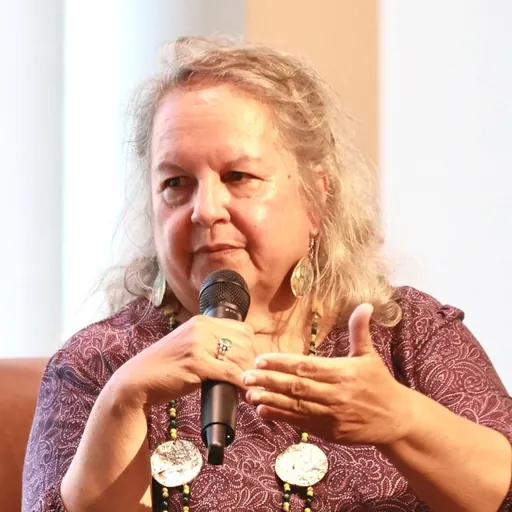
About Robin Wall Kimmerer
Born 1953. Robin Wall Kimmerer is an American naturalist, environmentalist, plant ecologist, ecologist, botanist and university teacher, known for Moss and Traditional ecological knowledge.
Robin Wall Kimmerer (born September 13, 1953) is a Potawatomi botanist, author, and the former director of the Center for Native Peoples and the Environment at the State University of New York College of Environmental Science and Forestry (SUNY-ESF).
As a scientist and a Native American, Kimmerer is informed in her work by both Western science and Indigenous environmental knowledge. Her father worked as a mechanical engineer, and her mother had a degree in chemical engineering. Her enthusiasm for the environment was encouraged by her parents, and her time outdoors inspired a deep appreciation for the natural environment. As a young child, she collected seeds and pressed leaves, storing them in shoe boxes under her bed. Kimmerer is an enrolled citizen of the Citizen Potawatomi Nation.
Kimmerer remained near home for college, attending State University of New York College of Environmental Science and Forestry and receiving a bachelor's degree in botany in 1975. She spent two years working for Bausch & Lomb as a microbiologist. Kimmerer then moved to Wisconsin to attend the University of Wisconsin–Madison, earning her master's degree in botany there in 1979, followed by her PhD in plant ecology in 1983. It was while studying forest ecology as part of her degree program that she first learnt about mosses, and bryology became the scientific focus of her career.
Career
From Wisconsin, Kimmerer moved to Kentucky, where she briefly taught at Transylvania University in Lexington, before moving to Danville, Kentucky, where she taught biology, botany, and ecology at Centre College. Kimmerer received tenure at Centre College. In 1993, at age 40 Kimmerer returned home to upstate New York and her alma mater, SUNY-ESF, where she currently teaches.
Kimmerer teaches in the Environmental and Forest Biology Department at ESF. She teaches courses on land and culture, traditional ecological knowledge, ethnobotany, ecology of mosses, disturbance ecology, and general botany. She served as director of the Center for Native Peoples and the Environment at ESF, which is part of her work to provide programs that allow for greater access for Indigenous students to study environmental science, and for science to benefit from the wisdom of Native philosophy to reach the common goal of sustainability.
Kimmerer's grandfather attended Carlisle Indian Industrial School. Kimmerer is a proponent of the Traditional Ecological Knowledge (TEK) approach, which she describes as a "way of knowing". TEK is an empirical approach based on long-term observation and relationship. The approach also involves cultural and spiritual considerations, often marginalized by the Western scientific community. As a botanist trained and published in Western science, she has high regard for both worldviews and their distinct practices. "Two-eyed seeing" is how she portrays the utilization of both. She also speaks in favor of communication modes unique to each of the two realms. As a university professor, academic papers were essential in the early part of her career. In her elder years she exemplifies the power of orally presented Indigenous stories for an outcome that science makes no attempt to achieve: conveyance and indirect advocacy of values.
Her current work spans traditional ecological knowledge, moss ecology, outreach to Indigenous communities, and creative writing.
Professional service
Kimmerer has helped sponsor the Undergraduate Mentoring in Environmental Biology (UMEB) project, which pairs students of color with faculty members in the enviro-bio sciences while they work together to research environmental biology. Kimmerer is also a part of the United States Department of Agriculture's Higher Education Multicultural Scholars Program. The program provides students with real-world experiences that involve complex problem-solving. Kimmerer is also involved in the American Indian Science and Engineering Society (AISES), and works with the Onondaga Nation's school doing community outreach. Kimmerer also uses traditional knowledge and science collectively for ecological restoration in research. She has served on the advisory board of the Strategies for Ecology Education, Development and Sustainability (SEEDS) program, a program to increase the number of minority ecologists. Kimmerer is also the co-founder and former chair of the Traditional Ecological Knowledge Section of the Ecological Society of America.
In April 2015, Kimmerer was invited to participate as a panelist at a United Nations plenary meeting to discuss how harmony with nature can help to conserve and sustainably use natural resources, titled "Harmony with Nature: Towards achieving sustainable development goals including addressing climate change in the post-2015 Development Agenda".
Writing influences Kimmerer has credited science writer Loren Eiseley as being the first to inspire her as a writer. She has also pointed to the poet Wendell Berry as inspiration as well as Rachel Carson, the author of Silent Spring. Kimmerer said that as a pioneering female scientist, Carson "combined her knowledge with a sense of responsibility for that knowledge."
Writing process Kimmerer does most of her writing in her home office and prefers to write first drafts in longhand on lined, yellow legal-sized paper using green or purple ink.
Honors and awards Kimmerer received the John Burroughs Medal Award for her book, Gathering Moss: A Natural and Cultural History of Mosses. Her first book, it incorporated her experience as a plant ecologist and her understanding of traditional knowledge about nature. Author Elizabeth Gilbert later relied on Gathering Moss while completing research for her novel The Signature of All Things. Gilbert said of the book and Kimmerer, "That book had been my touchstone during my research. She's my Mick Jagger."
Her second book, Braiding Sweetgrass: Indigenous Wisdom, Scientific Knowledge, and the Teachings of Plants, received the 2014 Sigurd F. Olson Nature Writing Award. Braiding Sweetgrass is about the interdependence of people and the natural world, primarily the plant world. She won a second Burroughs award for an essay, "Council of the Pecans", that appeared in Orion magazine in 2013. Kimmerer received an honorary M.Phil. degree in Human Ecology from College of the Atlantic on June 6, 2020.
In 2022, Kimmerer was awarded a MacArthur Fellowship. In 2024, Oregon State University named her the recipient of the Stone Award for Literary Achievement.
In 2023, The White house awarded Kimmerer with the National Humanities Medal.
Most recently in 2025, she was included on the Time 100 list of influential people.
Kimmerera is a fossil moss genus from the Late Cretaceous period in Antarctica that was described and named after Kimmerer in 2026.
Works Gathering Moss: A Natural and Cultural History of Mosses (Oregon State University Press, 2003) . Braiding Sweetgrass: Indigenous Wisdom, Scientific Knowledge, and the Teachings of Plants (Milkweed Editions, 2013) . The Serviceberry (Scribner, November 19, 2024) about how the serviceberry, by sharing its abundance with its ecosystem, embodies interdependence and mutual support. Bud Finds Her Gift (HarperCollins, September 30, 2025) , children's picture book.
In anthology
Don’t just read it —
keep it.
Full-length biographies made to live with: read them, listen on the way to work, watch them tonight.
- E-book
- Audio
- Video
Instant download · yours to keep · every purchase keeps this site free
Important facts
People in Robin Wall Kimmerer's life
Named in this biography and alive at the same time






Related people
Same field, nearest in time





Contemporaries
People whose lives overlapped Robin Wall Kimmerer's



Frequently asked questions
Who is Robin Wall Kimmerer?
American environmentalist
When was Robin Wall Kimmerer born?
Robin Wall Kimmerer was born in 1953 in New York.
What is Robin Wall Kimmerer's occupation?
Robin Wall Kimmerer is a naturalist, environmentalist, plant ecologist, ecologist, botanist and university teacher.
What is Robin Wall Kimmerer known for?
Robin Wall Kimmerer is known for Moss and Traditional ecological knowledge.
What nationality is Robin Wall Kimmerer?
Robin Wall Kimmerer is American.
Sources & further reading
· Wikipedia: Robin Wall Kimmerer
· DBpedia: Robin Wall Kimmerer
Cite this page
APA: Biography.guide. (2026). Robin Wall Kimmerer. https://biography.guide/robin-wall-kimmerer/
MLA: "Robin Wall Kimmerer." Biography.guide, https://biography.guide/robin-wall-kimmerer/.
Chicago: "Robin Wall Kimmerer." Biography.guide. https://biography.guide/robin-wall-kimmerer/.
Data last updated: 2026-09-22 · Spot an error? Report a correction.
Portrait: Wikimedia Commons · author & licence
Page generated 2026-09-27 05:03 UTC