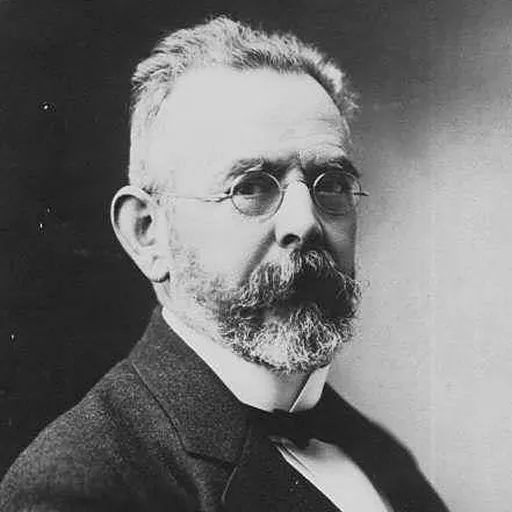
About Roberto Wernicke
Lived 1854 – 1922 (aged 68). Roberto Wernicke was an Argentine physician and academic.
Roberto Enrique Martín Wernicke (May 23, 1852 – October 22, 1922) was an Argentine physician, embryologist, bacteriologist, educator and researcher.
Wernicke's childhood was spent in Baradero about 160 km northwest of the city of Buenos Aires, where his father settled for health reasons and ran a school. Wernicke completed his secondary studies in Buenos Aires. Wernicke was one of the first to study the embryonic development of chicken hearts, using sand and water baths to maintain a constant temperature for the developing eggs. A translation of the work was published in the Anales de la Sociedad Científica Argentina (Annals of the Argentine Scientific Society).
Career in Buenos Aires In 1878, Roberto Wernicke returned to Buenos Aires. In 1884, he received the degree of Doctor of Medicine, after presenting a thesis sponsored by José Teodoro Baca, on the topic "Una primera lección de examen clínico" ("A first lesson in clinical study"). Soon after, he became Assistant Professor of the Chair of General Pathology in the Faculty of Medicine at the University of Buenos Aires.
Roberto Wernicke taught in room IX of the Hospital de Clínicas. His younger brother Otto Wernicke also became a doctor at the Hospital. Roberto Wernicke was known for arriving early and being a demanding instructor.
In 1884, Wernicke established a Laboratory for Contagious Diseases in Animals. Between 1884 and 1887, Wernicke carried out early experiments in photomicrography.
In 1886, the National Department of Hygiene sent him to Rosario to assess the situation created by the presence of cholera in the area. After some difficulties, he was able to impose sanitary criteria and set up a lazaretto outside the city for those who had contracted the disease.
In 1888, Wernicke founded the Laboratorio de la Sociedad Rural Argentina (Laboratory of the Argentine Rural Society) with the support of La Rural's president, Estanislao Zeballos.
In 1890, Wernicke was promoted to Professor of General Pathology in the Faculty of Medicine, holding that position until October 1907. His students included Guillermo Seeber, who described the parasite Rhinosporidium seeberi, and Alejandro Posadas, with whom Wernicke first described the fungal disease Coccidioidomycosis.
Wernicke was a founding member and served two terms as President of the Asociación Médica Argentina (Argentine Medical Association) from 1894-1895 and from 1896-1897. He was vice-president of the First Latin American Scientific Congress At the Second Latin American Scientific Congress, held in Montevideo from March 20 to 31, 1901, he served as president of the board as well as being president of the coordinating committee in Argentina and the official delegate of the Argentine government. He also presented a paper on amyloid degeneration.
In 1907, Wernicke formally retired from the University, stepping down from the Chair of General Pathology, and the positions of Academician and Counselor of the School of Medicine. In a ceremony on October 30, 1907, His students and colleagues published a Libro d'e Oro (Golden Book)
Wernicke continued to see patients in his private practice.
Roberto Wernicke died in Buenos Aires on October 14, 1922.
Don’t just read it —
keep it.
Full-length biographies made to live with: read them, listen on the way to work, watch them tonight.
- E-book
- Audio
- Video
Instant download · yours to keep · every purchase keeps this site free
Important facts
People in Roberto Wernicke's life
Named in this biography and alive at the same time

Related people
Same field, nearest in time




Contemporaries
People whose lives overlapped Roberto Wernicke's

Frequently asked questions
Who was Roberto Wernicke?
Argentinian physician (1852-1922)
When was Roberto Wernicke born?
Roberto Wernicke was born on 23 May 1854 in Buenos Aires.
When did Roberto Wernicke die?
Roberto Wernicke died on 4 October 1922 in Buenos Aires.
What was Roberto Wernicke's occupation?
Roberto Wernicke was a physician and academic.
What nationality was Roberto Wernicke?
Roberto Wernicke was Argentine.
Sources & further reading
Cite this page
APA: Biography.guide. (2026). Roberto Wernicke. https://biography.guide/roberto-wernicke/
MLA: "Roberto Wernicke." Biography.guide, https://biography.guide/roberto-wernicke/.
Chicago: "Roberto Wernicke." Biography.guide. https://biography.guide/roberto-wernicke/.
Data last updated: 2026-09-21 · Spot an error? Report a correction.
Portrait: Wikimedia Commons · author & licence
Page generated 2026-09-27 05:00 UTC