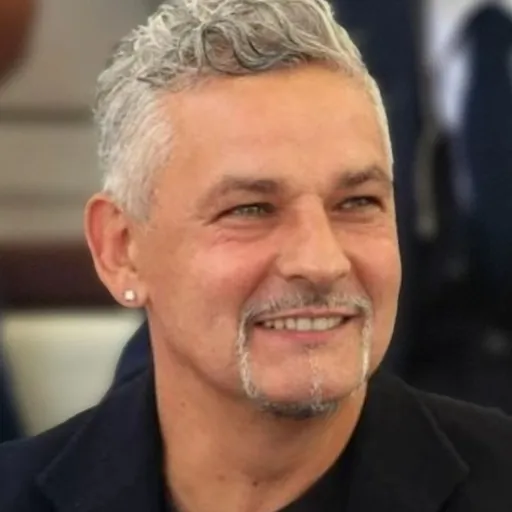
About Roberto Baggio
Born 1967. Roberto Baggio is an Italian association football player.
Early life Roberto Baggio was born in Caldogno, Veneto, the son of Matilde and Florindo Baggio, the sixth of eight siblings. His younger brother, Eddy Baggio, was also a footballer.
Club career
1976–1985: Early career and Vicenza
Baggio began his youth career after being noticed by his hometown youth team, Caldogno, at age nine. By the time he turned 11, he had scored 45 goals and provided 20 assists in 26 matches, also scoring six goals in one match. His talent was recognised by scout Antonio Mora, and he was acquired by the Vicenza youth team at age 13 for £300 (500,000 Lit). After scoring 110 goals in 120 matches, Baggio began his professional career with the Vicenza senior side in 1983, at age 15.
At the age of 16, Baggio made his Serie C1 debut with Vicenza on 5 June 1983, a 1–0 home loss against Piacenza, in the final league match of the season, coming on as a second-half substitute. He scored his first goal in Serie C1 during the following season, on 3 June 1984, from a penalty in a 3–0 win against Brescia, the club with which he retired in 2004. Baggio scored the first professional goal of his career in the Coppa Italia Serie C in a 4–1 away win over Legnano on 30 November 1983.
During the end of his final season at Vicenza, Baggio shattered both the anterior cruciate ligament (ACL) and the meniscus of his right knee while playing against Rimini on 5 May 1985, while attempting a slide tackle. The injury occurred two days before his official transfer deal to Fiorentina had been finalised, and it seriously threatened his career, at age 18. Although several team doctors feared he would not play again, Fiorentina retained their faith in him, agreeing to commit to the transfer as well as fund the required surgery, one of many reasons for Baggio's attachment to the club.
1985–1990: Fiorentina Fiorentina purchased Baggio in 1985 for £1.5 million. During his time at the club, despite initial injuries, he became extremely popular, and is regarded as one of the club's best ever players. In his first season with the club, Baggio did not appear in Serie A as he was sidelined by injury; Fiorentina finished in fifth place in the league and reached the semi-finals of the Coppa Italia, with Baggio making his club debut in the latter competition on 29 January 1986, coming on as a second-half substitute for Davide Pellegrini in a 3–1 home win over Udinese in the round of 16. He finally made his Serie A debut the following season on 21 September 1986, in a 2–0 home win against Sampdoria, Baggio suffered another knee injury on 28 September, and he was operated again, requiring 220 stitches to have it rebuilt, losing 12 kg as a result and missing most of the season. Baggio led Fiorentina to a Coppa Italia quarter-final during the 1988–89 season under manager Sven-Göran Eriksson, scoring nine goals, as Fiorentina were eliminated by eventual champions Sampdoria. This season would be Baggio's breakthrough, as he scored 15 goals in Serie A, finishing third in the capocannoniere (top goalscorer) title. He also helped Fiorentina finish in seventh place in Serie A and win an UEFA Cup spot, assisting the only goal by Roberto Pruzzo in the tiebreak qualifier against Roma. He formed a notable attacking partnership with Stefano Borgonovo, and the pair scored 29 of Fiorentina's 44 Serie A goals, earning the nickname "B2". Baggio's performances elevated him to hero status among the fans, and he drew praise from several pundits. His characteristics led former Fiorentina playmaker Miguel Montuori to say Baggio was "more productive than Maradona; he is without doubt the best number 10 in the league", also stating that Baggio had "ice in his veins" due to his composure in front of goal. He also scored the decisive penalty in the first round shootout against Atlético Madrid. With 17 goals, Baggio was the second-highest goalscorer in the 1989–90 Serie A season after Marco van Basten, and was awarded the Bravo Award as the best under-23 player in European competitions. He also placed eighth in the 1990 Ballon d'Or. With Fiorentina, Baggio scored 55 goals in 136 appearances, 39 of which were in Serie A, from 94 appearances. Following the transfer, there were riots on the streets of Florence, where 50 people were injured. Baggio replied to his fans, saying: "I was compelled to accept the transfer."
In this first season at Juventus, Baggio scored 14 goals and provided 12 assists in Serie A, often playing behind the forwards under Luigi Maifredi, although Juventus finished in seventh place in Serie A, outside the European qualification spots. However, Juventus did reach the semi-finals of the European Cup Winners' Cup that year, a tournament in which Baggio was top scorer with nine goals, bringing his seasonal total to 27 goals. Juventus would ultimately be eliminated by Johan Cruyff's Barcelona "Dream Team". Juventus were also eliminated in the quarter-finals of the Coppa Italia to eventual winners Roma, with Baggio scoring three goals. Juventus also lost the Supercoppa Italiana against Napoli at the beginning of the season; Baggio scored Juventus's only goal from a free-kick. Baggio made his 100th Serie A appearance in a 0–0 draw against Lazio on 21 October 1990. as Juventus finished runners-up to Fabio Capello's AC Milan in Serie A, and to Parma in the Coppa Italia final, in which Baggio scored in his club's 1–0 victory in the first leg from a penalty. It was during his second season with the club that Baggio came to be accepted by the Juventus fans, as he was seen as a leader around whom the club's play revolved. However, Trapattoni often deployed Baggio in a more advanced role, and Juventus management.
Baggio was appointed team captain for the 1992–93 season. He had a dominant season, winning the only European club trophy of his career after helping Juventus to the UEFA Cup final, in which he scored twice and assisted another goal over both legs, defeating Borussia Dortmund 6–1 on aggregate. En route to the final, Baggio scored two goals in the 2–1 home victory against Paris Saint-Germain, in the first leg of the semi-final, and he went on to score the only goal in the return leg. Juventus also reached the semi-finals of the Coppa Italia, losing on away goals to local rivals and winners Torino. Juventus finished fourth in Serie A that season, although they managed a 3–1 away win against the Serie A champions Milan, with Baggio scoring a memorable individual goal while also setting-up Andreas Möller's first goal of the match. One of the highlights of the season involved Baggio scoring four goals in open play against Udinese in a 5–0 Juventus home win. Baggio was once again runner-up for the Serie A capocannoniere title with 21 goals and 6 assists. He scored a personal best of 30 goals in all club competitions that season, in addition to five goals with the Italy national team. During the 1993 calendar year, Baggio managed a personal record 39 goals across all competitions, scoring 23 goals in Serie A, 3 in the Coppa Italia, 8 goals in European competitions and 5 goals for Italy, helping his national side qualify for the World Cup. Baggio's performances throughout the year earned him both the European Footballer of the Year, with 142 points from a possible 150, and the FIFA World Player of the Year awards. Juventus once again finished runners up to Milan in Serie A, and Baggio finished third in the capocannoniere title with 17 goals and 8 assists, while the club suffered a quarter-final elimination in the UEFA Cup against Cagliari. On 31 October 1993, Baggio scored a hat-trick in a 4–0 win over Genoa, which included his 100th Serie A goal; he also set up a goal for Möller during the match. Baggio made his 200th Serie A appearance on 5 December 1993 in a 1–0 win over Napoli. Baggio placed second in the 1994 Ballon d'Or, who was deployed as an outside forward in a 4–3–3 formation. Baggio was injured for most of the season, being ruled out for over three months after sustaining a knee injury against Padova on 27 November 1994. After scoring from a free-kick, he was substituted by Alessandro Del Piero, who temporarily took his place in the team. Baggio returned to the starting line-up in the first leg of the Coppa Italia semi-final against Lazio in Rome on 8 March 1995, setting up Fabrizio Ravanelli's winner. On his first Serie A match back from injury, on 12 March 1995, Baggio scored Juventus' second goal in a 2–0 win over Foggia, and set up Ravanelli's goal. Due to his injury, Baggio only managed 17 Serie A appearances, but still contributed to his first scudetto with Juventus by contributing eight goals and eight assists. He provided assists for three of the goals in the title-deciding match against Parma, which Juventus won 4–0 in Turin on 21 May 1995. He helped Juventus win the Coppa Italia that year, notching two goals and two assists, scoring the winning goal in the second leg of the semi-final. He helped lead Juventus to another UEFA Cup final by scoring four goals, including two goals and an assist over both legs of the semi-finals against Borussia Dortmund. Despite Baggio's strong performance, Juventus were defeated in the UEFA Cup final by Parma.
Baggio scored 115 goals in 200 appearances during his five seasons at Juventus; 78 were scored in Serie A in 141 appearances. In 1995, Baggio was nominated for the Ballon d'Or and placed fifth in the 1995 FIFA World Player of the Year Award. and is the joint tenth-highest goalscorer for Juventus in Serie A, alongside Pietro Anastasi. He is the sixth-highest Juventus goalscorer in the Coppa Italia with 14 goals, and is also the joint fourth all-time Juventus goalscorer in European competitions, as well as the joint fifth all-time Juventus goalscorer in international competitions, with 22 goals, alongside Anastasi once again.
1995–1997: AC Milan
In 1997, Capello returned to Milan, subsequently stating Baggio was not a part of his plans with the club. Baggio chose to move to Parma, but the manager at the time, Carlo Ancelotti, impeded the transfer, as he also did not feel Baggio would fit into his tactical plans. Ancelotti would later state he regretted this decision, stating that in his naïveté, he believed that the 4–4–2 formation was the ideal formation for success, and he felt that at the time, creative players such as Gianfranco Zola and Baggio were not compatible with this system.
Baggio subsequently transferred to Bologna, aiming to save the squad from relegation, and earn a place at the 1998 FIFA World Cup. Baggio refound his form with the club and had a dominant season, scoring a personal best of 22 goals in Serie A, as well as providing 9 assists, leading Bologna to an eighth-place finish, allowing them to qualify for the UEFA Intertoto Cup. Baggio was the highest scoring Italian in Serie A that season, and the third-highest goalscorer in Serie A. His performances earned him a place in Italy's 1998 World Cup squad. Baggio also led Bologna to the round of 16 in the Coppa Italia, where he scored one goal in three appearances. Although he rose to hero status amongst the fans, Ulivieri later denied ever having any difficulties with Baggio. At the beginning of the season, Baggio cut off his iconic ponytail, signifying his rebirth.
1998–2000: Inter Milan
After the 1998 World Cup, Baggio signed with his favourite childhood club Inter Milan in order to compete in the UEFA Champions League. After injuries, disappointing results, and several managerial changes throughout the season, including Luigi Simoni, Mircea Lucescu, and Roy Hodgson, Baggio struggled to gain playing time, and was used out of position as a winger, often as a substitute. Baggio scored five league goals and provided 10 assists in 23 appearances during the 1998–99 season, as Inter finished in eighth place, missing out on a European spot. He helped Inter to a Coppa Italia semi-final, losing out to eventual winners Parma. Baggio scored a goal against his former club Bologna in a European play-off match, but Inter lost both matches, failing to qualify for the UEFA Cup. Baggio also scored four goals in the Champions League, helping lead Inter through the qualifying rounds to the quarter-finals, where they were eliminated by eventual winners Manchester United, also scoring a memorable brace against defending champions Real Madrid in the group stage.
In the 1999–2000 season, Marcello Lippi, Baggio's former manager at Juventus, was appointed as Inter's new coach. Lippi did not favour Baggio and left him out of the squad for most of the season, stating Baggio was out of shape. In his autobiography, Baggio stated Lippi had dumped him after Baggio refused to point out which of Inter's players had expressed negative opinions about the coach, also highlighting an incident during a training session where he called out Christian Vieri and Christian Panucci for applauding Baggio for a notable assist. only to be defeated by Lazio. Despite his limited playing time, Baggio still managed several important goals to help Inter to a fourth-place finish, alongside Parma, such as his match winning goal against Hellas Verona, which he scored after coming off the bench, after being excluded from the team since 18 December 1999. Baggio had also previously helped to set up Inter's equaliser during the match. This was the first time Baggio had scored for Inter since his goal on 27 May of the previous season, and in the post-match the interview, he denied accusations made by Lippi in regard to his personal form.
Baggio's last important contribution to Inter was scoring two memorable goals against Parma in the play-off match for the last remaining Champions League place, which Inter won 3–1; Lippi had been forced to field Baggio due to several injuries. Baggio was given a perfect 10 rating from the Italian sports newspaper La Gazzetta dello Sport, which described his performance as "absolutely perfect all game". This match is considered an example of professionalism shown by Baggio, as Inter president Massimo Moratti had stated Lippi would only stay on if the team qualified for the Champions League.
2000–2004: Brescia
After two years with Inter, Baggio decided not to renew his expiring contract due to his conflicts with Marcello Lippi, making him a free agent at age 33. and also various Premier League and La Liga clubs, including Barcelona. He was made captain and was given the number 10 shirt, playing as an attacking midfielder.
Despite injury problems during the first half of the season, Baggio re-found his form and managed ten goals and ten assists in the 2000–01 season. Brescia finished in a joint seventh place, their best Serie A finish since the league's re-establishment in 1946, and qualified for the UEFA Intertoto Cup, also reaching the quarter-finals of the Coppa Italia, losing to eventual winners Fiorentina. Baggio helped Brescia to the final of the 2001 UEFA Intertoto Cup, where they were defeated by Paris Saint-Germain on away goals. Baggio scored one goal in the tournament, in the final from a penalty. His performances earned him a nomination for the 2001 Ballon d'Or, and he finished 25th overall in the rankings. Baggio was one of the best offensive playmakers in the league, winning the Guerin d'oro Award in 2001, awarded by the Italian sports magazine Guerin Sportivo, to the player with the highest average rating throughout the season with at least 19 appearances.
At the start of 2001–02 season, Baggio scored eight goals in the first nine matches, leading him to the top of the Serie A goalscoring table. A week later, against Venezia, he scored from a penalty, but he endured a more serious injury following a hard challenge which caused him to tear the ACL of his left knee, keeping him out of action for four months. He suffered a second serious injury that season, tearing the meniscus in his left knee, after returning to the team, and coming off the bench, in the Coppa Italia semi-final against Parma on 31 January 2002. He was operated on 4 February 2002 and he returned for three matches before the end of the season, making a recovery in 76 days. On 21 April 2002, in the first game after his comeback, Baggio came on as a substitute to score two goals against Fiorentina, helping Brescia win the match. Despite Baggio's performances and public demand, Italy national team head coach Giovanni Trapattoni did not deem him fully fit, prompting the coach to leave Baggio out of the final squad for the 2002 World Cup. Trapattoni also expressed concern about bringing Baggio to the World Cup due to the presence of Francesco Totti and Alessandro Del Piero in his role, believing that this could create a rivalry between the players. After missing out on the tournament, Baggio reversed his initial decision to retire after the World Cup, expressing his intention to surpass the 200 Serie A goal mark.
Baggio maintained a high level of performance under new coach Gianni De Biasi.
In the 2003–04 season, the final season of his career, Baggio recorded 12 goals and 11 assists. He scored his 200th goal in Serie A in a 2–2 draw against Parma on 14 March 2004, saving Brescia from relegation, as they finished the season in 11th place. Baggio played his last career match on 16 May 2004 on the final matchday of the season at the San Siro against Milan, which ended in a 4–2 loss to the Serie A champions; during the game, he set-up Matuzalém's second goal. In the 88th minute, De Biasi substituted Baggio, prompting the 80,000 present at the San Siro to give him a standing ovation; Milan's captain, defender Paolo Maldini, who was Baggio's former teammate both with the Italy national team and Milan, also embraced him before he left the pitch.
With Brescia, Baggio scored 46 goals in 101 appearances in all competitions, scoring 45 goals in 95 Serie A appearances, and one goal in two European matches. Baggio also made four Coppa Italia appearances with Brescia. Baggio retired as Brescia's all-time leading goalscorer in Serie A. He ended his career with 205 goals in Serie A, making him the seventh-highest scorer of all time, behind Silvio Piola, Francesco Totti (who overtook him in 2011), Gunnar Nordahl, Giuseppe Meazza, José Altafini, and Antonio Di Natale (who overtook him in 2015). Baggio's number 10 shirt was retired by Brescia in his honour, and he is considered the club's greatest ever player. Before Baggio had joined Brescia, they had never been able to avoid relegation after being newly promoted to Serie A, in over 40 years. During the four years under Baggio, Brescia recorded their best ever Serie A run and were never relegated.
International career Youth career and senior debut Baggio totalled 27 goals in 56 caps for his national team at senior level, making him Italy's fourth-highest all-time goalscorer, tied with Del Piero, who managed the tally in 91 appearances. At youth level, he was capped for the Italy U16 on four occasions in 1984, scoring three goals. He scored his first goal for Italy on 22 April 1989, from a free-kick in a 1–1 draw against Uruguay in an international friendly in Verona. |name="ItalyBrace1989"|group="nb" also later assisting Andrea Carnevale's goal with a cross from a free kick, and contributing to Nikolay Iliev's own goal by setting-up Vialli, whose shot was subsequently deflected by the Bulgarian defender.
1990 FIFA World Cup and by many in the sport, as one of the greatest players in the history of the game. comparing his elegance to the painter Raffaello, while he described the emerging talent Alessandro Del Piero as Pinturicchio. In a 2011 interview with La Gazzetta dello Sport, Del Piero stated that Baggio, along with Zinedine Zidane, was the best player with whom he had ever played, and his former Brescia teammate Pep Guardiola in 2010, as well as his former Inter teammate Javier Zanetti in 2020, while Matthew Le Tissier named Baggio as his best ever opponent in 2012. In 2018, Cathal Kelly of The Globe and Mail described Baggio playing in the 1994 World Cup as "the best player in the world" at the time, while The Guardian described him as "he definitive player of the decade", also adding that "the 1990s belonged to Il Divin Codino", and labelled him as "probably the finest player in the world between 1992 and 1995." In 2015, Les Carpenter of The Guardian described Baggio as "perhaps the greatest player of his time," while his colleague Emmet Gates dubbed him "the best player of his generation." In 2010, Marco Gori of TuttoMercatoWeb labelled Baggio as "one of the best footballers in history." Throughout his career, pundit Gianni Brera compared his playing style to that of Italian former footballer Giuseppe Meazza, while manager Trapattoni instead compared Baggio's technical characteristics to other former number 10s such as Zico, Platini, and Juan Alberto Schiaffino. Zico described him as "one of the best players in the history of Italian football", while Tommaso Pellizzari of Il Corriere della Sera called him "the greatest pure talent of Italian football." a view shared by Stefano Discreti of Mediaset, who called Baggio "the best Italian footballer of all time" in 2019. Also in 2017, Giuseppe Bergomi described Baggio as "extraordinary" and as a "pure talent", who was "devastating when he played because he was capable of deciding games on his own." In 2004, Gianni Rivera described him as "one of the greatest Italian footballers ever." In 2020, Luca Stamerra of Eurosport described him as one of the "best number 10s in the history of this sport." In 2019, his former Italy manager Dino Zoff listed Baggio as one of the best players he ever coached, while his former Fiorentina manager Sven-Göran Eriksson named him as the most talented player he had ever coached alongside Wayne Rooney in 2021, commenting: "He had everything: incredible technique, vision, pace." In 2019, author Paolo Condò ranked Baggio among the greatest players of all time, a view shared by Emmanuel Amunike in 2020 as well as Roberto Mancini and John Keilman of the Chicago Tribune, who both described Baggio as one of the "all-time greats" in 2018 and 2019, respectively. Former RAI commentator Bruno Pizzul, who served as a pundit for the Italy national team's World Cup matches between 1986 and 2002, named Baggio as his favourite player, and as one of the best footballers he ever saw, among both Italian and non-Italian players. In 2020, Matteo Marani of La Stampa dubbed Baggio as "one of the purest expressions of talent that world football has produced".
Known for his dislike of the defensive, physical and tactical nature of Italian football in the 1990s, Baggio drew criticism from certain pundits and some of his managers for his limited defensive work-rate when possession was lost, as well as the fact that the athletic part of his game was not his main focus during training sessions in his youth, while in his later career, his physical ailments often forced him to train independently with a personal fitness coach and physiotherapist, rather than with his team; as such, Baggio's Milan manager Capello believed that he was not capable of playing for 90 minutes, due to the precarious physical condition of his knees. Luigi Simoni, one of his Inter managers, lauded Baggio for his work-rate in training, stating in 2009 that he would do up to six or seven hours of gym work a day under his tenure, a view which was also shared by Baggio's former Bologna teammate Daniele Carnasciali in 2013. Carlo Mazzone and Gianni De Biasi, his managers at Brescia, as well as his former teammates Luca Toni and Emanuele Filippini, also praised Baggio for his discipline, professionalism, and dedication in training during his time with the club, with De Biasi calling him "an example." Known to be an introvert in the media, due to his quiet private life and reluctance to give interviews, some in the sport, including Gianni Rivera, argued that Baggio lacked leadership qualities on the pitch. His personality is thought to have limited him from being more successful, in particular with larger clubs, with some pundits instead arguing that he excelled more with smaller teams; others instead believed that he had a difficult character due to his disagreements with several of his managers throughout his career, although he was generally regarded as a "correct" and co-operative player by officials, and as a classy and well-behaved footballer in the media. Mazzone also said of him: "Baggio was one of the greatest Italian football players of all time. But I can tell you this, he was an even greater man. He was quiet, polite, respectful, humble. He never let his great talent weigh on anyone else. He was a friend who helped me win games on a Sunday." In 1995, Fabio Capello described Baggio as a player who was "decisive." His former teammate Andrea Pirlo instead commented that "[Baggio] was a silent leader, and above all, he was a leader on the pitch. When he played for the team, he made you win the games",
Despite his talent, success, popularity with the fans, and reputation as one of the greatest players of all time, critical reception of Baggio was occasionally divided throughout his career; this was in part due to his recurring injury struggles, as well as the fact that tactically certain managers struggled to find a suitable playing position for him. His role as a playmaker between the midfield and forward lines, as well as his skilful and creative playing style, were often regarded as being obsolete in modern football, in which managers often favoured the use of the 4–4–2 formation and a more athletic approach to the game; moreover, while Baggio was not an outright forward, he was also thought to lack the stamina to play in midfield, which made him less suited to this particular system, and occasionally led him to be excluded by his managers, although he was ultimately able to adapt to playing as a forward effectively. Baggio's unique playing position, style, and approach to the game, combined with his talent, limited work-rate, and injury struggles, led him to have both many admirers and several detractors. injuries led certain pundits, such as Benedetto Ferrara of La Repubblica in 2010, to label Baggio as a "superfine talent" but who was also "inconsistent." In 1995, Maurizio Crosetti, Ferrara's colleague, had previously described Baggio as "fragile." Regarding the injuries that threatened his career as a youngster, and which haggled him until he retired, Baggio wrote in his 2001 autobiography that "all of my professional career, I played it with a leg and a half. Thousands of hours of work to keep alive a leg which, if it were up to her, would diminish each day. I played it without being fully all right, ever, because if I were to play matches only when I felt one-hundred percent I would play three matches a year." In 2004, Sacchi praised Baggio for his strength of character, which he believed even surpassed his talent, as it allowed him to overcome his injuries and physical struggles, and ultimately "win [his] personal battles against bad luck." In 2017, Capello noted that Baggio had the extraordinary willpower to carry on playing despite his physical struggles.
Legacy Baggio's Italy jersey is preserved in the Football Museum in Florence. Widely considered to be one of the greatest footballers of all time, Baggio came fourth in the 1999 FIFA Player of the Century internet poll, in IFFHS's election for the best player of the 20th century in the same year, he was elected the ninth-best Italian player and the 53rd-best European player of the Century. In 2004, he was named by Pelé in the FIFA 100 list of the world's greatest living players, In 2010, Baggio was named one of the 50 greatest Juventus legends. In a 2014 FIFA poll, Baggio was voted the ninth-greatest number 10 of all time, and later that year he was ranked 24th in The Guardians list of the 100 greatest World Cup players of all time, ahead of the 2014 World Cup in Brazil.
In 2015, journalists of La Gazzetta dello Sport elected the greatest Italian player of all time, with Baggio finishing in second place behind only Gianni Rivera; in a fan poll that was subsequently organised by the newspaper, Baggio was instead voted as the greatest Italian footballer of all time, while Majid Mohamed of UEFA ranked him as the twentieth-best player ever not to have won the UEFA Champions League. That same year, The Daily Telegraph also included Baggio at number 12 in their list of "The top 20 overrated football players of all time." In July 2019, the same magazine ranked Baggio at number ten in their list of the "101 greatest football players of the last 25 years" since their first edition in the summer of 1994, while in September 2023, he was ranked 27th in their list of the "100 best football players of all time." In December 2023, Tom Hancock, of the same magazine, placed Baggio at number three, behind only Zidane and Ronaldo, in his list of the greatest footballers of the 1990s. In 2020, Jack Gallagher of 90min.com placed Baggio at number nine in his list of "The 50 Greatest Footballers of All Time", while Sky Sports ranked him as the fifth-best player ever never to have won the Champions League or European Cup.
Records and selected statistics Baggio played in 16 World Cup matches for Italy; the Republic of Ireland is the only nation against which he played more than once. He is the joint-highest Italian goalscorer of all time in the World Cup, with nine goals, alongside Paolo Rossi and Christian Vieri. Baggio is the only Italian to have scored in three World Cups (two goals in 1990, five in 1994 and two in 1998). Three of his World Cup goals were scored in the group stage and six were scored during knockout matches. With Baggio, Italy was always eliminated from the World Cup in penalty shootouts: in 1990, in the semi-finals against Argentina; in 1994, in the final against Brazil; and in 1998, in the quarter-finals against France.
Despite his decisive penalty miss in the 1994 World Cup final shoot-out, Baggio is statistically one of the greatest penalty kick specialists in Italian football history, as he scored 85% of his career penalties with only 19 misses, scoring 108 out of 127 penalties in official matches, the most in Italian football history. 68 of his penalties were scored in Serie A, from 83 attempts, with an 82% conversion rate, one of the best records in Serie A history. In Serie A, Baggio scored 17 penalties for Fiorentina (from 19 attempts), 25 for Juventus (from 28 attempts), 3 for Milan (from 5 attempts), 11 for Bologna (from 11 attempts), 1 for Inter Milan (from 2 attempts), and 11 for Brescia (from 18 attempts). Baggio has scored penalties for six different Serie A clubs. Of his other penalties, 8 were scored in Serie C (from 8 attempts), 8 in European competitions (from 9 attempts), and 17 in the Coppa Italia (from 20 attempts). In shoot-outs, Baggio converted three of four career penalties: one in the UEFA Cup with Fiorentina, and the other two with Italy at the World Cup;
Although he never won the Serie A top goalscorer title, Baggio is currently the seventh all-time highest scorer in Serie A, with 205 goals in 452 appearances. Of these goals, 96 were decisive (either equalisers or match winners). Of his open play goals in Serie A, 84 were with his right foot, 26 with his left, and 6 were headers. making him the second–highest assist provider of all time in Serie A, behind only Totti. He is the fourth-highest scoring Italian in all competitions, behind Del Piero, Giueseppe Meazza and Silvio Piola, with 318 professional career goals in 699 appearances. With eight hat-tricks in Serie A, he has also scored the joint-tenth most hat-tricks in the history of the Italian league, alongside Amedeo Amadei, Giampiero Boniperti, Hernán Crespo, and Marco van Basten. Throughout his career, including friendlies, Baggio scored 425 goals.
After retirement
Following Italy’s failure to move on from the 2010 World Cup group stage, in August 2010 Baggio was appointed president of the technical sector of the Italian Football Federation, replacing his former Italy national team manager Azeglio Vicini. In December 2011, he presented a 900-page report titled "Renewing the future", which proposed an overhaul of the federation’s talent development paths. On 23 January 2013, Baggio stepped down from the position, stating the federation had ignored his ideas about improving the system and focusing on youth talent, which prompted him to resign. In 2026, following Italy’s third consecutive failure to reach the World Cup from the play-off round, Baggio’s report and his attempts to reform the Italian football system were recirculated in the media. On 5 July 2012, Baggio obtained his Category 1 UEFA Pro Coaching Licence at Coverciano, which officially allows him to coach a professional Serie A club.
Outside of professional football Personal life After his career threatening injury in 1985, Baggio, formerly a Roman Catholic, converted to Buddhism, practicing Nichiren Buddhism, and is a member of the Soka Gakkai International Buddhist organisation. The captain's armband that he wore throughout his career bore the colours of this religious school (blue, yellow, and red) and the Japanese motto "We win. We must win" in ideograms of the language. Despite his conversion, he married his long-time girlfriend Andreina Fabbi in 1989 in a traditional Roman Catholic ceremony. They have a daughter, Valentina (1990), and two sons, Mattia (1994) and Leonardo (2005).
Between 1991 and 2012, Baggio was the owner of a sporting goods store in Thiene, Vicenza, called Baggio Sport, which he was eventually forced to close due to losses from the Great Recession.
In 2001, Baggio wrote an autobiography entitled (literally "A Door in the Sky", also known as "A Goal in the Sky"), including details about his career, childhood, religion, personal life and rifts with managers. It won the award for best football book at the 2002 Serie A Awards.
Philanthropy On 16 October 2002, Baggio was named a Goodwill Ambassador of the Food and Agriculture Organization of the United Nations, Through the organisation, Baggio helped to fund hospitals, raise money for the victims of the Haiti earthquake, contribute to tackling bird flu, and was involved in the Burmese pro-democracy movement, which supported the opposition leader Aung San Suu Kyi and her release from prison. Baggio was awarded the 2010 Man of Peace title in Hiroshima, presented by the World Summit of Nobel Peace Laureates in recognition of his charitable work and contribution to social justice and peace.
On 8 October 2008, Baggio appeared in a charity match between Milan and Fiorentina, which had been organised in honour of his former Fiorentina teammate Stefano Borgonovo to raise money for his foundation, his treatment and for ALS research. In 2014, Baggio was one of the many celebrities to take part in the "ALS Ice Bucket Challenge" to raise awareness about the disease and funds for ALS research.
On 1 September 2014, Baggio took part in the "Match for Peace", which was played at the Stadio Olimpico in Rome, with the proceeds being donated to charity. Baggio set up Juan Iturbe's goal and scored from a Diego Maradona assist. On 25 October 2014, Baggio participated in the opening of the SGI Ikeda Cultural Center in Corsico, on the outskirts of Milan. It is the largest Buddhist center in Europe.
Media and popular culture In 1994, Italian satirist Corrado Guzzanti parodied Baggio's advertisement for Italian Petrol Company IP prior to the 1994 World Cup. Italian poet Giovanni Raboni composed the sonnet "Lode a Baggio" in a tribute to him. He has been referenced in several songs, such as "Baggio, Baggio" by Lucio Dalla, "Marmellata n. 25" by Cesare Cremonini and "Baggio" by Miles Kane.
Baggio has featured in two Italian commercials which reference his penalty miss in the 1994 World Cup final. The first was made for Wind in 2000, and shows Baggio scoring the final penalty to win the tournament. The second, made for Johnnie Walker in 2001, showed how he managed to conquer his grief from the miss by believing in himself and scoring the equalising penalty against Chile in the 1998 World Cup. He has featured in several Diadora commercials, as he endorsed their products. In July 2017, Diadora teamed up with Baggio once again to launch the new Signature Match Winner RB Capsule Collection.
Baggio is popular in Japan, and has held close ties with the country since his conversion to Buddhism. He has endorsed several Japanese football video games, such as Human Entertainment's Super Formation Soccer 95: della Serie A, and Sega's Virtua Pro Football and Let's Make a Soccer Team!. An animated version of himself appeared in the Japanese football cartoon Captain Tsubasa, best known in Italy as Che Campioni: Holly & Benji.
In the Channel 4 sitcom Father Ted, Baggio (and Alessandro Costacurta) is mentioned during the 1995 episode "Grant Unto Him Eternal Rest" by Father Dougal McGuire (portrayed by Ardal O'Hanlon), who, when prompted to say the last rites in Latin, ends up saying the footballers' names. (This stems from Graham Linehan and O'Hanlon being fans of Football Italia). In the music video for the 2010 World Cup song "Waka Waka (This Time for Africa)" by Shakira,
Throughout his career, Baggio has been nicknamed the Divin' Codino ("Divine Ponytail" in Italian, a reference to the iconic hairstyle he wore for a large part of his career as well as his playing ability and Buddhist beliefs) and Robi, or Roby, by his fans. An alter-ego of his is referenced in the Italian children's comics of "Mickey Mouse" and "Duck Tales" (Topolino) in the volume Topolino e il Giallo alla World Cup in which he is known as Roberto Paggio. In 2011, Italian sports newspaper La Gazzetta dello Sport issued a collection of DVDs entitled Io Che Sarò Roberto Baggio recounting his career. Baggio's impact on football has been celebrated with the release of an online game called Baggio's Magical Kicks, in which players try to replicate his accuracy on free-kicks and penalties. In 2015, the arcade game company Konami announced Baggio would feature in their football video game Pro Evolution Soccer 2016 as one of the new myClub Legends. On 3 August 2018, EA Sports announced on their official Twitter account that Baggio would feature in EA Sports' football video game FIFA 19 as one of the new Ultimate Team Icons.
In 2019, Netflix announced the development of a documentary on Roberto Baggio in partnership with Mediaset. In March 2021, Netflix released the trailer of a docudrama film on Baggio's career, entitled Baggio: The Divine Ponytail, which was released on 26 May 2021; Andrea Arcangeli portrayed Baggio.
Career statistics Club
International
Scores and results list Italy's goal tally first, score column indicates score after each Baggio goal. + List of international goals scored by Roberto Baggio Third Place 1990 Individual UEFA Cup Winners' Cup Top Scorer: 1990–91 (9 Goals) World Soccers World Player of the Year: 1993 Ballon d'Or: 1993 8th Place: 1990 Onze d'Or: 1993 Onze de Bronze: 1994 FIFA World Cup All-Star Team: 1994 Don Balón Award: 1994 Serie A Top Assist-Provider: 1995–96 (12 Assists) Il Venerdì'''s Best 100 Players of All Time: 1997 (32nd Place) World Soccers Greatest Players of the 20th Century: 1999 (16th Place) IFFHS Italian Player of the 20th Century: 1999 (9th Place) IFFHS European Player of the 20th Century: 1999 (53rd Place) Placars Best 100 Players of All Time: 1999 (91st Place) FIFA XI: 2000, 2002 Guerin d'Oro: 2001 Gran Galà del Calcio 'Best Football Book' Award: 2001 UEFA Golden Jubilee Poll: 2004 (24th Place) San Siro Gentleman Nazionale Award: 2004 Placars Best 100 World Cup Players: 2005 (24th Place) Association of Football Statisticians's Best 100 Players of All Time: 2007 (79th Place) Juventus FC 50 Club Legends: 2011 Gentleman di Platino: 2015 Walk of Fame of Italian Sport: 2015 IFFHS' 48 Football Men's Legend Players
Don’t just read it —
keep it.
Full-length biographies made to live with: read them, listen on the way to work, watch them tonight.
- E-book
- Audio
- Video
Instant download · yours to keep · every purchase keeps this site free
Important facts
People in Roberto Baggio's life
Named in this biography and alive at the same time




Related people
Same field, nearest in time


Contemporaries
People whose lives overlapped Roberto Baggio's


Frequently asked questions
Who is Roberto Baggio?
Italian association football player (born 1967)
When was Roberto Baggio born?
Roberto Baggio was born on 18 February 1967 in Caldogno.
What is Roberto Baggio's occupation?
Roberto Baggio is an association football player.
What nationality is Roberto Baggio?
Roberto Baggio is Italian.
Sources & further reading
Cite this page
APA: Biography.guide. (2026). Roberto Baggio. https://biography.guide/roberto-baggio/
MLA: "Roberto Baggio." Biography.guide, https://biography.guide/roberto-baggio/.
Chicago: "Roberto Baggio." Biography.guide. https://biography.guide/roberto-baggio/.
Data last updated: 2026-09-20 · Spot an error? Report a correction.
Page generated 2026-09-27 05:09 UTC