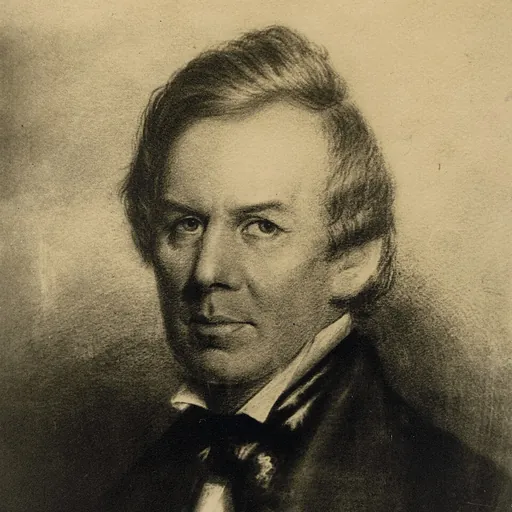
About Robert Wash
Lived 1790 – 1856 (aged 66). Robert Wash was an American judge.
Robert Wash (November 29, 1790 – November 30, 1856) served on the Supreme Court of Missouri from September 1825 to May 1837. During his term, the pro-slavery judge, who owned slaves himself, wrote the dissenting opinion on several important freedom suits, including Milly v. Smith, Julia v. McKinney and Marguerite v. Chouteau. However, he did join in the unanimous finding for the plaintiff in the landmark Rachel v. Walker case.
Judge Wash's decision to split up a family of slaves he owned was the impetus for Polly Wash's freedom suit and her daughter Lucy's memoir.
Early life Wash was born on November 29, 1790, in Louisa County, Virginia. He was the youngest of seven children born to William Wash and Anee Lipscomb Wash (born Anee Kennedy). His parents were wealthy enough to send him to William and Mary College. He graduated in 1808, at the age of 18, spent the following two years studying law, and was admitted to the bar. and then as aide de camp on the staff of Benjamin Howard. Wash traveled with Howard on an expedition up the Mississippi River from St. Louis to Peoria as part of a plan to strike the Meskwaki and Sauk peoples campaigning with the British. But, as the bulk of fighting was occurring further east, Howard's soldiers saw few of these warriors.
When Missouri gained statehood in 1821 and St. Louis was incorporated, Wash was elected to its first nine-member board of aldermen.
A number of notable cases were decided during Judge Wash's term. Many of these were suits in which slaves petitioned for their freedom. At the end of 1824, the Missouri General Assembly passed a law providing a process for enslaved persons to sue for freedom and have some protections in the process. The years between 1824 and 1844 are considered the "golden age" of freedom suits since many slaves won their freedom in these years. Following the Dred Scott decision, in which the "once free, always free" precedent was overturned, very few slaves pressed successful suits.
The following are important cases heard by Judge Wash.
Milly v. Smith (1829) In 1826, bankrupt, elderly miller David Shipman's creditors seized and sold two of his slaves to satisfy a portion of his debt. Faced with further foreclosure, the Kentucky resident asked his adult nephew, Stephen Smith, to provide security for him. Shipman deeded him the mortgage on his land and other property, then fled to Indiana with his remaining seven slaves. In Jefferson County, he signed manumission papers for them, effectively freeing Milly, her three children and two young men.
The entire group continued on to Illinois where they took up residence in a Quaker community. Shipman told his new neighbors the black persons in his household were free. They later testified the former slaves were permitted to come and go as they pleased.
In his dissent, Wash asserted that “the mortgagee is the legal owner. Various authorities have been cited on both sides for and against the position. Most clearly the mortgagor is not the full owner, he is at most but the qualified owner. In this case Shipman was the qualified owner for specific purposes, and had no right to emancipate the plaintiff in Kentucky or elsewhere; indeed, it seems to be conceded on all hands, that Shipman could not have emancipated Milly by his express deed, and why give indirect and fraudulent efforts and implied assent for effect than his deed could have? I incline to consider the plaintiff in the light of a purchaser from Shipman, with a full knowledge of Smith’s lien.”
Julia sued for her freedom in the Circuit Court of St. Louis County, naming her new owner as defendant. She contended that she and Carrington had lived in Illinois from late October to early December 1829. To Julia's disadvantage, the court's instructions to the jury centered on Carrington's intent, rather than her actions. If they believed Julia “was taken into the State of Illinois by her owner without any intention on the part of such owner to make that State the residence of Julia, that the plaintiff is not entitled to recover in this action.”
As Catiche's action moved forward, her sister Marguerite also sued Choteau for her freedom. The 1826 case hinged on the plaintiff's skin color, and whether she was red or black. Another important factor was whether the slave status of an Indian claimant, who had survived the transfer of Louisiana to Spain, continued under Spanish rule and remained under U.S. law. Enslavement of blacks was authorized under both French and Spanish law, whereas Indians were deemed free under the latter. The circuit court found for Chouteau, leading to an appeal before the Missouri Supreme Court.
Rachel v. Walker (1834) This freedom suit by an enslaved woman of color hinged on the question of whether or not a slave was forfeited if taken into territory where slavery was prohibited. Rachel's claim was based on a legal clause from a decade earlier that allowed slaves to petition for freedom based on their status as "poor people" with "limited rights and privileges." Major Taylor Berry had purchased Polly as a domestic servant. When Major Berry died in a duel, his widow married Judge Robert Wash, who was then responsible for Polly, who was married and had two daughters while with the Berry and Wash families. Polly won her freedom and filed another freedom suit for her daughter, which was tried beginning in February 1844. Since Polly should have been free when she gave birth to Lucy, under partus sequitur ventrem, Lucy should have been free. The case was submitted to the jury, which decided in Lucy's favor. the daughter of Major William Christy, with whom he had a daughter, Frances. His second wife, Eliza Catherine Lewis Taylor, the daughter of Colonel Nathaniel P. Taylor, had four sons: Robert, William, Clark and Pendleton, and five daughters: Elizabeth, Virginia, Julia, Medora and Edmonia.
Wash was an Episcopalian who served on the vestry of Christ Church.
He was also an indefatigable booster for the City of St. Louis, foreseeing a great future for the municipality. As soon as he was financially able, he began buying real estate. The properties laid the foundation for a considerable fortune, which enjoyed throughout his life.
In May 1818, Judge Wash was part of a group entering into an agreement to build a theater. A lot on Chestnut St. was purchased for the purpose and a foundation was constructed. But when funds ran out, the project was abandoned. A wood-frame livery stable took over the site.
Wash's colleagues noted he had a passion for hunting and kept a pack of hounds. One anecdote puts Wash on the bench when "an attorney who understood the judge's proclivity for sports of the field whispered to him that they had started three [foxes] at one time in the neighborhood of the judge's residence. He was immediately taken with severe cramps in the stomach, which rendered an adjournment of the court necessary. Within an hour he was in his saddle, following closely upon the heels of the hounds. These sudden attacks were of frequent occurrence..."
After retiring from the court, Wash lived among family and friends at his St. Louis home for the rest of his life. He died on November 30, 1856.
Don’t just read it —
keep it.
Full-length biographies made to live with: read them, listen on the way to work, watch them tonight.
- E-book
- Audio
- Video
Instant download · yours to keep · every purchase keeps this site free
Important facts
People in Robert Wash's life
Named in this biography and alive at the same time


Related people
Same field, nearest in time



Contemporaries
People whose lives overlapped Robert Wash's


Frequently asked questions
Who was Robert Wash?
American judge
When was Robert Wash born?
Robert Wash was born on 29 November 1790 in Louisa County.
When did Robert Wash die?
Robert Wash died on 30 November 1856 in St. Louis, Missouri.
What was Robert Wash's occupation?
Robert Wash was a judge.
What nationality was Robert Wash?
Robert Wash was American.
Sources & further reading
Cite this page
APA: Biography.guide. (2026). Robert Wash. https://biography.guide/robert-wash/
MLA: "Robert Wash." Biography.guide, https://biography.guide/robert-wash/.
Chicago: "Robert Wash." Biography.guide. https://biography.guide/robert-wash/.
Data last updated: 2026-09-21 · Spot an error? Report a correction.
Portrait: Wikimedia Commons · author & licence
Page generated 2026-09-27 04:58 UTC